FreeQAs
 Request Exam  Contact
  • Home
  • View All Exams
  • New QA's
  • Upload
PRACTICE EXAMS:
  • Oracle
  • Fortinet
  • Juniper
  • Microsoft
  • Cisco
  • Citrix
  • CompTIA
  • VMware
  • ISC
  • SAP
  • EMC
  • PMI
  • HP
  • Salesforce
  • Other
  • Oracle
    Oracle
  • Fortinet
    Fortinet
  • Juniper
    Juniper
  • Microsoft
    Microsoft
  • Cisco
    Cisco
  • Citrix
    Citrix
  • CompTIA
    CompTIA
  • VMware
    VMware
  • ISC
    ISC
  • SAP
    SAP
  • EMC
    EMC
  • PMI
    PMI
  • HP
    HP
  • Salesforce
    Salesforce
  1. Home
  2. Microsoft Certification
  3. DP-420 Exam
  4. Microsoft.DP-420.v2026-11-21.q284 Dumps
  • «
  • 1
  • 2
  • 3
  • 4
  • 5
  • 6
  • 7
  • 8
  • 9
  • 10
  • …
  • »
  • »»
Download Now

Question 21

You plan to store order data in Azure Cosmos DB for NoSQL account. The data contains information about orders and their associated items.
You need to develop a model that supports order read operations. The solution must minimize the number or requests.

Correct Answer: B
Explanation
Azure Cosmos DB is a multi-model database that supports various data models, such as documents, key-value, graph, and column-family3. The core content-model of Cosmos DB's database engine is based on atom-record-sequence (ARS), which allows it to store and query different types of data in a flexible and efficient way3.
To develop a model that supports order read operations and minimizes the number of requests, you should consider the following factors:
The size and shape of your data
The frequency and complexity of your queries
The latency and throughput requirements of your application
The trade-offs between storage efficiency and query performance
Based on these factors, one possible model that you could implement is B. Create a single database that contains one container. Create a separate document for each order and embed the order items into the order documents.
This model has the following advantages:
It stores orders and order items as self-contained documents that can be easily retrieved by order ID1.
It avoids storing redundant data or creating additional containers for order items1.
It allows you to view the order history of a customer with simple queries1.
It leverages the benefits of embedding data, such as reducing the number of requests, improving query performance, and simplifying data consistency2.
This model also has some limitations, such as:
It may not be suitable for some order items that have data that is greater than 2 KB, as it could exceed the maximum document size limit of 2 MB2.
It may not be optimal for scenarios where order items need to be queried independently from orders or aggregated by other criteria2.
It may not support transactions across multiple orders or customers, as transactions are scoped to a single logical partition2.
Depending on your specific use case and requirements, you may need to adjust this model or choose a different one. For example, you could use a hybrid data model that combines embedding and referencing data2
, or you could use a graph data model that expresses entities and relationships as vertices and edges.
insert code

Question 22

You have a container named container1 in an Azure Cosmos DB for NoSQL account named account1.
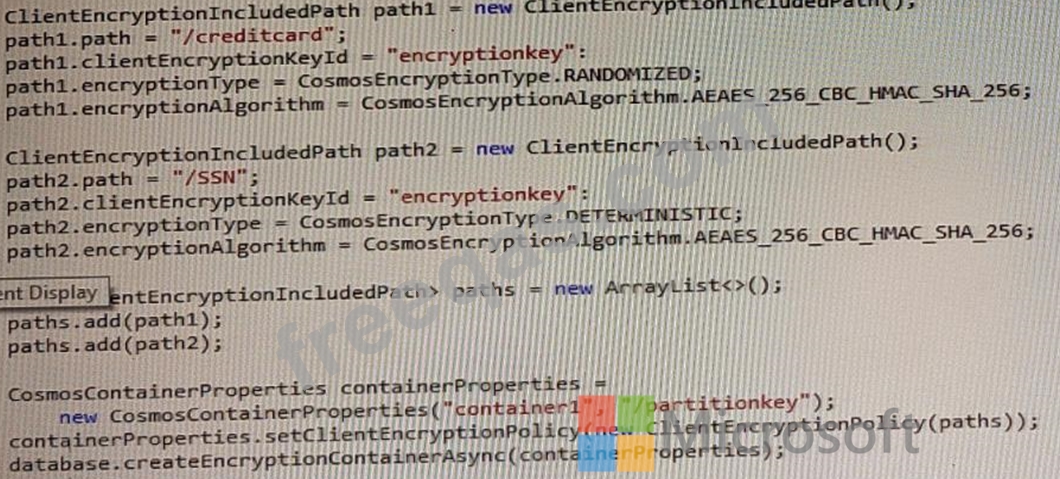
You configure container1 to use Always Encrypted by using an encryption policy as shown in the C# and the Java exhibits. (Click the C# tab to view the encryption policy in C#. Click the Java tab to see the encryption policy in Java.)

For each of the following statements, select Yes if the statement is true. Otherwise, select No.
NOTE: Each correct selection is worth one point.
Correct Answer:

Explanation
According to the Azure Cosmos DB documentation1, Always Encrypted is a feature designed to protect sensitive data, such as credit card numbers or national identification numbers, stored in Azure Cosmos DB.
Always Encrypted allows clients to encrypt sensitive data inside client applications and never reveal the encryption keys to the database.
To use Always Encrypted, you need to define an encryption policy for each container that specifies which properties should be encrypted and which data encryption keys (DEK) should be used. The DEKs are stored in Azure Cosmos DB and are wrapped by customer-managed keys (CMK) that are stored in Azure Key Vault.
Based on the encryption policy shown in the exhibits, the creditcard property is encrypted with a DEK named dek1, and the SSN property is encrypted with a DEK named dek2. Both DEKs are wrapped by a CMK named cmk1.
To answer your statements:
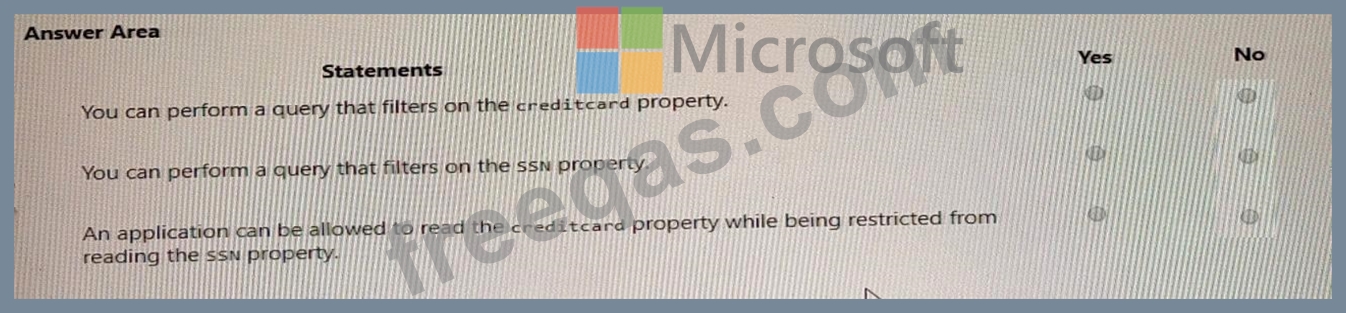
You can perform a query that filters on the creditcard property = No. This is because the creditcard property is encrypted and cannot be used for filtering or sorting operations1.
You can perform a query that filters on the SSN property = No. This is also because the SSN property is encrypted and cannot be used for filtering or sorting operations1 An application can be allowed to read the creditcard property while being restricted from reading the SSN property = Yes. This is possible by using different CMKs to wrap different DEKs and applying access policies on the CMKs in Azure Key Vault. For example, if you use cmk2 to wrap dek2 instead of cmk1, you can grant an application access to cmk1 but not cmk2, which means it can read the creditcard property but not the SSN property
insert code

Question 23

You have an Azure Cosmos DB for NoSQL container named Contacts that is configured as shown in the following exhibit.

Contacts contains the items shown in the following table.

To Contacts, you plan to insert the items shown in the following table.

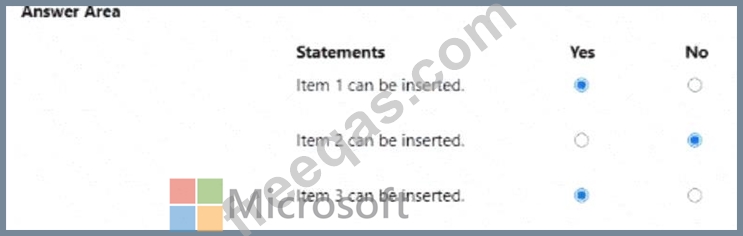
For each of the following statements select Yes if the statement is true. Otherwise, select No.
NOTE: Each correct selection is worth one point.

Correct Answer:

Explanation:
insert code

Question 24

You have an Azure Cosmos DB for NoSQL account.
The change feed is enabled on a container named invoice.
You create an Azure function that has a trigger on the change feed.
What is received by the Azure function?

Correct Answer: A
Explanation
According to the Azure Cosmos DB documentation12, the change feed is a persistent record of changes to a container in the order they occur. The change feed outputs the sorted list of documents that were changed in the order in which they were modified.
The Azure function that has a trigger on the change feed receives all the properties of the updated items2. The change feed does not include the original items or only the changed properties. The change feed also includes some system-defined properties such as _ts (the last modified timestamp) and _lsn (the logical sequence number)3.
Therefore, the correct answer is: A. all the properties of the updated items
insert code

Question 25

You have an Azure Cosmos DB for NoSQL account that hosts a container named Container1.
You implement a change feed processor.
You discover that the processor is processing changes more slowly than the changes occur in Container1.
You need to resolve the issue.
What should you use?


Correct Answer: C
insert code
  • «
  • 1
  • 2
  • 3
  • 4
  • 5
  • 6
  • 7
  • 8
  • 9
  • 10
  • …
  • »
  • »»
[×]

Download PDF File

Enter your email address to download Microsoft.DP-420.v2026-11-21.q284 Dumps

Email:

FreeQAs

Our website provides the Largest and the most Latest vendors Certification Exam materials around the world.

Using dumps we provide to Pass the Exam, we has the Valid Dumps with passing guranteed just which you need.

  • DMCA
  • About
  • Contact Us
  • Privacy Policy
  • Terms & Conditions
©2026 FreeQAs

www.freeqas.com materials do not contain actual questions and answers from Cisco's certification exams.