FreeQAs
 Request Exam  Contact
  • Home
  • View All Exams
  • New QA's
  • Upload
PRACTICE EXAMS:
  • Oracle
  • Fortinet
  • Juniper
  • Microsoft
  • Cisco
  • Citrix
  • CompTIA
  • VMware
  • ISC
  • SAP
  • EMC
  • PMI
  • HP
  • Salesforce
  • Other
  • Oracle
    Oracle
  • Fortinet
    Fortinet
  • Juniper
    Juniper
  • Microsoft
    Microsoft
  • Cisco
    Cisco
  • Citrix
    Citrix
  • CompTIA
    CompTIA
  • VMware
    VMware
  • ISC
    ISC
  • SAP
    SAP
  • EMC
    EMC
  • PMI
    PMI
  • HP
    HP
  • Salesforce
    Salesforce
  1. Home
  2. Microsoft Certification
  3. DP-600 Exam
  4. Microsoft.DP-600.v2026-10-12.q204 Dumps
  • ««
  • «
  • …
  • 33
  • 34
  • 35
  • 36
  • 37
  • 38
  • 39
  • 40
  • 41
  • 42
  • »
Download Now

Question 196

You have a Fabric tenant that contains a workspace named Workspace1. Workspace1 contains a warehouse named DW1. DW1 contains two tables named Employees and Sales. All users have read access to DW1.
You need to implement access controls to meet the following requirements:
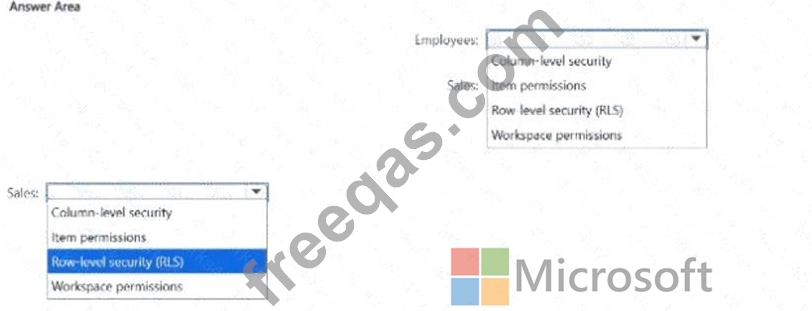
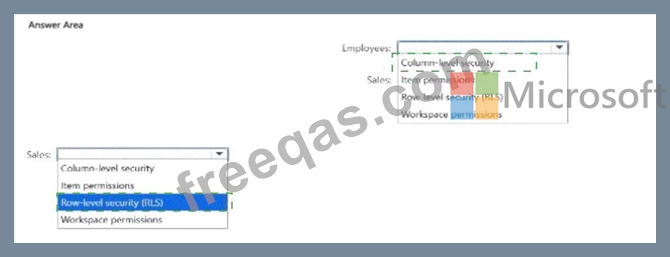
For the Sales table, ensure that the users can see only the sales data from their respective region.
For the Employees table, restrict access to all Personally Identifiable Information (PII).
Maintain access to unrestricted data for all the users.
What should you use for each table? To answer, select the appropriate options in the answer area.
NOTE: Each correct selection is worth one point.

Correct Answer:

Explanation:

Requirement Analysis
Sales table # Users should only see sales data for their own region .
This requires filtering rows based on a condition (e.g., Region = User's Region).
The correct feature: Row-level security (RLS) .
Employees table # Restrict access to Personally Identifiable Information (PII) while allowing access to non- sensitive columns.
This requires restricting access to specific columns (such as SSN, phone, address, etc.), but leaving others visible.
The correct feature: Column-level security .
Maintain access to unrestricted data for all users # Both RLS and column-level security allow users to continue accessing non-restricted data.
Why Other Options Are Not Correct
Item permissions : Control access at the object level (e.g., table or report), not at the row or column level. Too coarse for this requirement.
Workspace permissions : Apply at the workspace level, not suitable for table-level data filtering.
Completed Answer
Employees # Column-level security
Sales # Row-level security (RLS)
References
Row-level security in Microsoft Fabric
Column-level security in Microsoft Fabric
insert code

Question 197

You have a Fabric tenant that contains a workspace named Workspace1. Workspace1 uses Pro license mode and contains a semantic model named Model1.
You need to ensure that Model1 supports XMLA connections.
Which setting should modify?

Correct Answer: D
XMLA Endpoints are only supported on Premium, Premium Per User, and Power BI Embedded workspaces.
https://learn.microsoft.com/en-us/power-bi/enterprise/service-premium-connect-tools
insert code

Question 198

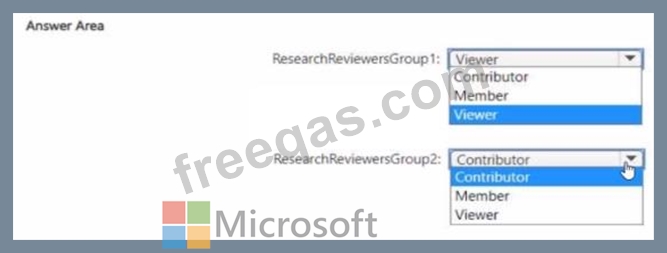
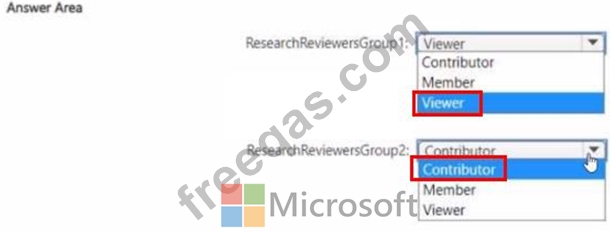
Which workspace rote assignments should you recommend for ResearchReviewersGroupl and ResearchReviewersGroupZ? To answer, select the appropriate options in the answer area.
NOTE: Each correct selection is worth one point.
Correct Answer:
insert code

Question 199

You have a Fabric tenant that uses a Microsoft Power BI Premium capacity.
You need to enable scale-out for a semantic model.
What should you do first?

Correct Answer: C
https://learn.microsoft.com/en-us/power-bi/enterprise/service-premium-scale-out-configure
insert code

Question 200

You have a Fabric warehouse that contains a table named Staging.Sales. Staging.Sales contains the following columns.
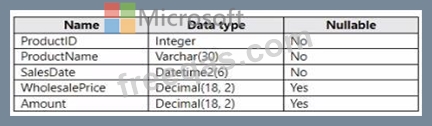
You need to write a T-SQL query that will return data for the year 2023 that displays ProductID and ProductName arxl has a summarized Amount that is higher than 10,000. Which query should you use?


Correct Answer: B
The correct query to use in order to return data for the year 2023 that displays ProductID, ProductName, and has a sum marized Amount greater than 10,000 is Option B. The reason is that it uses the GROUP BY clause to organize the data by ProductID and ProductName and then filters the result using the HAVING clause to only include groups where the sum of Amount is greater t han 10,000. Additionally, the DATEPART (YEAR, SaleDate) = ' 2023 ' part of the HAVING clause ensures that only records from the year 2023 are included. References = For more information, please visit the official documentation on T-SQL queries and the GROUP BY clause at T-SQL GROUP BY .
insert code
  • ««
  • «
  • …
  • 33
  • 34
  • 35
  • 36
  • 37
  • 38
  • 39
  • 40
  • 41
  • 42
  • »
[×]

Download PDF File

Enter your email address to download Microsoft.DP-600.v2026-10-12.q204 Dumps

Email:

FreeQAs

Our website provides the Largest and the most Latest vendors Certification Exam materials around the world.

Using dumps we provide to Pass the Exam, we has the Valid Dumps with passing guranteed just which you need.

  • DMCA
  • About
  • Contact Us
  • Privacy Policy
  • Terms & Conditions
©2026 FreeQAs

www.freeqas.com materials do not contain actual questions and answers from Cisco's certification exams.