Note: This question is part of a series of questions that present the same scenario. Each question in the series contains a unique solution that might meet the stated goals. Some question sets might have more than one correct solution, while others might not have a correct solution.
After you answer a question in this section, you will NOT be able to return to it. As a result, these questions will not appear in the review screen.
You have a KQL database that contains two tables named Stream and Reference. Stream contains streaming data in the following format.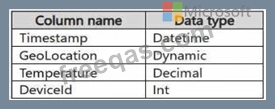
Reference contains reference data in the following format.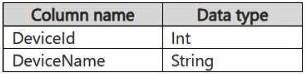
Both tables contain millions of rows.
You have the following KQL queryset.
You need to reduce how long it takes to run the KQL queryset.
Solution: You change the join type to kind=outer.
Does this meet the goal?
Note: This question is part of a series of questions that present the same scenario. Each question in the series contains a unique solution that might meet the stated goals. Some question sets might have more than one correct solution, while others might not have a correct solution.
After you answer a question in this section, you will NOT be able to return to it. As a result, these questions will not appear in the review screen.
You have a Fabric eventstream that loads data into a table named Bike_Location in a KQL database. The table contains the following columns:
BikepointID
Street
Neighbourhood
No_Bikes
No_Empty_Docks
Timestamp
You need to apply transformation and filter logic to prepare the data for consumption. The solution must return data for a neighbourhood named Sands End when No_Bikes is at least 15. The results must be ordered by No_Bikes in ascending order.
Solution: You use the following code segment:
Does this meet the goal?

You have a Fabric workspace that contains a warehouse named Warehouse1. Warehouse! contains a table named Customer. Customer contains the following data.
You have an internal Microsoft Entra user named User1 that has an email address of [email protected].
You need to provide User1 with access to the Customer table. The solution must prevent User1 from accessing the CreditCard column.
How should you complete the statement? To answer, select the appropriate options in the answer area.
NOTE: Each correct selection is worth one point.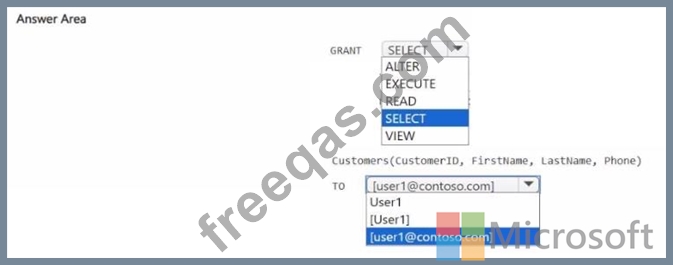

You have an Azure key vault named KeyVaultl that contains secrets.
You have a Fabric workspace named Workspace-!. Workspace! contains a notebook named Notebookl that performs the following tasks:
* Loads stage data to the target tables in a lakehouse
* Triggers the refresh of a semantic model
You plan to add functionality to Notebookl that will use the Fabric API to monitor the semantic model refreshes. You need to retrieve the registered application ID and secret from KeyVaultl to generate the authentication token.
Solution: You use the following code segment:
Use notebookutils.credentials.getSecret and specify the key vault URL and key vault secret. Does this meet the goal?
You have a Fabric workspace that contains a lakehouse and a notebook named Notebook1. Notebook1 reads data into a DataFrame from a table named Table1 and applies transformation logic. The data from the DataFrame is then written to a new Delta table named Table2 by using a merge operation.
You need to consolidate the underlying Parquet files in Table1.
Which command should you run?

