FreeQAs
 Request Exam  Contact
  • Home
  • View All Exams
  • New QA's
  • Upload
PRACTICE EXAMS:
  • Oracle
  • Fortinet
  • IBM
  • Juniper
  • Microsoft
  • Cisco
  • Citrix
  • CompTIA
  • VMware
  • ISC
  • SAP
  • EMC
  • PMI
  • HP
  • Salesforce
  • Other
  • Oracle
    Oracle
  • Fortinet
    Fortinet
  • IBM
    IBM
  • Juniper
    Juniper
  • Microsoft
    Microsoft
  • Cisco
    Cisco
  • Citrix
    Citrix
  • CompTIA
    CompTIA
  • VMware
    VMware
  • ISC
    ISC
  • SAP
    SAP
  • EMC
    EMC
  • PMI
    PMI
  • HP
    HP
  • Salesforce
    Salesforce
  1. Home
  2. Microsoft Certification
  3. DP-700 Exam
  4. Microsoft.DP-700.v2025-08-07.q46 Dumps
  • ««
  • «
  • …
  • 2
  • 3
  • 4
  • 5
  • 6
  • 7
  • 8
  • 9
  • 10
  • 11
  • »
Download Now

Question 26

You have a Fabric F32 capacity that contains a workspace. The workspace contains a warehouse named DW1 that is modelled by using MD5 hash surrogate keys.
DW1 contains a single fact table that has grown from 200 million rows to 500 million rows during the past year.
You have Microsoft Power BI reports that are based on Direct Lake. The reports show year-over-year values.
Users report that the performance of some of the reports has degraded over time and some visuals show errors.
You need to resolve the performance issues. The solution must meet the following requirements:
Provide the best query performance.
Minimize operational costs.
Which should you do?

Correct Answer: D
In this case, the key issue causing performance degradation likely stems from the use of MD5 hash surrogate keys. MD5 hashes are 128-bit values, which can be inefficient for large datasets like the 500 million rows in your fact table. Using a more efficient data type for surrogate keys (such as integer or bigint) would reduce the storage and processing overhead, leading to better query performance. This approach will improve performance while minimizing operational costs because it reduces the complexity of querying and indexing, as smaller data types are generally faster and more efficient to process.
insert code

Question 27

You need to ensure that the data analysts can access the gold layer lakehouse.
What should you do?

Correct Answer: C
Data Analysts' Access Requirements must only have read access to the Delta tables in the gold layer and not have access to the bronze and silver layers.
The gold layer data is typically queried via SQL Endpoints. Granting the Read all SQL Endpoint data permission allows data analysts to query the data using familiar SQL-based tools while restricting access to the underlying files.
insert code

Question 28

You have a Fabric workspace that contains a Real-Time Intelligence solution and an eventhouse.
Users report that from OneLake file explorer, they cannot see the data from the eventhouse.
You enable OneLake availability for the eventhouse.
What will be copied to OneLake?

Correct Answer: D
When you enable OneLake availability for an eventhouse, both new and existing data in the eventhouse will be copied to OneLake. This feature ensures that data, whether newly ingested or already present, becomes available for access through OneLake, making it easier for users to interact with and explore the data directly from OneLake file explorer.
insert code

Question 29

You have a Fabric workspace named Workspace1_DEV that contains the following items:
You create a deployment pipeline named Pipeline1 to move items from Workspace1_DEV to a new workspace named Workspace1_TEST.
You deploy all the items from Workspace1_DEV to Workspace1_TEST.
For each of the following statements, select Yes if the statement is true. Otherwise, select No.
NOTE: Each correct selection is worth one point.
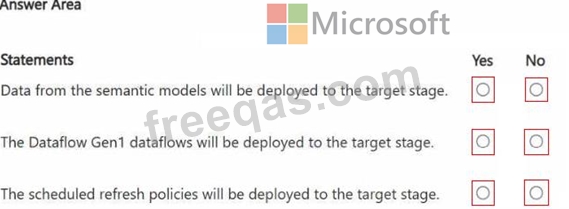
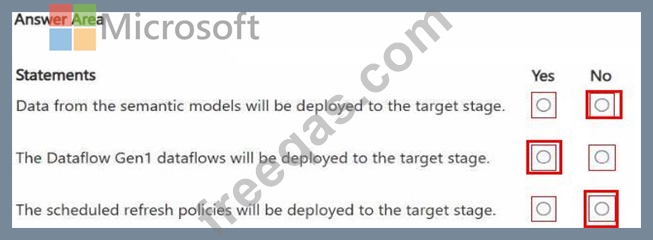
Correct Answer:
insert code

Question 30

You have a Fabric workspace.
You have semi-structured data.
You need to read the data by using T-SQL, KQL, and Apache Spark. The data will only be written by using Spark.
What should you use to store the data?


Correct Answer: A
A lakehouse is the best option for storing semi-structured data when you need to read it using T-SQL, KQL, and Apache Spark. A lakehouse combines the flexibility of a data lake (which can handle semi-structured and unstructured data) with the performance features of a data warehouse. It allows data to be written using Apache Spark and can be queried using different technologies such as T-SQL (for SQL-based querying), KQL (Kusto Query Language for querying), and Apache Spark (for distributed processing). This solution is ideal when dealing with semi-structured data and requiring a versatile querying approach.
insert code
  • ««
  • «
  • …
  • 2
  • 3
  • 4
  • 5
  • 6
  • 7
  • 8
  • 9
  • 10
  • 11
  • »
[×]

Download PDF File

Enter your email address to download Microsoft.DP-700.v2025-08-07.q46 Dumps

Email:

FreeQAs

Our website provides the Largest and the most Latest vendors Certification Exam materials around the world.

Using dumps we provide to Pass the Exam, we has the Valid Dumps with passing guranteed just which you need.

  • DMCA
  • About
  • Contact Us
  • Privacy Policy
  • Terms & Conditions
©2026 FreeQAs

www.freeqas.com materials do not contain actual questions and answers from Cisco's certification exams.