You have a Microsoft Exchange Server 2019 organization.
You need to ensure that all email is retained for one year, and then moved to an archive mailbox.
What should you use?
You are migrating mailboxes from a Microsoft Exchange Server 2016 organization to Exchange Online. The mailbox migrations are configured to suspend, and you plan to perform a coordinated cutover.
Which PowerShell command should you run to complete all the suspended mailbox migrations? To answer, select the appropriate options in the answer area.
NOTE: Each correct selection is worth one point.

Note: This question is part of a series of questions that present the same scenario. Each question in the series contains a unique solution that might meet the stated goals. Some question sets might have more than one correct solution, while others might not have a correct solution.
After you answer a question in this section, you will NOT be able to return to it. As a result, these questions will not appear in the review screen.
You have a Microsoft Exchange Server 2019 hybrid deployment. All user mailboxes are hosted in Microsoft
365. All outbound SMTP email is routed through the on-premises Exchange organization.
A corporate security policy requires that you must prevent credit card numbers from being sent to internet recipients by using email.
You need to configure the deployment to meet the security policy requirement.
Solution: From the Exchange organization, you create a data loss prevention (DLP) policy.
Does this meet the goal?
You have a Microsoft Exchange Online tenant.
All users have Exchange Online mailboxes.
Your company has 10 projectors that are used by 30 managers.
You need to recommend a solution to manage the availability and scheduling of the projectors. The solution must NOT require additional Microsoft 365 licenses.
What Exchange Online object should you recommend creating for each projector?
You have a Microsoft Exchange Server 2019 organization.
You have the Address Book Policies (ABP) and address lists in the following table.
You have the users in the following table.
You assign ABP1 to User1 and User2.
User3 is NOT assigned to an Address Book Policy.
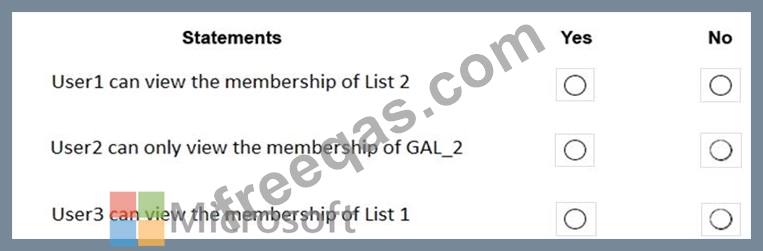
For each of the following statements, select Yes if the statement is true. Otherwise, select No.
NOTE: Each correct selection is worth one point.