FreeQAs
 Request Exam  Contact
  • Home
  • View All Exams
  • New QA's
  • Upload
PRACTICE EXAMS:
  • Oracle
  • Fortinet
  • Juniper
  • Microsoft
  • Cisco
  • Citrix
  • CompTIA
  • VMware
  • ISC
  • SAP
  • EMC
  • PMI
  • HP
  • Salesforce
  • Other
  • Oracle
    Oracle
  • Fortinet
    Fortinet
  • Juniper
    Juniper
  • Microsoft
    Microsoft
  • Cisco
    Cisco
  • Citrix
    Citrix
  • CompTIA
    CompTIA
  • VMware
    VMware
  • ISC
    ISC
  • SAP
    SAP
  • EMC
    EMC
  • PMI
    PMI
  • HP
    HP
  • Salesforce
    Salesforce
  1. Home
  2. MuleSoft Certification
  3. MCD-Level-2 Exam
  4. MuleSoft.MCD-Level-2.v2024-05-04.q23 Dumps
  • «
  • 1
  • 2
  • 3
  • 4
  • 5
  • 6
  • »
Download Now

Question 6

Refer to the exhibit.
What is the result if ''Insecure'' selected as part of the HTTP Listener configuration?

Correct Answer: C
Explanation
Based on the exhibit below, if 'Insecure' is selected as part of the HTTP Listener configuration, the HTTP listener will only accept HTTP requests. This means that no TLS context will be configured for this listener and no encryption or authentication will be applied to incoming requests. The protocol attribute of this listener will be set to HTTP instead of HTTPS. References:
https://docs.mulesoft.com/http-connector/1.6/http-listener-ref#insecure
insert code

Question 7

Mule application A is deployed to CloudHub and is using Object Store v2. Mute application B is also deployed to CloudHub.
Which approach can Mule application B use to remove values from Mule application A'S Object Store?

Correct Answer: A
Explanation
To remove values from Mule application A's Object Store v2, Mule application B can use Object Store v2 REST API. This API allows performing operations on Object Store v2 resources using HTTP methods, such as GET, POST, PUT, and DELETE. Mule application B can use the DELETE method to remove values from Mule application A's Object Store v2 by specifying the object store ID and the key of the value to delete.
References: https://docs.mulesoft.com/object-store/osv2-apis
insert code

Question 8

An API has been developed and deployed to CloudHub Among the policies applied to this API is an allowlist of IP addresses. A developer wants to run a test in Anypoint Studio and does not want any policies applied because their workstation is not included in the allowlist.
What must the developer do in order to run this test locally without the policies applied?

Correct Answer: A
Explanation
To run a test locally without the policies applied, the developer should create a properties file specifically for local development and set the API instance ID to a value that is not used in API Manager. This way, the developer can use different configuration properties for different environments and avoid triggering API autodiscovery when running tests locally. API autodiscovery is a mechanism that associates an API implementation with its corresponding API specification and policies in API Manager based on its API instance ID. By setting this ID to a value that does not exist in API Manager, the developer can prevent API autodiscovery from finding and applying any policies to the local test. References:
https://docs.mulesoft.com/api-manager/2.x/api-auto-discovery-new-concept#configuring-api-autodiscovery
https://docs.mulesoft.com/mule-runtime/4.3/configuring-properties
insert code

Question 9

A developer is working on a project that requires encrypting all data before sending it to a backend application. To accomplish this, the developer will use PGP encryption in the Mule 4 Cryptography module.
What is required to encrypt the data before sending it to the backend application?

Correct Answer: C
Explanation
To encrypt the data before sending it to the backend application using PGP encryption, the application needs the public key from the backend service. PGP encryption uses a public-key cryptography system, which means that each party has a pair of keys: a public key and a private key. The public key is used to encrypt data, and the private key is used to decrypt data. Therefore, to encrypt data for a specific recipient (the backend service), the application needs to use the recipient's public key. The recipient can then use its own private key to decrypt the data. References: https://docs.mulesoft.com/mule-runtime/4.3/cryptography-pgp
insert code

Question 10

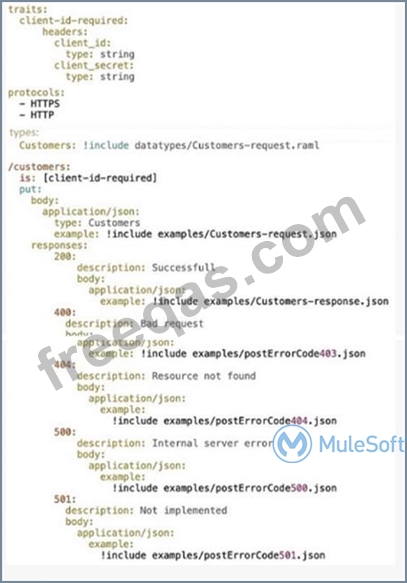
Refer to the exhibit.

A developer generates the base scaffolding for an API in Anypoint Studio.
Which HTTP status code is returned while testing using the API Kit console if no values are entered in client-secret?

Correct Answer: B
Explanation
Based on the code snippet and schema.json file below, when testing using the API Kit console if no values are entered in client-secret, HTTP status code 403 (FORBIDDEN) is returned. This is because client-secret is defined as a required header parameter in schema.json file, which means that it must be present in every request. If no values are entered in client-secret, then it is equivalent to omitting this header parameter, which violates the schema and causes APIKit Router to return HTTP status code 403. References:
https://docs.mulesoft.com/apikit/4.x/apikit-4-headers
insert code
  • «
  • 1
  • 2
  • 3
  • 4
  • 5
  • 6
  • »
[×]

Download PDF File

Enter your email address to download MuleSoft.MCD-Level-2.v2024-05-04.q23 Dumps

Email:

FreeQAs

Our website provides the Largest and the most Latest vendors Certification Exam materials around the world.

Using dumps we provide to Pass the Exam, we has the Valid Dumps with passing guranteed just which you need.

  • DMCA
  • About
  • Contact Us
  • Privacy Policy
  • Terms & Conditions
©2026 FreeQAs

www.freeqas.com materials do not contain actual questions and answers from Cisco's certification exams.