FreeQAs
 Request Exam  Contact
  • Home
  • View All Exams
  • New QA's
  • Upload
PRACTICE EXAMS:
  • Oracle
  • Fortinet
  • Juniper
  • Microsoft
  • Cisco
  • Citrix
  • CompTIA
  • VMware
  • ISC
  • SAP
  • EMC
  • PMI
  • HP
  • Salesforce
  • Other
  • Oracle
    Oracle
  • Fortinet
    Fortinet
  • Juniper
    Juniper
  • Microsoft
    Microsoft
  • Cisco
    Cisco
  • Citrix
    Citrix
  • CompTIA
    CompTIA
  • VMware
    VMware
  • ISC
    ISC
  • SAP
    SAP
  • EMC
    EMC
  • PMI
    PMI
  • HP
    HP
  • Salesforce
    Salesforce
  1. Home
  2. MuleSoft Certification
  3. MCD-Level-2 Exam
  4. MuleSoft.MCD-Level-2.v2024-05-04.q23 Dumps
  • «
  • 1
  • 2
  • 3
  • 4
  • 5
  • 6
Download Now

Question 21

A Mule application contain two policies Policy A and Policy A has order1, and Policy B has order 2. Policy A Policy B, and a flow are defined by he configuration below.
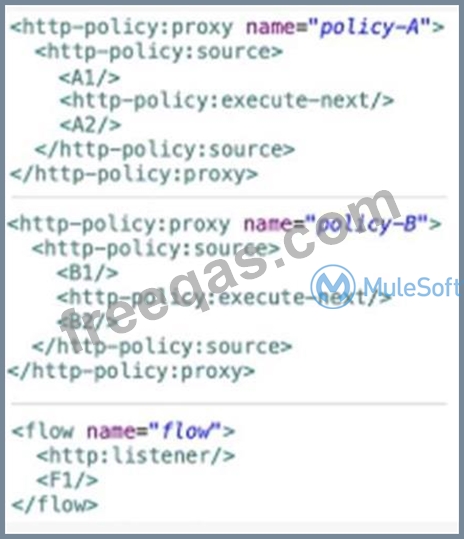
When a HTTP request arrives at the Mule application's endpoint, what will be the execution order?

Correct Answer: A
Explanation
Based on the configuration below, when a HTTP request arrives at the Mule application's endpoint, the execution order will be A1, B1, F1, B2, A2. This is because policies are executed before and after the API implementation flow according to their order attribute. Policy A has order 1, which means it is executed first before Policy B, which has order 2. The flow is executed after both policies are executed before the flow.
Then, Policy B is executed after the flow before Policy A is executed after the flow. References:
https://docs.mulesoft.com/api-manager/2.x/policies-policy-order
insert code

Question 22

When registering a client application with an existing API instance or API Group instance, what is required to manually approve or reject request access?

Correct Answer: A
Explanation
To manually approve or reject request access when registering a client application with an existing API instance or API Group instance, it is required to configure the SLA tier for the application and have one of the following roles or permissions: Organization Administrator, API Manager Environment Administrator, or Manage Contracts permission. These roles or permissions allow managing client applications and contracts in API Manager. References:
https://docs.mulesoft.com/api-manager/2.x/client-applications#managing-client-applications-and-contracts
insert code

Question 23

A Mule application uses API autodiscovery to access and enforce policies for a RESTful implementation.

Correct Answer: D
Explanation
To use API autodiscovery to access and enforce policies for a RESTful implementation, flowRef must be set to the name of the flow that has HTTP listener to receive all incoming RESTful operation requests. This way, API autodiscovery can identify the API implementation and associate it with the corresponding API specification and policies in API Manager. The flow that has HTTP listener is usually the main flow that contains the APIKit Router. References:
https://docs.mulesoft.com/api-manager/2.x/api-auto-discovery-new-concept#flowref
insert code
  • «
  • 1
  • 2
  • 3
  • 4
  • 5
  • 6
[×]

Download PDF File

Enter your email address to download MuleSoft.MCD-Level-2.v2024-05-04.q23 Dumps

Email:

FreeQAs

Our website provides the Largest and the most Latest vendors Certification Exam materials around the world.

Using dumps we provide to Pass the Exam, we has the Valid Dumps with passing guranteed just which you need.

  • DMCA
  • About
  • Contact Us
  • Privacy Policy
  • Terms & Conditions
©2026 FreeQAs

www.freeqas.com materials do not contain actual questions and answers from Cisco's certification exams.
