FreeQAs
 Request Exam  Contact
  • Home
  • View All Exams
  • New QA's
  • Upload
PRACTICE EXAMS:
  • Oracle
  • Fortinet
  • Juniper
  • Microsoft
  • Cisco
  • Citrix
  • CompTIA
  • VMware
  • ISC
  • SAP
  • EMC
  • PMI
  • HP
  • Salesforce
  • Other
  • Oracle
    Oracle
  • Fortinet
    Fortinet
  • Juniper
    Juniper
  • Microsoft
    Microsoft
  • Cisco
    Cisco
  • Citrix
    Citrix
  • CompTIA
    CompTIA
  • VMware
    VMware
  • ISC
    ISC
  • SAP
    SAP
  • EMC
    EMC
  • PMI
    PMI
  • HP
    HP
  • Salesforce
    Salesforce
  1. Home
  2. MuleSoft Certification
  3. MCIA-Level-1-Maintenance Exam
  4. MuleSoft.MCIA-Level-1-Maintenance.v2023-06-17.q42 Dumps
  • «
  • 1
  • 2
  • 3
  • 4
  • 5
  • 6
  • 7
  • 8
  • 9
  • 10
  • »
Download Now

Question 6

What is not true about Mule Domain Project?

Correct Answer: C
Explanation
* Mule Domain Project is ONLY available for customer-hosted Mule runtimes, but not for Anypoint Runtime Fabric
* Mule domain project is available for Hybrid and Private Cloud (PCE). Rest all provide application isolation and can't support domain project.
What is Mule Domain Project?
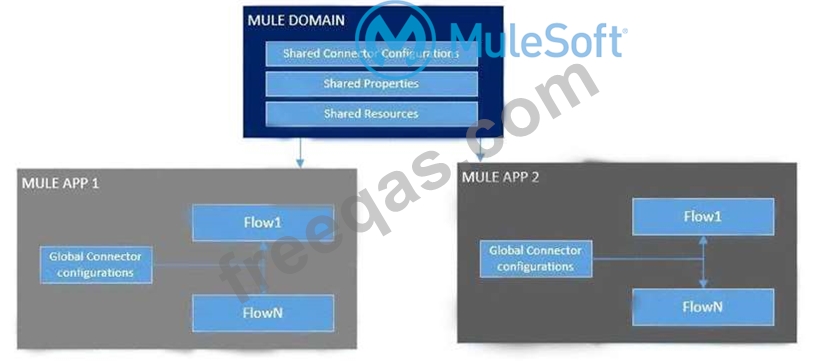
* A Mule Domain Project is implemented to configure the resources that are shared among different projects.
These resources can be used by all the projects associated with this domain. Mule applications can be associated with only one domain, but a domain can be associated with multiple projects. Shared resources allow multiple development teams to work in parallel using the same set of reusable connectors. Defining these connectors as shared resources at the domain level allows the team to: - Expose multiple services within the domain through the same port. - Share the connection to persistent storage. - Share services between apps through a well-defined interface. - Ensure consistency between apps upon any changes because the configuration is only set in one place.
* Use domains Project to share the same host and port among multiple projects. You can declare the http connector within a domain project and associate the domain project with other projects. Doing this also allows to control thread settings, keystore configurations, time outs for all the requests made within multiple applications. You may think that one can also achieve this by duplicating the http connector configuration across all the applications. But, doing this may pose a nightmare if you have to make a change and redeploy all the applications.
* If you use connector configuration in the domain and let all the applications use the new domain instead of a default domain, you will maintain only one copy of the http connector configuration. Any changes will require only the domain to the redeployed instead of all the applications.
You can start using domains in only three steps:
1) Create a Mule Domain project
2) Create the global connector configurations which needs to be shared across the applications inside the Mule Domain project
3) Modify the value of domain in mule-deploy.properties file of the applications Graphical user interface Description automatically generated
insert code

Question 7

An organization is successfully using API led connectivity, however, as the application network grows, all the manually performed tasks to publish share and discover, register, apply policies to, and deploy an API are becoming repetitive pictures driving the organization to automate this process using efficient CI/'CD pipeline.
Considering Anypoint platforms capabilities how should the organization approach automating is API lifecycle?

Correct Answer: C
insert code

Question 8

What API policy would LEAST likely be applied to a Process API?

Correct Answer: D
Explanation
Key to this question lies in the fact that Process API are not meant to be accessed directly by clients. Lets analyze options one by one. Client ID enforcement : This is applied at process API level generally to ensure that identity of API clients is always known and available for API-based analytics Rate Limiting : This policy is applied on Process Level API to secure API's against degradation of service that can happen in case load received is more than it can handle Custom circuit breaker : This is also quite useful feature on process level API's as it saves the API client the wasted time and effort of invoking a failing API. JSON threat protection :
This policy is not required at Process API and rather implemented as Experience API's. This policy is used to safeguard application from malicious attacks by injecting malicious code in JSON object. As ideally Process API's are never called from external world , this policy is never used on Process API's Hence correct answer is JSON threat protection MuleSoft Documentation Reference :
https://docs.mulesoft.com/api-manager/2.x/policy-mule3-json-threat
insert code

Question 9

A Mule application is built to support a local transaction for a series of operations on a single database. The mule application has a Scatter-Gather scope that participates in the local transaction.
What is the behavior of the Scatter-Gather when running within this local transaction?

Correct Answer: C
insert code

Question 10

Which of the below requirements prevent the usage of Anypoint MQ in a company's network?(Choose two answers)

Correct Answer: A,B
insert code
  • «
  • 1
  • 2
  • 3
  • 4
  • 5
  • 6
  • 7
  • 8
  • 9
  • 10
  • »
[×]

Download PDF File

Enter your email address to download MuleSoft.MCIA-Level-1-Maintenance.v2023-06-17.q42 Dumps

Email:

FreeQAs

Our website provides the Largest and the most Latest vendors Certification Exam materials around the world.

Using dumps we provide to Pass the Exam, we has the Valid Dumps with passing guranteed just which you need.

  • DMCA
  • About
  • Contact Us
  • Privacy Policy
  • Terms & Conditions
©2026 FreeQAs

www.freeqas.com materials do not contain actual questions and answers from Cisco's certification exams.
