FreeQAs
 Request Exam  Contact
  • Home
  • View All Exams
  • New QA's
  • Upload
PRACTICE EXAMS:
  • Oracle
  • Fortinet
  • Juniper
  • Microsoft
  • Cisco
  • Citrix
  • CompTIA
  • VMware
  • ISC
  • SAP
  • EMC
  • PMI
  • HP
  • Salesforce
  • Other
  • Oracle
    Oracle
  • Fortinet
    Fortinet
  • Juniper
    Juniper
  • Microsoft
    Microsoft
  • Cisco
    Cisco
  • Citrix
    Citrix
  • CompTIA
    CompTIA
  • VMware
    VMware
  • ISC
    ISC
  • SAP
    SAP
  • EMC
    EMC
  • PMI
    PMI
  • HP
    HP
  • Salesforce
    Salesforce
  1. Home
  2. MuleSoft Certification
  3. MCIA-Level-1-Maintenance Exam
  4. MuleSoft.MCIA-Level-1-Maintenance.v2023-06-17.q42 Dumps
  • «
  • 1
  • 2
  • 3
  • 4
  • 5
  • 6
  • 7
  • 8
  • 9
  • 10
  • »
Download Now

Question 31

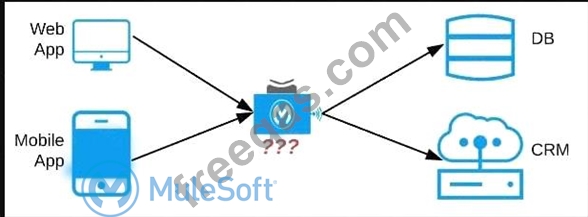
An organization needs to enable access to their customer data from both a mobile app and a web application, which each need access to common fields as well as certain unique fields. The data is available partially in a database and partially in a 3rd-party CRM system. What APIs should be created to best fit these design requirements?
Correct Answer: C
Explanation
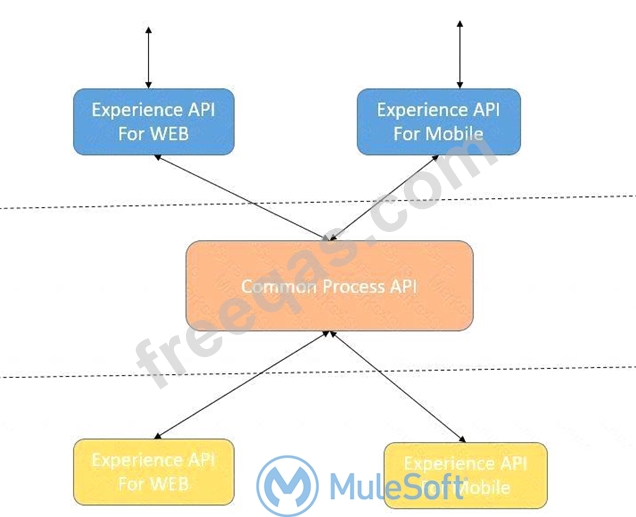
Lets analyze the situation in regards to the different options available Option : A common Experience API but separate Process APIs Analysis : This solution will not work because having common experience layer will not help the purpose as mobile and web applications will have different set of requirements which cannot be fulfilled by single experience layer API Option : Common Process API Analysis : This solution will not work because creating a common process API will impose limitations in terms of flexibility to customize API;s as per the requirements of different applications. It is not a recommended approach.
Option : Separate set of API's for both the applications Analysis : This goes against the principle of Anypoint API-led connectivity approach which promotes creating reusable assets. This solution may work but this is not efficient solution and creates duplicity of code.
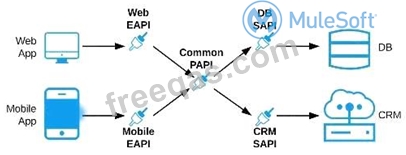
Hence the correct answer is: Separate Experience APIs for the mobile and web app, but a common Process API that invokes separate System APIs created for the database and CRM system A screenshot of a computer Description automatically generated with low confidence

Lets analyze the situation in regards to the different options available Option : A common Experience API but separate Process APIs Analysis : This solution will not work because having common experience layer will not help the purpose as mobile and web applications will have different set of requirements which cannot be fulfilled by single experience layer API Option : Common Process API Analysis : This solution will not work because creating a common process API will impose limitations in terms of flexibility to customize API;s as per the requirements of different applications. It is not a recommended approach.
Option : Separate set of API's for both the applications Analysis : This goes against the principle of Anypoint API-led connectivity approach which promotes creating reusable assets. This solution may work but this is not efficient solution and creates duplicity of code.
Hence the correct answer is: Separate Experience APIs for the mobile and web app, but a common Process API that invokes separate System APIs created for the database and CRM system Diagram Description automatically generated
insert code

Question 32

An application deployed to a runtime fabric environment with two cluster replicas is designed to periodically trigger of flow for processing a high-volume set of records from the source system and synchronize with the SaaS system using the Batch job scope After processing 1000 records in a periodic synchronization of 1 lakh records, the replicas in which batch job instance was started went down due to unexpected failure in the runtime fabric environment What is the consequence of losing the replicas that run the Batch job instance?

Correct Answer: B
insert code

Question 33

A rale limiting policy has been applied to a soap VI.2 API published in Clondhub. The API implementation catches errors in a global error handler on error propagate in the main flow for HTTP: RETRY_EXHAUSTED with HTTP status set to 429 and any with the HTTP status set to 500.
What is the expected H1TP status when the client exceeds the quota of the API calls?

Correct Answer: B
insert code

Question 34

In one of the critical payment related mule application, transaction is being used . As an enhancement to implementation , scatter gather route is introduced which is also the part of transaction group. Scatter gather route has 4 routes.
What will be the behavior of the Mule application in case of error occurs in 4th route of the scatter-gather router and transaction needs to be rolled back?

Correct Answer: B
Explanation
*Scatter Gather: When running within a transaction, Scatter Gather does not execute in parallel. This means that the second route is executed after the first one is processed, the third after the second one, etc. In case of error, all routes will be rolled back
insert code

Question 35

A new upstream API Is being designed to offer an SLA of 500 ms median and 800 ms maximum (99th percentile) response time. The corresponding API implementation needs to sequentially invoke 3 downstream APIs of very similar complexity. The first of these downstream APIs offers the following SLA for its response time: median: 100 ms, 80th percentile: 500 ms, 95th percentile: 1000 ms. If possible, how can a timeout be set in the upstream API for the invocation of the first downstream API to meet the new upstream API's desired SLA?

Correct Answer: D
Explanation
Before we answer this question , we need to understand what median (50th percentile) and 80th percentile means. If the 50th percentile (median) of a response time is 500ms that means that 50% of my transactions are either as fast or faster than 500ms.
If the 90th percentile of the same transaction is at 1000ms it means that 90% are as fast or faster and only 10% are slower. Now as per upstream SLA , 99th percentile is 800 ms which means 99% of the incoming requests should have response time less than or equal to 800 ms. But as per one of the backend API , their 95th percentile is 1000 ms which means that backend API will take 1000 ms or less than that for 95% of. requests.
As there are three API invocation from upstream API , we can not conclude a timeout that can be set to meet the desired SLA as backend SLA's do not support it.
Let see why other answers are not correct.
1) Do not set a timeout --> This can potentially violate SLA's of upstream API
2) Set a timeout of 100 ms; ---> This will not work as backend API has 100 ms as median meaning only 50% requests will be answered in this time and we will get timeout for 50% of the requests. Important thing to note here is, All APIs need to be executed sequentially, so if you get timeout in first API, there is no use of going to second and third API. As a service provider you wouldn't want to keep 50% of your consumers dissatisfied. So not the best option to go with.
*To quote an example: Let's assume you have built an API to update customer contact details.
- First API is fetching customer number based on login credentials
- Second API is fetching Info in 1 table and returning unique key
- Third API, using unique key provided in second API as primary key, updating remaining details
* Now consider, if API times out in first API and can't fetch customer number, in this case, it's useless to call API 2 and 3 and that is why question mentions specifically that all APIs need to be executed sequentially.
3) Set a timeout of 50 ms --> Again not possible due to the same reason as above Hence correct answer is No timeout is possible to meet the upstream API's desired SLA; a different SLA must be negotiated with the first downstream API or invoke an alternative API
insert code
  • «
  • 1
  • 2
  • 3
  • 4
  • 5
  • 6
  • 7
  • 8
  • 9
  • 10
  • »
[×]

Download PDF File

Enter your email address to download MuleSoft.MCIA-Level-1-Maintenance.v2023-06-17.q42 Dumps

Email:

FreeQAs

Our website provides the Largest and the most Latest vendors Certification Exam materials around the world.

Using dumps we provide to Pass the Exam, we has the Valid Dumps with passing guranteed just which you need.

  • DMCA
  • About
  • Contact Us
  • Privacy Policy
  • Terms & Conditions
©2026 FreeQAs

www.freeqas.com materials do not contain actual questions and answers from Cisco's certification exams.
