Refer to the exhibit.
An organization deploys multiple Mule applications to the same customer -hosted Mule runtime. Many of these Mule applications must expose an HTTPS endpoint on the same port using a server-side certificate that rotates often.
What is the most effective way to package the HTTP Listener and package or store the server-side certificate when deploying these Mule applications, so the disruption caused by certificate rotation is minimized?
Refer to the exhibit.
Ashopping cart checkout process consists of a web store backend sending a sequence of API invocations to an Experience API, which in turn invokes a Process API. All API invocations are over HTTPS POST. The Java web store backend executes in a Java EE application server, while all API implementations are Mule applications executing in a customer -hosted Mule runtime.
End-to-end correlation of all HTTP requests and responses belonging to each individual checkout Instance is required. This is to be done througha common correlation ID, so that all log entries written by the web store backend, Experience API implementation, and Process API implementation include the same correlation ID for all requests and responses belonging to the same checkout instance.
What is the most efficient way (using the least amount of custom coding or configuration) for the web store backend and the implementations of the Experience API and Process API to participate in end-to-end correlation of the API invocations for each checkout instance?
A)
The web store backend, being a Java EE application, automatically makes use of the thread-local correlation ID generated by the Java EE application server and automatically transmits that to the Experience API using HTTP-standard headers No special code or configuration is included in the web store backend, Experience API, and Process API implementations to generate and manage the correlation ID
B)
The web store backend generates a new correlation ID value at the start of checkout and sets it on the X-CORRELATlON-lt HTTP request header In each API invocation belonging to that checkout No special code or configuration is included in the Experience API and Process API implementations to generate and manage the correlation ID
C)
The Experience API implementation generates a correlation ID for each incoming HTTP request and passes it to the web store backend in the HTTP response, which includes it in all subsequent API invocations to the Experience API.
The Experience API implementation must be coded to also propagate the correlation ID to the Process API in a suitable HTTP request header
D)
The web store backend sends a correlation ID value in the HTTP request body In the way required by the Experience API The Experience API and Process APIimplementations must be coded to receive the custom correlation ID In the HTTP requests and propagate It in suitable HTTP request headers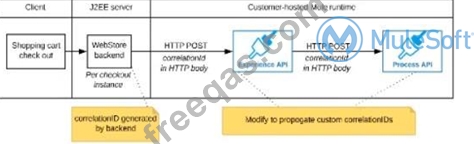
What Mule application can have API policies applied by Anypoint Platform to the endpoint exposed by that Mule application?
In a Mule Application, a flow contains two (2) JMS consume operations that are used to connect to a JMS broker and consume messages from two(2) JMS destination. The Mule application then joins the two JMS messages together.
The JMS broker does not implement high availability (HA) and periodically experiences scheduled outages of upto 10 mins for routine maintenance.
What is the most idiomatic (used for its intented purpose) way to build the mule flow so it can best recover from the expected outages?
A Mule application uses APIkit for SOAP to implement a SOAP web service. The Mule application has been deployed to a CloudHub worker in a testing environment.
The integration testing team wants to use a SOAP client to perform Integration testing. To carry out the integration tests, the integration team must obtain the interface definition for the SOAP web service.
What is the most idiomatic (used for its intended purpose) way for the integration testing team to obtain the interface definition for the deployed SOAP web service in order to perform integration testing with the SOAP client?
Enter your email address to download MuleSoft.MCIA-Level-1.v2022-07-26.q109 Dumps

