FreeQAs
 Request Exam  Contact
  • Home
  • View All Exams
  • New QA's
  • Upload
PRACTICE EXAMS:
  • Oracle
  • Fortinet
  • Juniper
  • Microsoft
  • Cisco
  • Citrix
  • CompTIA
  • VMware
  • ISC
  • SAP
  • EMC
  • PMI
  • HP
  • Salesforce
  • Other
  • Oracle
    Oracle
  • Fortinet
    Fortinet
  • Juniper
    Juniper
  • Microsoft
    Microsoft
  • Cisco
    Cisco
  • Citrix
    Citrix
  • CompTIA
    CompTIA
  • VMware
    VMware
  • ISC
    ISC
  • SAP
    SAP
  • EMC
    EMC
  • PMI
    PMI
  • HP
    HP
  • Salesforce
    Salesforce
  1. Home
  2. MuleSoft Certification
  3. MCIA-Level-1 Exam
  4. MuleSoft.MCIA-Level-1.v2022-07-26.q109 Dumps
  • ««
  • «
  • …
  • 4
  • 5
  • 6
  • 7
  • 8
  • 9
  • 10
  • 11
  • 12
  • 13
  • …
  • »
  • »»
Download Now

Question 36

An organization is designing a Mule application to periodically poll an SFTP location for new files containing sales order records and then process those sales orders. Each sales order must be processed exactly once.
To support this requirement, the Mule application must identify and filter duplicate sales orders on the basis of a unique ID contained in each sales order record and then only send the new sales orders to the downstream system.
What is the most idiomatic (used for its intended purpose) Anypoint connector, validator, or scope that can be configured in the Mule application to filter duplicate sales orders on the basis of the unique ID field contained in each sales order record?

Correct Answer: D
insert code

Question 37

An organization uses one specific CloudHub (AWS) region for all CloudHub deployments. How are CloudHub workers assigned to availability zones (AZs) when the organization's Mule applications are deployed to CloudHub in that region?

Correct Answer: C
Correct answer is Workers are randomly distributed across available AZs within that region. This ensure high availability for deployed mule applications Mulesoft documentation reference :
https://docs.mulesoft.com/runtime-manager/cloudhub-hadr
insert code

Question 38

An organization uses a four(4) node customer hosted Mule runtime cluster to host one(1) stateless api implementation. The API is accessed over HTTPS through a load balancer that uses round-robin for load distribution. Each node in the cluster has been sized to be able to accept four(4) times the current number of requests.
Two(2) nodes in the cluster experience a power outage and are no longer available. The load balancer directs the outage and blocks the two unavailable the nodes from receiving further HTTP requests.
What performance-related consequence is guaranteed to happen to average, assuming the remaining cluster nodes are fully operational?

Correct Answer: C
* "100% increase in the throughput of the API" might look correct, as the number of requests processed per second might increase, but is it guaranteed to increase by 100%? Using 4 nodes will definitely increase throughput of system. But it is cant be precisely said if there would be 100% increase in throughput as it depends on many other factors. Also it is nowhere mentioned in the description that all nodes have same CPU/memory assigned. The question is about the guaranteed behavior * Increasing number of nodes will have no impact on response time as we are scaling application horizontally and not vertically. Similarly there is no change in JVM heap memory usage. * So Correct answer is 50% reduction in the number of requests being received by each node This is because of the two reasons. 1) API is mentioned as stateless 2) Load Balancer is used
insert code

Question 39

What comparison is true about a CloudHub Dedicated Load Balancer (DLB) vs. the CloudHub Shared Load Balancer (SLB)?
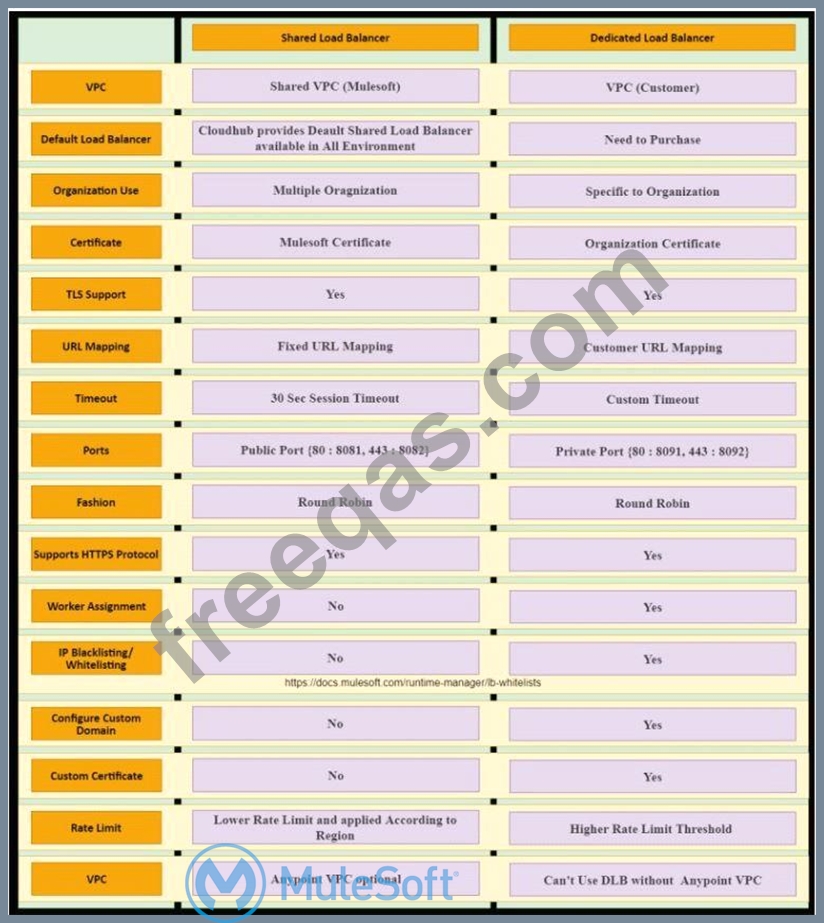
Correct Answer: A
* Shared load balancers don't allow you to configure custom SSL certificates or proxy rules
* Dedicated Load Balancer are optional but you need to purchase them additionally if needed.
* TLS is a cryptographic protocol that provides communications security for your Mule app. TLS offers many different ways of exchanging keys for authentication, encrypting data, and guaranteeing message integrity.
* The CloudHub Shared Load Balancer terminates TLS connections and uses its own server-side certificate.
* Only a DLB allows the configuration of a custom TLS server certificate
* DLB enables you to define SSL configurations to provide custom certificates and optionally enforce two-way SSL client authentication.
* To use a DLB in your environment, you must first create an Anypoint VPC. Because you can associate multiple environments with the same Anypoint VPC, you can use the same dedicated load balancer for your different environments.
* MuleSoft Reference: https://docs.mulesoft.com/runtime-manager/dedicated-load-balancer-tutorial Additional Info on SLB Vs DLB:
insert code

Question 40

A Mule application contains a Batch Job with two Batch Steps (Batch_Step_1 and Batch_Step_2). A payload with 1000 records is received by the Batch Job.
How many threads are used by the Batch Job to process records, and how does each Batch Step process records within the Batch Job?

Correct Answer: A
Explanation/Reference: https://docs.mulesoft.com/mule-runtime/3.8/batch-processing
insert code
  • ««
  • «
  • …
  • 4
  • 5
  • 6
  • 7
  • 8
  • 9
  • 10
  • 11
  • 12
  • 13
  • …
  • »
  • »»
[×]

Download PDF File

Enter your email address to download MuleSoft.MCIA-Level-1.v2022-07-26.q109 Dumps

Email:

FreeQAs

Our website provides the Largest and the most Latest vendors Certification Exam materials around the world.

Using dumps we provide to Pass the Exam, we has the Valid Dumps with passing guranteed just which you need.

  • DMCA
  • About
  • Contact Us
  • Privacy Policy
  • Terms & Conditions
©2026 FreeQAs

www.freeqas.com materials do not contain actual questions and answers from Cisco's certification exams.
