FreeQAs
 Request Exam  Contact
  • Home
  • View All Exams
  • New QA's
  • Upload
PRACTICE EXAMS:
  • Oracle
  • Fortinet
  • IBM
  • Juniper
  • Microsoft
  • Cisco
  • Citrix
  • CompTIA
  • VMware
  • ISC
  • SAP
  • EMC
  • PMI
  • HP
  • Salesforce
  • Other
  • Oracle
    Oracle
  • Fortinet
    Fortinet
  • IBM
    IBM
  • Juniper
    Juniper
  • Microsoft
    Microsoft
  • Cisco
    Cisco
  • Citrix
    Citrix
  • CompTIA
    CompTIA
  • VMware
    VMware
  • ISC
    ISC
  • SAP
    SAP
  • EMC
    EMC
  • PMI
    PMI
  • HP
    HP
  • Salesforce
    Salesforce
  1. Home
  2. MuleSoft Certification
  3. MCIA-Level-1 Exam
  4. MuleSoft.MCIA-Level-1.v2022-07-26.q109 Dumps
  • «
  • 1
  • 2
  • 3
  • 4
  • 5
  • 6
  • 7
  • 8
  • 9
  • 10
  • …
  • »
  • »»
Download Now

Question 1

What is required before an API implemented using the components of Anypoint Platform can be managed and governed (by applying API policies) on Anypoint Platform?

Correct Answer: C
Context of the question is about managing and governing mule applications deployed on Anypoint platform.
Anypoint API Manager (API Manager) is a component of Anypoint Platform that enables you to manage, govern, and secure APIs. It leverages the runtime capabilities of API Gateway and Anypoint Service Mesh, both of which enforce policies, collect and track analytics data, manage proxies, provide encryption and authentication, and manage applications.
Prerequisite of managing an API is that the API must be published to Anypoint Exchange. Hence the correct option in C Mule Ref Doc : https://docs.mulesoft.com/api-manager/2.x/getting-started-proxy
insert code

Question 2

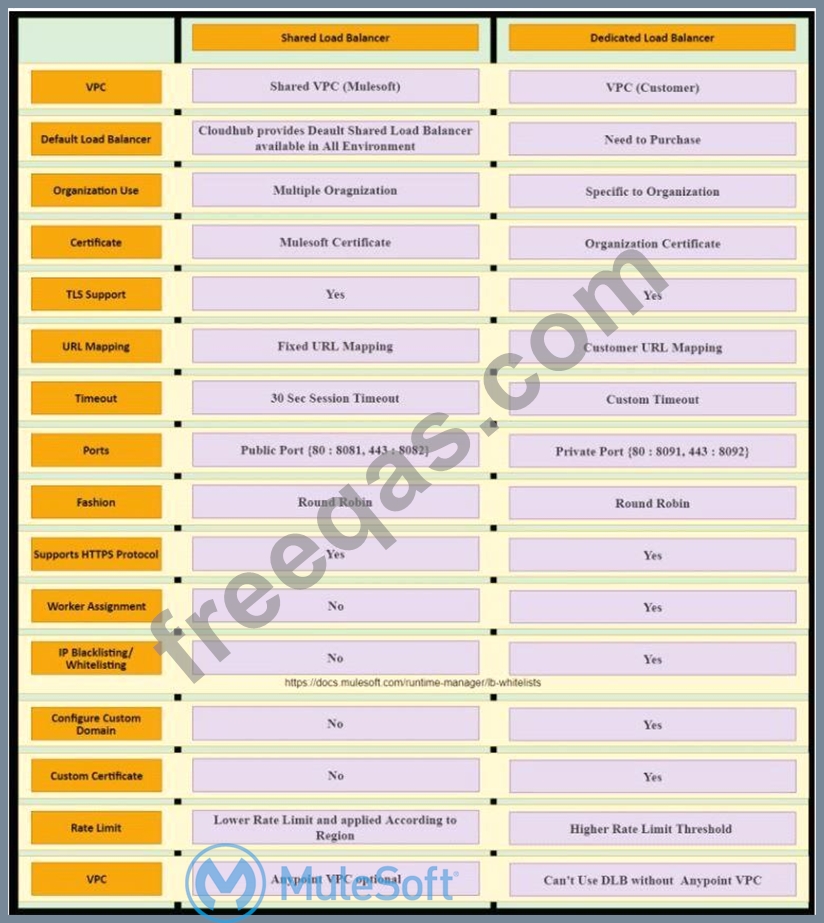
An organization is designing a mule application to support an all or nothing transaction between serval database operations and some other connectors so that they all roll back if there is a problem with any of the connectors Besides the database connector , what other connector can be used in the transaction.
Correct Answer: A
Correct answer is VM VM support Transactional Type. When an exception occur, The transaction rolls back to its original state for reprocessing. This feature is not supported by other connectors.
Here is additional information about Transaction management:
insert code

Question 3

Refer to the exhibit.

A Mule application is deployed to a cluster of two customer-hosted Mute runtimes. The Mute application has a flow that polls a database and another flow with an HTTP Listener.
HTTP clients send HTTP requests directly to individual cluster nodes.
What happens to database polling and HTTP request handling in the time after the primary (master) node of the cluster has railed, but before that node is restarted?

Correct Answer: D
insert code

Question 4

Refer to the exhibit.
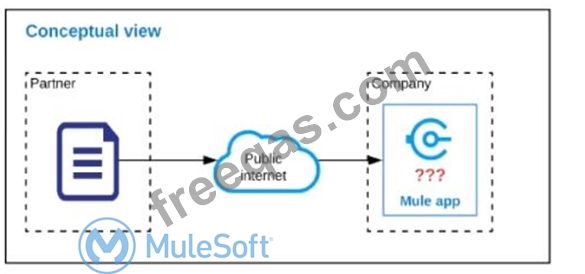
An organization is designing a Mule application to receive data from one external business partner. The two companies currently have no shared IT infrastructure and do not want to establish one. Instead, all communication should be over the public internet (with no VPN).
What Anypoint Connector can be used in the organization's Mule application to securely receive data from this external business partner?
Correct Answer: C
* Object Store and VM Store is used for sharing data inter or intra mule applications in same setup. Can't be used with external Business Partner
* Also File connector will not be useful as the two companies currently have no shared IT infrastructure. It's specific for local use.
* Correct answer is SFTP connector. The SFTP Connector implements a secure file transport channel so that your Mule application can exchange files with external resources. SFTP uses the SSH security protocol to transfer messages. You can implement the SFTP endpoint as an inbound endpoint with a one-way exchange pattern, or as an outbound endpoint configured for either a one-way or request-response exchange pattern.
insert code

Question 5

An organization has implemented a continuous integration (CI) lifecycle that promotes Mule applications through code, build, and test stages. To standardize the organization's CI journey, a new dependency control approach is being designed to store artifacts that include information such as dependencies, versioning, and build promotions.
To implement these process improvements, the organization will now require developers to maintain all dependencies related to Mule application code in a shared location.
What is the most idiomatic (used for its intended purpose) type of system the organization should use in a shared location to standardize all dependencies related to Mule application code?

Correct Answer: A
insert code
  • «
  • 1
  • 2
  • 3
  • 4
  • 5
  • 6
  • 7
  • 8
  • 9
  • 10
  • …
  • »
  • »»
[×]

Download PDF File

Enter your email address to download MuleSoft.MCIA-Level-1.v2022-07-26.q109 Dumps

Email:

FreeQAs

Our website provides the Largest and the most Latest vendors Certification Exam materials around the world.

Using dumps we provide to Pass the Exam, we has the Valid Dumps with passing guranteed just which you need.

  • DMCA
  • About
  • Contact Us
  • Privacy Policy
  • Terms & Conditions
©2026 FreeQAs

www.freeqas.com materials do not contain actual questions and answers from Cisco's certification exams.
