FreeQAs
 Request Exam  Contact
  • Home
  • View All Exams
  • New QA's
  • Upload
PRACTICE EXAMS:
  • Oracle
  • Fortinet
  • IBM
  • Juniper
  • Microsoft
  • Cisco
  • Citrix
  • CompTIA
  • VMware
  • ISC
  • SAP
  • EMC
  • PMI
  • HP
  • Salesforce
  • Other
  • Oracle
    Oracle
  • Fortinet
    Fortinet
  • IBM
    IBM
  • Juniper
    Juniper
  • Microsoft
    Microsoft
  • Cisco
    Cisco
  • Citrix
    Citrix
  • CompTIA
    CompTIA
  • VMware
    VMware
  • ISC
    ISC
  • SAP
    SAP
  • EMC
    EMC
  • PMI
    PMI
  • HP
    HP
  • Salesforce
    Salesforce
  1. Home
  2. MuleSoft Certification
  3. MCPA-Level-1 Exam
  4. MuleSoft.MCPA-Level-1.v2025-01-06.q100 Dumps
  • «
  • 1
  • 2
  • 3
  • 4
  • 5
  • 6
  • 7
  • 8
  • 9
  • 10
  • …
  • »
  • »»
Download Now

Question 16

An organization wants MuleSoft-hosted runtime plane features (such as HTTP load balancing, zero downtime, and horizontal and vertical scaling) in its Azure environment. What runtime plane minimizes the organization's effort to achieve these features?

Correct Answer: A
Correct answer: Anypoint Runtime Fabric
*****************************************
>> When a customer is already having an Azure environment, It is not at all an ideal approach to go with hybrid model having some Mule Runtimes hosted on Azure and some on MuleSoft. This is unnecessary and useless.
>> CloudHub is a Mulesoft-hosted Runtime plane and is on AWS. We cannot customize to point CloudHub to customer's Azure environment.
>> Anypoint Platform for Pivotal Cloud Foundry is specifically for infrastructure provided by Pivotal Cloud Foundry
>> Anypoint Runtime Fabric is right answer as it is a container service that automates the deployment and orchestration of Mule applications and API gateways. Runtime Fabric runs within a customer-managed infrastructure on AWS, Azure, virtual machines (VMs), and bare-metal servers.
-Some of the capabilities of Anypoint Runtime Fabric include:
-Isolation between applications by running a separate Mule runtime per application.
-Ability to run multiple versions of Mule runtime on the same set of resources.
-Scaling applications across multiple replicas.
-Automated application fail-over.
-Application management with Anypoint Runtime Manager.
insert code

Question 17

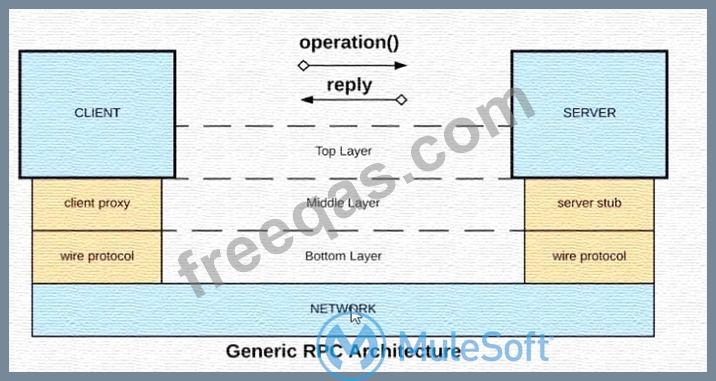
Refer to the exhibit.

What is a valid API in the sense of API-led connectivity and application networks?
A)Java RMI over TCP

B)Java RMI over TCP

C)CORBA over HOP

D)XML over UDP

Correct Answer: D
XML over HTTP
*****************************************
>> API-led connectivity and Application Networks urge to have the APIs on HTTP based protocols for building most effective APIs and networks on top of them.
>> The HTTP based APIs allow the platform to apply various varities of policies to address many NFRs
>> The HTTP based APIs also allow to implement many standard and effective implementation patterns that adhere to HTTP based w3c rules.

Bottom of Form
Top of Form
insert code

Question 18

Mule applications that implement a number of REST APIs are deployed to their own subnet that is inaccessible from outside the organization.
External business-partners need to access these APIs, which are only allowed to be invoked from a separate subnet dedicated to partners - called Partner-subnet. This subnet is accessible from the public internet, which allows these external partners to reach it.
Anypoint Platform and Mule runtimes are already deployed in Partner-subnet. These Mule runtimes can already access the APIs.
What is the most resource-efficient solution to comply with these requirements, while having the least impact on other applications that are currently using the APIs?

Correct Answer: D
insert code

Question 19

An API experiences a high rate of client requests (TPS) vwth small message paytoads. How can usage limits be imposed on the API based on the type of client application?

Correct Answer: B
insert code

Question 20

An organization uses various cloud-based SaaS systems and multiple on-premises systems. The on-premises systems are an important part of the organization's application network and can only be accessed from within the organization's intranet.
What is the best way to configure and use Anypoint Platform to support integrations with both the cloud-based SaaS systems and on-premises systems?
A) Use CloudHub-deployed Mule runtimes in an Anypoint VPC managed by Anypoint Platform Private Cloud Edition control plane

B) Use CloudHub-deployed Mule runtimes in the shared worker cloud managed by the MuleSoft-hosted Anypoint Platform control plane

C) Use an on-premises installation of Mule runtimes that are completely isolated with NO external network access, managed by the Anypoint Platform Private Cloud Edition control plane

D) Use a combination of Cloud Hub-deployed and manually provisioned on-premises Mule runtimes managed by the MuleSoft-hosted Anypoint Platform control plane

Correct Answer: C
insert code
  • «
  • 1
  • 2
  • 3
  • 4
  • 5
  • 6
  • 7
  • 8
  • 9
  • 10
  • …
  • »
  • »»
[×]

Download PDF File

Enter your email address to download MuleSoft.MCPA-Level-1.v2025-01-06.q100 Dumps

Email:

FreeQAs

Our website provides the Largest and the most Latest vendors Certification Exam materials around the world.

Using dumps we provide to Pass the Exam, we has the Valid Dumps with passing guranteed just which you need.

  • DMCA
  • About
  • Contact Us
  • Privacy Policy
  • Terms & Conditions
©2026 FreeQAs

www.freeqas.com materials do not contain actual questions and answers from Cisco's certification exams.