FreeQAs
 Request Exam  Contact
  • Home
  • View All Exams
  • New QA's
  • Upload
PRACTICE EXAMS:
  • Oracle
  • Fortinet
  • IBM
  • Juniper
  • Microsoft
  • Cisco
  • Citrix
  • CompTIA
  • VMware
  • ISC
  • SAP
  • EMC
  • PMI
  • HP
  • Salesforce
  • Other
  • Oracle
    Oracle
  • Fortinet
    Fortinet
  • IBM
    IBM
  • Juniper
    Juniper
  • Microsoft
    Microsoft
  • Cisco
    Cisco
  • Citrix
    Citrix
  • CompTIA
    CompTIA
  • VMware
    VMware
  • ISC
    ISC
  • SAP
    SAP
  • EMC
    EMC
  • PMI
    PMI
  • HP
    HP
  • Salesforce
    Salesforce
  1. Home
  2. MuleSoft Certification
  3. MCPA-Level-1 Exam
  4. MuleSoft.MCPA-Level-1.v2025-01-06.q100 Dumps
  • ««
  • «
  • …
  • 3
  • 4
  • 5
  • 6
  • 7
  • 8
  • 9
  • 10
  • 11
  • 12
  • …
  • »
  • »»
Download Now

Question 31

An organization makes a strategic decision to move towards an IT operating model that emphasizes consumption of reusable IT assets using modern APIs (as defined by MuleSoft).
What best describes each modern API in relation to this new IT operating model?

Correct Answer: B
insert code

Question 32

What API policy would LEAST likely be applied to a Process API?

Correct Answer: D
JSON threat protection
*****************************************
Fact: Technically, there are no restrictions on what policy can be applied in what layer. Any policy can be applied on any layer API. However, context should also be considered properly before blindly applying the policies on APIs.
That is why, this question asked for a policy that would LEAST likely be applied to a Process API.
From the given options:
>> All policies except "JSON threat protection" can be applied without hesitation to the APIs in Process tier.
>> JSON threat protection policy ideally fits for experience APIs to prevent suspicious JSON payload coming from external API clients. This covers more of a security aspect by trying toavoid possibly malicious and harmful JSON payloads from external clients calling experience APIs.
As external API clients are NEVER allowed to call Process APIs directly and also these kind of malicious and harmful JSON payloads are always stopped at experience API layer only using this policy, it is LEAST LIKELY that this same policy is again applied on Process Layer API.
insert code

Question 33

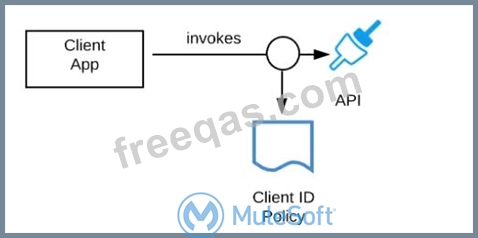
Refer to the exhibit.

A developer is building a client application to invoke an API deployed to the STAGING environment that is governed by a client ID enforcement policy.
What is required to successfully invoke the API?

Correct Answer: C
Correct answer: The client ID and secret obtained from Anypoint Exchange for the API instance in the STAGING environment
*****************************************
>> We CANNOT use the client ID and secret of Anypoint Platform account or any individual environments for accessing the APIs
>> As the type of policy that is enforced on the API in question is "Client ID Enforcment Policy", OAuth token based access won't work.
Right way to access the API is to use the client ID and secret obtained from Anypoint Exchange for the API instance in a particular environment we want to work on.
References:
Managing API instance Contracts on API Manager
https://docs.mulesoft.com/api-manager/1.x/request-access-to-api-task
https://docs.mulesoft.com/exchange/to-request-access
https://docs.mulesoft.com/api-manager/2.x/policy-mule3-client-id-based-policies
insert code

Question 34

Which of the following sequence is correct?

Correct Answer: B
Correct answer: API Consumer requests access to API >> API Client implementes logic to call an API >> API routes the request to >> API Implementation
*****************************************
>> API consumer does not implement any logic to invoke APIs. It is just a role. So, the option stating "API Consumer implementes logic to call an API" is INVALID.
>> API Implementation does not route any requests. It is a final piece of logic where functionality of target systems is exposed. So, the requests should be routed to the API implementation by some other entity. So, the options stating "API Implementation routes the request to >> API" is INVALID
>> The statements in one of the options are correct but sequence is wrong. The sequence is given as "API Client implementes logic to call an API >> API Consumer requests access to API >> API routes the request to >> API Implementation". Here, the statements in the options are VALID but sequence is WRONG.
>> Right option and sequence is the one where API consumer first requests access to API on Anypoint Exchange and obtains client credentials. API client then writes logic to call an API by using the access client credentials requested by API consumer and the requests will be routed to API implementation via the API which is managed by API Manager.
insert code

Question 35

An API implementation is deployed on a single worker on CloudHub and invoked by external API clients (outside of CloudHub). How can an alert be set up that is guaranteed to trigger AS SOON AS that API implementation stops responding to API invocations?

Correct Answer: A
insert code
  • ««
  • «
  • …
  • 3
  • 4
  • 5
  • 6
  • 7
  • 8
  • 9
  • 10
  • 11
  • 12
  • …
  • »
  • »»
[×]

Download PDF File

Enter your email address to download MuleSoft.MCPA-Level-1.v2025-01-06.q100 Dumps

Email:

FreeQAs

Our website provides the Largest and the most Latest vendors Certification Exam materials around the world.

Using dumps we provide to Pass the Exam, we has the Valid Dumps with passing guranteed just which you need.

  • DMCA
  • About
  • Contact Us
  • Privacy Policy
  • Terms & Conditions
©2026 FreeQAs

www.freeqas.com materials do not contain actual questions and answers from Cisco's certification exams.