Based on the data below, which unit should the quality Improvement coordinator focus on?
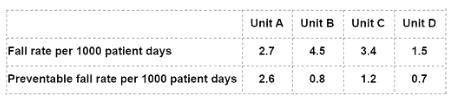
Correct Answer: B
* Based on the data below, which shows the percentage of patients who acquired a hospital-associated infection (HAI) in each unit, the quality improvement coordinator should focus on Unit C, which has the highest rate of HAI among the four units.
* A hospital-associated infection (HAI) is an infection that patients get during or after receiving health care in a hospital or other health care facility. HAIs can cause serious complications, increase morbidity and mortality, prolong hospital stays, and increase health care costs. Therefore, preventing and reducing HAIs is a key quality and safety goal for health care organizations.
* A quality improvement coordinator is a professional who develops and implements quality improvement initiatives, monitors and evaluates quality performance, and provides education and support to staff and leaders on quality methods and tools. One of their responsibilities is to identify and prioritize areas for improvement based on data analysis and evidence-based practices.
* To determine which unit should be the focus of quality improvement efforts, the quality improvement coordinator can use a data analysis tool such as a Pareto chart, which shows the frequency or impact of different factors or causes in descending order, along with a cumulative line that indicates the percentage of the total. A Pareto chart can help identify the most significant issues or opportunities for improvement, based on the 80/20 rule, which states that 80% of the effects come from 20% of the causes.
* Using the data below, a Pareto chart can be created as follows:
Table
Unit
HAI Rate (%)
A
5
B
7
C
12
D
4
* The Pareto chart shows that Unit C has the highest HAI rate (12%), followed by Unit B (7%), Unit A (5%), and Unit D (4%). The cumulative line shows that Unit C alone accounts for 40% of the total HAI rate, and Units C and B together account for 63.3% of the total HAI rate. Therefore, according to the Pareto principle, the quality improvement coordinator should focus on Unit C, as it represents the most significant problem area and the greatest opportunity for improvement.
* The quality improvement coordinator can then conduct a root cause analysis to identify the possible factors or causes that contribute to the high HAI rate in Unit C, such as staff compliance, infection control practices, patient characteristics, environmental factors, etc. A root cause analysis can be facilitated by using a visual tool such as a fishbone diagram, which organizes possible factors into categories, such as people, process, equipment, environment, etc. The quality improvement coordinator can also collect and compare data from other units or sources to identify gaps and best practices.
* Based on the root cause analysis, the quality improvement coordinator can then develop and implement an action plan to address the identified causes and improve the HAI rate in Unit C. The action plan should include specific, measurable, achievable, relevant, and time-bound (SMART) goals, interventions, and indicators. The quality improvement coordinator can also involve the staff and leaders of Unit C in the planning and implementation process, to ensure their engagement and ownership of the improvement efforts.
* The quality improvement coordinator should also monitor and evaluate the progress and outcomes of the action plan, using data collection and analysis tools such as run charts, control charts, or statistical process control (SPC), which can show the variation and trends in the HAI rate over time. The quality improvement coordinator should also provide feedback and recognition to the staff and leaders of Unit C, and make adjustments to the action plan as needed, based on the data and evidence.
References:
* NAHQ HQ Principles, Module 2: Data Management, Lesson 2.3: Data Analysis Tools, Topic 2.3.1:
Pareto Chart, Topic 2.3.2: Fishbone Diagram
* NAHQ Learning Lab: The Role of the Healthcare Quality Professional in Population Health Management, Module 3: Data Collection and Analysis, Slide 16: Pareto Chart, Slide 18: Fishbone Diagram
* NAHQ Journal for Healthcare Quality, Volume 42, Issue 5, September/October 2020, Article:
Utilization of Improvement Methodologies by Healthcare Quality Professionals During the COVID-19 Pandemic, Page 283: Figure 1. Pareto Chart of COVID-19 Cases by State as of June 30, 2020
* NAHQ News and Media, News: Shaping the Future of the Healthcare Quality Profession, Paragraph 5:
The Role of the Quality Improvement Coordinator
* NAHQ Resources, Healthcare Quality Solutions: Ready Your Workforce for Quality, Page 5: The Role of the Quality Improvement Coordinator

