Which action should be taken to support continuous survey readiness?
Correct Answer: D
Continuous survey readiness ensures that healthcare organizations are consistently prepared for accreditation surveys (e.g., Joint Commission, CMS) by maintaining compliance with standards. Tracers, which involve following a patient's care journey to assess compliance with standards, are a key tool for identifying gaps and ensuring ongoing readiness. Option A (Facilitate a failure mode and effects analysis (FMEA) on patient consent): FMEA is a proactive risk assessment tool for specific processes, not a broad strategy for survey readiness. It may be used for targeted improvements but does not address overall compliance monitoring. Option B (Conduct time studies for patient registration processes): Time studies are useful for process improvement (e.g., reducing wait times) but are not directly tied to survey readiness, which focuses on compliance with accreditation standards across multiple areas. Option C (Map the value stream for elective surgery patients): Value stream mapping is a Lean tool for process optimization, not a method for ensuring survey readiness. It is too narrow in scope to address comprehensive compliance needs. Option D (Perform tracers on patients in restraints): Tracers are a cornerstone of survey readiness, as they simulate the survey process by tracking patient care across departments to verify compliance with standards (e. g., restraint use, documentation, safety protocols). NAHQ CPHQ study materials recommend tracers as a best practice for continuous readiness, particularly for high-risk areas like restraint use, which is heavily scrutinized by accrediting bodies. Reference: NAHQ CPHQ Study Guide, Domain 4: Performance and Process Improvement, emphasizes tracers as a critical tool for maintaining continuous survey readiness by assessing compliance with accreditation standards.
Question 37
Which of the following represents a medically underserved population?
Correct Answer: D
A medically underserved population is a population of individuals with either a large elderly population, high infant mortality rate, high level of poverty or lack of providers1. This definition aligns with option D, which refers to patients living below the income poverty line. These individuals often lack access to primary care health services2, which is a key characteristic of medically underserved populations. Therefore, the answer is D: patients living below the Income poverty line.
Question 38
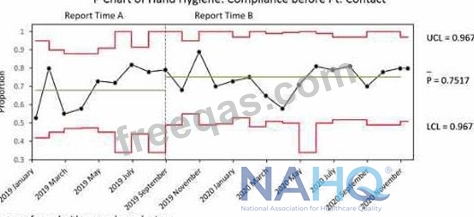
The following data are known: Which of the following accurately describes this chart?
Correct Answer: A
The chart you've provided is a P chart, which is used to measure the proportion of nonconformities in a process over time, in this case, hand hygiene compliance before patient contact. This type of control chart is particularly useful for analyzing the performance of processes in areas like healthcare compliance. From the visual analysis of the chart: Upper Control Limit (UCL) and Lower Control Limit (LCL) are clearly labeled and appear consistent across both Report Time A and B at 0.9677. This addresses option A, indicating that the lower control limits remain unchanged between the two reporting periods. Central Line (P), which represents the average proportion across the data set, is also consistent across both periods at 0.7517. Outliers and Special Cause Variations would typically be indicated by points falling outside the control limits or showing non-random patterns that suggest shifts or trends.
Question 39
Which of the following actions best demonstrates that an organization has begun the work necessary to achieve the Malcolm Baldrige award?
Correct Answer: D
The Malcolm Baldrige National Quality Award is the highest level of national recognition that a U.S. organization can receive for performance excellence1. The award criteria focus on eight performance dimensions: Leadership and Governance, Strategy, Operations, Operational Continuity, Workforce, Customers and Markets, Community Engagement, and Finance1. To achieve the Malcolm Baldrige award, an organization must demonstrate organizational resilience and long-term success through favorable performance levels and trends, comparisons to competitors and industry benchmarks (as appropriate), and relevant metrics1. Therefore, reviewing the Malcolm Baldrige standards to determine organization alignment is the best demonstration that an organization has begun the work necessary to achieve the Malcolm Baldrige award. While creating a team to revise operations to conform to the Malcolm Baldrige requirements (Option A) is a step in the process, it does not necessarily demonstrate that the organization has begun the work necessary to achieve the award. The same applies to developing a crosswalk between Malcolm Baldrige and Joint Commission requirements (Option B) and determining effects on CMS Conditions of Participation (Option C). These actions could be part of the process, but they do not directly demonstrate that the organization has begun the work necessary to achieve the Malcolm Baldrige award. Beginning work toward achieving the Malcolm Baldrige National Quality Award necessitates a comprehensive understanding of the criteria and how an organization currently aligns with them. This would involve a thorough review of the Baldrige Excellence Framework, which includes the standards for performance excellence. By assessing current practices against the Baldrige criteria, an organization can identify areas of strength and opportunities for improvement. This review serves as a foundational step in the Baldrige journey, guiding the development of a detailed action plan to address gaps and enhance performance. Reference: The Baldrige Performance Excellence Program provides a framework for organizations to improve performance and achieve excellence. The NAHQ references the Baldrige framework as a comprehensive standard for quality that healthcare organizations can aspire to and align with as part of their continuous quality improvement efforts.
Question 40
_____________ is the collection of data used to analyze physician practice pattern, utilization of services, and outcomes of care. Its goal is to improve physician performance through accounts through accountability feedback and to decrease practice variations through adherence to evidence-based standards of care.