FreeQAs
 Request Exam  Contact
  • Home
  • View All Exams
  • New QA's
  • Upload
PRACTICE EXAMS:
  • Oracle
  • Fortinet
  • IBM
  • Juniper
  • Microsoft
  • Cisco
  • Citrix
  • CompTIA
  • VMware
  • ISC
  • SAP
  • EMC
  • PMI
  • HP
  • Salesforce
  • Other
  • Oracle
    Oracle
  • Fortinet
    Fortinet
  • IBM
    IBM
  • Juniper
    Juniper
  • Microsoft
    Microsoft
  • Cisco
    Cisco
  • Citrix
    Citrix
  • CompTIA
    CompTIA
  • VMware
    VMware
  • ISC
    ISC
  • SAP
    SAP
  • EMC
    EMC
  • PMI
    PMI
  • HP
    HP
  • Salesforce
    Salesforce
  1. Home
  2. Oracle Certification
  3. 1Z0-1084-21 Exam
  4. Oracle.1Z0-1084-21.v2023-01-27.q26 Dumps
  • «
  • 1
  • 2
  • 3
  • 4
  • 5
  • 6
  • 7
  • »
Download Now

Question 1

You are processing millions of files in an Oracle Cloud Infrastructure (OCI) Object Storage bucket. Each time a new file is created, you want to send an email to the customer and create an order in a database. The solution should perform and minimize cost, Which action should you use to trigger this email?
Correct Answer: B
Explanation
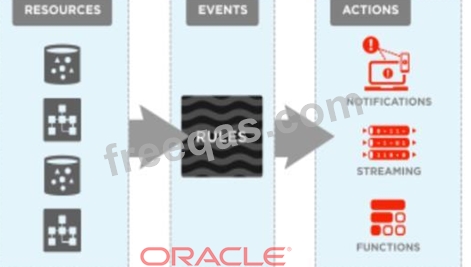
Oracle Cloud Infrastructure Events enables you to create automation based on the state changes of resourcesthroughout your tenancy. Use Events to allow your development teams to automatically respond when a resource changes its state.
Here are some examples of how you might use Events:
Send a notification to a DevOps team when a database backup completes.
Convert files of one format to another when files are uploaded to an Object Storage bucket.
You can only deliver events to certain Oracle Cloud Infrastructure services with a rule. Use the following services to create actions:
Notifications
Streaming
Functions

References:
https://docs.cloud.oracle.com/en-us/iaas/Content/Events/Concepts/eventsoverview.htm
https://docs.cloud.oracle.com/en-us/iaas/Content/Notification/Concepts/notificationoverview.htm
insert code

Question 2

A programmerIs developing a Node is application which will run in a Linux server on their on-premises data center. This application will access various Oracle Cloud Infrastructure (OC1) services using OCI SDKs.
What is the secure way to access OCI services with OCI Identity and Access Management (JAM)?

Correct Answer: C
Explanation
Set up an Oracle Cloud Infrastructure API Signing Key for Use with Oracle Functions:
Before using Oracle Functions, you have to set up an OracleCloud Infrastructure API signing key.
The instructions in this topic assume:
- you are using Linux
For more information and other options, see Required Keys and OCIDs.
The instructions below describe how to create a new ~/.oci directory, how to generate a new private key file and public key file in that ~/.oci directory, how to upload the public key to Oracle Cloud Infrastructure to create a new API signing key, and how to obtain a fingerprint for the public API key. Be aware that instructions and examples elsewhere in this documentation assume the ~/.oci directory exists and contains the private and public key files.
To set up an API signing key:
Log in to your development environment as a functions developer.
In a terminal window, confirm that the ~/.oci directory does not already exist. For example, by entering:
ls ~/.oci
Assuming the ~/.oci directory does not already exist, create it.For example, by entering:
mkdir ~/.oci
Generate a private key encrypted with a passphrase that you provide by entering:
$ openssl genrsa -out ~/.oci/<private-key-file-name>.pem -aes128 2048
where <private-key-file-name> is a name of your choice for theprivate key file (for example, john_api_key_private.pem).
For example:
$ openssl genrsa -out ~/.oci/john_api_key_private.pem -aes128 2048
Generating RSA private key, 2048 bit long modulus
+++
+++
e is 65537 (0x10001)
Enter pass phrase for /Users/johndoe/.oci/john_api_key_private.pem:
References:
https://docs.cloud.oracle.com/en-us/iaas/Content/Functions/Tasks/functionssetupapikey.htm
insert code

Question 3

You are developing a serverless application with Oracle Functions. Your function needs to store state in a database. Your corporate security Standards mandate encryption of secret information like database passwords.
As a function developer, which approach should you follow to satisfy this security requirement?

Correct Answer: C
insert code

Question 4

Which two handle Oracle Functionsauthentication automatically?

Correct Answer: C,E
Explanation
If you use the Fn Project CLI or the Oracle Cloud Infrastructure CLI to invoke a function, authentication is handled for you. See Using the Fn Project CLI to Invoke Functions and Using the Oracle Cloud Infrastructure CLI to Invoke Functions.
If you use an Oracle Cloud Infrastructure SDK to invoke a function, you can use the SDK to handle authentication. See Using SDKs to Invoke Functions.
If you make a signed HTTP request to a function's invoke endpoint, you'll have to handleauthentication yourself by including a signature and the OCID of the compartment to which the function belongs in the request header Fn Project CLI you can create an Fn Project CLI Context to Connect to Oracle Cloud Infrastructure and specify --provider oracle This option enables Oracle Functions to perform authentication and authorization using Oracle Cloud Infrastructure request signing, private keys, user groups, and policies that grant permissions to those user groups.
References:
https://blogs.oracle.com/developers/oracle-functions-invoking-functions-automatically-with-cloud-events
https://docs.cloud.oracle.com/en-us/iaas/Content/Functions/Tasks/functionsinvokingfunctions.htm
insert code

Question 5

You are a consumer of Oracle Cloud Infrastructure (OCI) Streaming service. Which API should you use to read and process the stream?


Correct Answer: B
Explanation
https://docs.cloud.oracle.com/en-us/iaas/Content/Streaming/Concepts/streamingoverview.htm
Building consumers to read and process messages from a stream using the GetMessages API .
How StreamingWorks:
The Streaming service provides a robust, scalable mechanism that you can use to produce and consume high volumes of data between application components.
Here's how Streaming works: a producer publishes messages to a stream, which is an append-only log. These messages are distributed among the partitions using the message's key.
Streams are divided into a number of partitions for scalability. Partitions allow you to distribute a stream by splitting messages across multiple nodes (or brokers). Each partition can be placed on a separate machine to allow multiple consumers to read a stream in parallel. Multiple consumers can read from any partition regardless of where the partition is hosted.
A consumer can read messages from one or more streams. Each message within a stream is marked with an offset value, so a consumer can pick up where it left off if it is interrupted.
You can use the Streaming service by:
A:Creating a stream using the Console or API.
B:Using a producer to publish data to the stream.
C:Building consumers to read and process stream using the GetMessages API . .
References:
https://docs.cloud.oracle.com/en-us/iaas/Content/Streaming/Concepts/streamingoverview.htm
insert code
  • «
  • 1
  • 2
  • 3
  • 4
  • 5
  • 6
  • 7
  • »
[×]

Download PDF File

Enter your email address to download Oracle.1Z0-1084-21.v2023-01-27.q26 Dumps

Email:

FreeQAs

Our website provides the Largest and the most Latest vendors Certification Exam materials around the world.

Using dumps we provide to Pass the Exam, we has the Valid Dumps with passing guranteed just which you need.

  • DMCA
  • About
  • Contact Us
  • Privacy Policy
  • Terms & Conditions
©2026 FreeQAs

www.freeqas.com materials do not contain actual questions and answers from Cisco's certification exams.