FreeQAs
 Request Exam  Contact
  • Home
  • View All Exams
  • New QA's
  • Upload
PRACTICE EXAMS:
  • Oracle
  • Fortinet
  • IBM
  • Juniper
  • Microsoft
  • Cisco
  • Citrix
  • CompTIA
  • VMware
  • ISC
  • SAP
  • EMC
  • PMI
  • HP
  • Salesforce
  • Other
  • Oracle
    Oracle
  • Fortinet
    Fortinet
  • IBM
    IBM
  • Juniper
    Juniper
  • Microsoft
    Microsoft
  • Cisco
    Cisco
  • Citrix
    Citrix
  • CompTIA
    CompTIA
  • VMware
    VMware
  • ISC
    ISC
  • SAP
    SAP
  • EMC
    EMC
  • PMI
    PMI
  • HP
    HP
  • Salesforce
    Salesforce
  1. Home
  2. Oracle Certification
  3. 1Z0-1084-21 Exam
  4. Oracle.1Z0-1084-21.v2023-01-27.q26 Dumps
  • «
  • 1
  • 2
  • 3
  • 4
  • 5
  • 6
  • 7
  • »
Download Now

Question 21

You have a containerized app that requires an Autonomous Transaction Processing (ATP) Database. Which option is not valid for o from a container in Kubernetes?

Correct Answer: A
Explanation
The Kubernetes documentation lays out the following use case for the Service Catalog API:
An application developer wants to use message queuing as part of their application running in a Kubernetes cluster. However, they do not want todeal with the overhead of setting such a service up and administering it themselves. Fortunately, there is a cloud provider that offers message queuing as a managed service through its service broker.
A cluster operator can setup Service Catalog and use itto communicate with the cloud provider's service broker to provision an instance of the message queuing service and make it available to the application within the Kubernetes cluster. The application developer therefore does not need to be concerned withthe implementation details or management of the message queue. The application can simply use it as a service.
The samples in theOCI Service Broker source code include a deployment YAML file that describes how to use an init container to take the values in the Autonomous Transaction Processing service binding and put them in environment variables or in a volume mount. After that, your application can use those values to connect to the database.
Once you've installed and registered the service broker, you're ready to use the ATP service plan to provision an ATP instance. I'll go into details below, but the overview of the process looks like so:
-Create a Kubernetes secret with a new admin and wallet password (in JSON format)
- Create a YAML configuration for the ATP Service Instance
- Deploy the Service Instance
- Create a YAML config for the ATP Service Binding
- Deploy the Service Binding to obtain which results in the creation of a new Kubernetes secret containing the wallet contents
- Create a Kubernetes secret for Microservice deployment use containing the admin password and the wallet password (in plain text format)
- Create a YAML config for the Microservice deployment which uses an initContainer to decode the wallet secrets (due to a bug which double encodes them) and mounts the wallet contents as a volume References:
https://blogs.oracle.com/developers/creating-an-atp-instance-with-the-oci-service-broker
https://blogs.oracle.com/cloud-infrastructure/integrating-oci-service-broker-with-autonomous-transaction-proces
insert code

Question 22

Which statements is incorrect with regards to the Oracle Cloud Infrastructure (OCI) Notifications service?

Correct Answer: F
Explanation
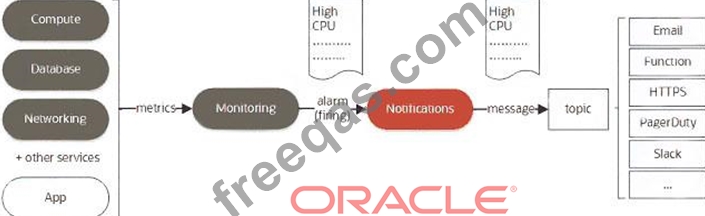
Notification service supports subscriptions topics: E-Mail, Function, Https, PagerDuty and Slack

Alarms: Notifications sends alarm messages when alarms are breached. The alarm message is sent to the topic specified in the alarm. For example, an alarm message might be configured for high CPU usage.
See Managing Alarms.

References:
https://docs.cloud.oracle.com/en-us/iaas/Content/Notification/Concepts/notificationoverview.htm
insert code

Question 23

Which is NOT a supported SDK on Oracle Cloud Infrastructure (OCI)?

Correct Answer: E
Explanation
https://docs.cloud.oracle.com/en-us/iaas/Content/API/Concepts/sdks.htm
insert code

Question 24

You are developing a polyglot serverless application using Oracle Functions. Which language cannot be used to write your function code?

Correct Answer: A
Explanation
Overviewof Functions:
The serverless and elastic architecture of Oracle Functions means there's no infrastructure administration or software administration for you to perform. You don't provision or maintain compute instances, and operating system softwarepatches and upgrades are applied automatically. Oracle Functions simply ensures your app is highly-available, scalable, secure, and monitored. With Oracle Functions, you can write code in Java, Python, Node, Go, and Ruby (and for advanced use cases, bringyour own Dockerfile, and Graal VM). You can then deploy your code, call it directly or trigger it in response to events, and get billed only for the resources consumed during the execution.
References:
https://docs.cloud.oracle.com/en-us/iaas/Content/Functions/Concepts/functionsoverview.htm
insert code

Question 25

You are tasked with developing an application that requires the use of Oracle Cloud Infrastructure (OCI) APIs to POST messages to a stream in the OCI Streaming service.
Which statement is incorrect?


Correct Answer: D
Explanation
Authorization Header
The Oracle Cloud Infrastructure signature uses the "Signature" Authentication scheme (with an Authorization header), and not the Signature HTTP header.
Required Credentials and OCIDs
You need an APIsigning key in the correct format. See Required Keys and OCIDs.
You also need the OCIDs for your tenancy and user. See Where to Get the Tenancy's OCID and User's OCID.
Summary of Signing Steps
In general, these are the steps required to sign a request:
Form the HTTPS request (SSL protocolTLS 1.2 is required).
Create the signing string, which is based on parts of the request.
Create the signature from the signing string, using your private key and the RSA-SHA256 algorithm.
Add the resulting signature and other required information to the Authorization header in the request.
References:
https://docs.cloud.oracle.com/en-us/iaas/Content/Streaming/Concepts/streamingoverview.htm
https://docs.cloud.oracle.com/en-us/iaas/Content/API/Concepts/signingrequests.htm
insert code
  • «
  • 1
  • 2
  • 3
  • 4
  • 5
  • 6
  • 7
  • »
[×]

Download PDF File

Enter your email address to download Oracle.1Z0-1084-21.v2023-01-27.q26 Dumps

Email:

FreeQAs

Our website provides the Largest and the most Latest vendors Certification Exam materials around the world.

Using dumps we provide to Pass the Exam, we has the Valid Dumps with passing guranteed just which you need.

  • DMCA
  • About
  • Contact Us
  • Privacy Policy
  • Terms & Conditions
©2026 FreeQAs

www.freeqas.com materials do not contain actual questions and answers from Cisco's certification exams.