View the exhibit and examine the descriptions of the DEPT and LOCATIONS tables.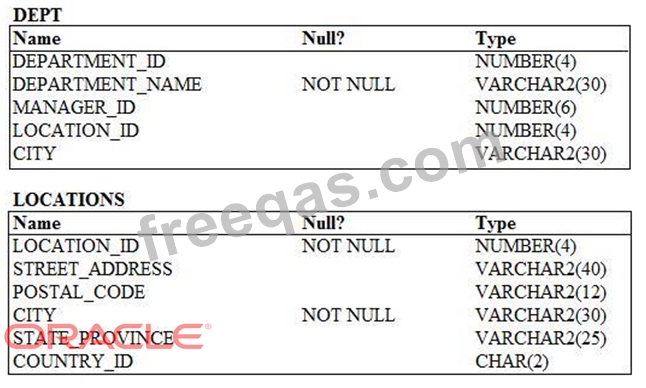
You want to update the CITY column of the DEPT table for all the rows with the corresponding value in the CITY column of the LOCATIONS table for each department.
Which SQL statement would you execute to accomplish the task?
You are designing the structure of a table in which two columns have the specifications:
COMPONENT_ID- must be able to contain a maximum of 12 alphanumeric characters and uniquely identify the row
EXECUTION_DATETIME- contains Century, Year, Month, Day, Hour, Minute, Second to the maximum precision and is used for calculations and comparisons between components.
Which two options define the data types that satisfy these requirements most efficiently?
Examine the description of the EMP_DETAILS table given below: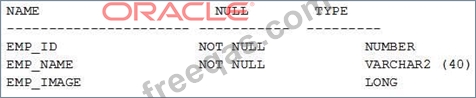
Which two statements are true regarding SQL statements that can be executed on the EMP_DETAIL TABLE?
The following are the steps for a correlated subquery, listed in random order:
* The WHERE clause of the outer query is evaluated.
* The candidate row is fetched from the table specified in the outer query.
* This is repeated for the subsequent rows of the table, till all the rows are processed.
* Rows are returned by the inner query, after being evaluated with the value from the candidate row in the outer query.
Which is the correct sequence in which the Oracle server evaluates a correlated subquery?
Examine the data in the PRODUCTS table: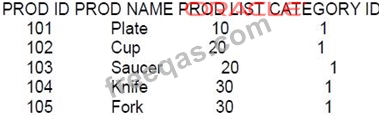
Examine these queries:
1. SELECT prod name, prod list
FROM products
WHERE prod 1ist NOT IN(10,20) AND category _id=1;
2. SELECT prod name, | prod _ list
FROM products
WHERE prod list < > ANY (10,20) AND category _id= 1;
SELECT prod name, prod _ list
FROM products
WHERE prod_ list <> ALL (10, 20) AND category _ id= 1;
Which queries generate the same output?

