/DMO/I_Connection is a CDS view. What variable type is connection full based on the following code? DATA connection full TYPE /DMD/I_Connection.
Correct Answer: B
Question 27
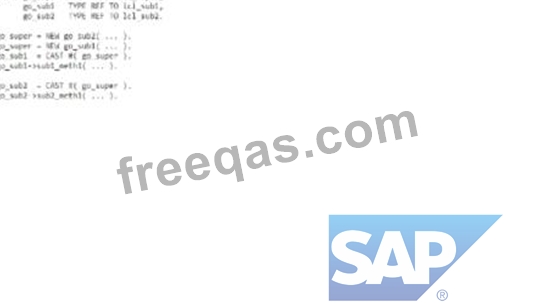
Exhibit: With Icl_super being superclass for Icl_subl and Icl_sub2 and with methods subl_methl and sub2_methl being subclass-specific methods of Id_subl or Icl_sub2, respectivel. What will happen when executing these casts? Note: There are 2 correct answers to this question
Correct Answer: A,D
Explanation The following are the explanations for each statement: A: This statement is correct. go_subl = CAST #(go_super) will not work. This is because go_subl is a data object of type REF TO cl_subl, which is a reference to the subclass cl_subl. go_super is a data object of type REF TO cl_super, which is a reference to the superclass cl_super. The CAST operator is used to perform a downcast or an upcast of a reference variable to another reference variable of a compatible type. A downcast is a conversion from a more general type to a more specific type, while an upcast is a conversion from a more specific type to a more general type. In this case, the CAST operator is trying to perform a downcast from go_super to go_subl, but this is not possible, as go_super is not pointing to an instance of cl_subl, but to an instance of cl_super. Therefore, the CAST operator will raise an exception CX_SY_MOVE_CAST_ERROR at runtime12 B: This statement is incorrect. go_sub2 = CAST #(go_super) will work. go_subl = CAST #(go_super) will not work. This is because go_sub2 is a data object of type REF TO cl_sub2, which is a reference to the subclass cl_sub2. go_super is a data object of type REF TO cl_super, which is a reference to the superclass cl_super. The CAST operator is used to perform a downcast or an upcast of a reference variable to another reference variable of a compatible type. A downcast is a conversion from a more general type to a more specific type, while an upcast is a conversion from a more specific type to a more general type. In this case, the CAST operator is trying to perform a downcast from go_super to go_sub2, and this is possible, as go_super is pointing to an instance of cl_sub2, which is a subclass of cl_super. Therefore, the CAST operator will assign the reference of go_super to go_sub2 without raising an exception. However, the CAST operator will not work for go_subl, as explained in statement A12 C: This statement is incorrect. go_sub2 = CAST #(go_super) will work. go_sub2->sub2_meth1(...) will not work. This is because go_sub2 is a data object of type REF TO cl_sub2, which is a reference to the subclass cl_sub2. go_super is a data object of type REF TO cl_super, which is a reference to the superclass cl_super. The CAST operator is used to perform a downcast or an upcast of a reference variable to another reference variable of a compatible type. A downcast is a conversion from a more general type to a more specific type, while an upcast is a conversion from a more specific type to a more general type. In this case, the CAST operator is trying to perform a downcast from go_super to go_sub2, and this is possible, as go_super is pointing to an instance of cl_sub2, which is a subclass of cl_super. Therefore, the CAST operator will assign the reference of go_super to go_sub2 without raising an exception. However, the method call go_sub2->sub2_meth1(...) will not work, as sub2_meth1 is a subclass-specific method of cl_sub2, which is not inherited by cl_super. Therefore, the method call will raise an exception CX_SY_DYN_CALL_ILLEGAL_METHOD at runtime123 D: This statement is correct. go_subl->subl_meth1(...) will work. This is because go_subl is a data object of type REF TO cl_subl, which is a reference to the subclass cl_subl. subl_meth1 is a subclass-specific method of cl_subl, which is not inherited by cl_super. Therefore, the method call go_subl->subl_meth1(...) will work, as go_subl is pointing to an instance of cl_subl, which has the method subl_meth1123 References: NEW - ABAP Keyword Documentation, CAST - ABAP Keyword Documentation, Method Call - ABAP Keyword Documentation
Question 28
Which of the following are features of Core Data Services? Note: There are 3 correct answers to this question.
Correct Answer: B,C,E
Core Data Services (CDS) is a framework for defining and consuming semantically rich data models in SAP HANA. CDS supports various features that enhance the capabilities of SQL and enable developers to create data models that are optimized for performance, readability, and extensibility12. Some of the features of CDS are: Associations: Associations are a way of defining relationships between CDS entities, such as tables or views. Associations enable navigation and path expressions in CDS queries, which allow accessing data from related entities without explicit joins. Associations also support cardinality, referential constraints, and cascading options34. Annotations: Annotations are a way of adding metadata to CDS entities or their elements, such as fields or parameters. Annotations provide additional information or instructions for the CDS compiler, the database, or the consumers of the CDS views. Annotations can be used for various purposes, such as defining access control, UI rendering, OData exposure, or search capabilities5 . Structured Query Language (SQL): SQL is the standard language for querying and manipulating data in relational databases. CDS is based on SQL and extends it with additional features and syntax. CDS supports SQL features such as joins, aggregations, filters, expressions, functions, and subqueries. CDS also supports SQL Script, which is a scripting language for stored procedures and functions in SAP HANA . You cannot do any of the following: Inheritance: Inheritance is not a feature of CDS. Inheritance is a concept in object-oriented programming that allows a class to inherit the properties and methods of another class. CDS does not support object-oriented programming or classes. Delegation: Delegation is not a feature of CDS. Delegation is a concept in object-oriented programming that allows an object to delegate some of its responsibilities to another object. CDS does not support object-oriented programming or objects.
Question 29
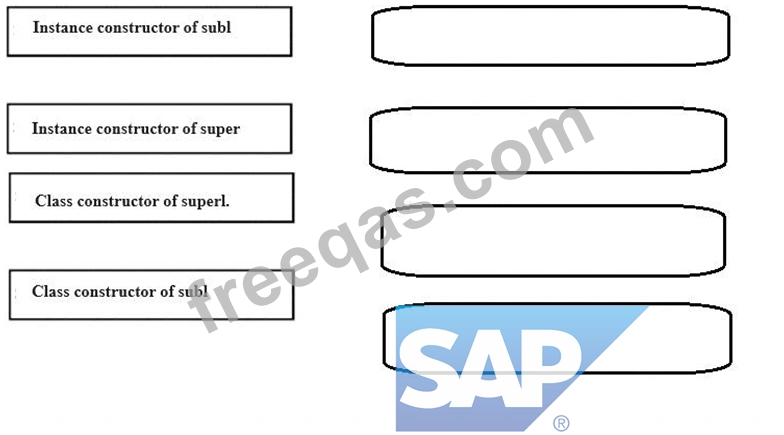
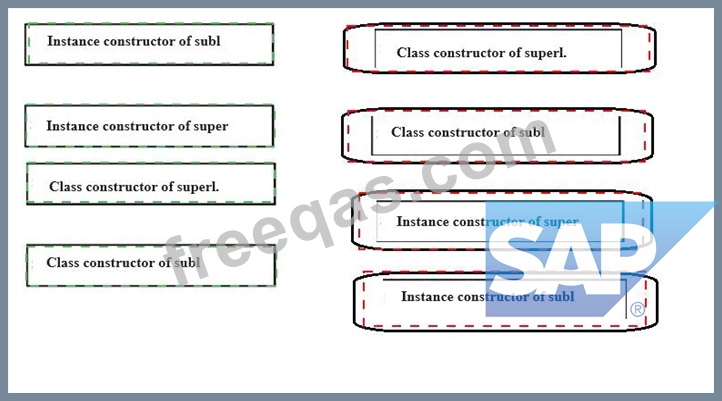
You have a superclass superl and a subclass subl of superl. Each class has an instance constructor and a static constructor. The first statement of your program creates an instance of subl. In which sequence will the constructors be executed?
Correct Answer:
Explanation: The sequence in which the constructors will be executed is as follows: * Class constructor of superl. This is because the class constructor is a static method that is executed automatically before the class is accessed for the first time. The class constructor is used to initialize the static attributes and components of the class. The class constructor of the superclass is executed before the class constructor of the subclass, as the subclass inherits the static components of the superclass12 * Class constructor of subl. This is because the class constructor is a static method that is executed automatically before the class is accessed for the first time. The class constructor is used to initialize the static attributes and components of the class. The class constructor of the subclass is executed after the class constructor of the superclass, as the subclass inherits the static components of the superclass12 * Instance constructor of superl. This is because the instance constructor is an instance method that is executed automatically when an instance of the class is created using the statement CREATE OBJECT. The instance constructor is used to initialize the instance attributes and components of the class. The instance constructor of the superclass is executed before the instance constructor of the subclass, as the subclass inherits the instance components of the superclass. The instance constructor of the subclass must call the instance constructor of the superclass explicitly using super->constructor, unless the superclass is the root node object12 * Instance constructor of subl. This is because the instance constructor is an instance method that is executed automatically when an instance of the class is created using the statement CREATE OBJECT. The instance constructor is used to initialize the instance attributes and components of the class. The instance constructor of the subclass is executed after the instance constructor of the superclass, as the subclass inherits the instance components of the superclass. The instance constructor of the subclass must call the instance constructor of the superclass explicitly using super->constructor, unless the superclass is the root node object12 References: Constructors of Classes - ABAP Keyword Documentation, METHODS - constructor - ABAP Keyword Documentation
Question 30
/DMO/I_Connection is a CDS view. What variable type is connection full based on the following code? DATA connection full TYPE /DMD/I_Connection.
Correct Answer: B
Based on the following code, the variable type of connection_full is a structure. A structure is a complex data type that consists of a group of related data objects, called components, that have their own data types and names. A structure can be defined using the TYPES statement or based on an existing structure type, such as a CDS view entity or a CDS DDIC-based view. In this case, the variable connection_full is declared using the TYPE addition, which means that it has the same structure type as the CDS view entity /DMO/I_Connection. The CDS view entity /DMO/I_Connection is a data model view that defines a data model based on the database table /DMO/Connection. The CDS view entity /DMO/I_Connection has the following components: carrid, connid, airpfrom, airpto, distance, and fltime. Therefore, the variable connection_full has the same components as the CDS view entity /DMO/I_Connection, and each component has the same data type and length as the corresponding field in the database table /DMO/Connection.