What are the effects of this annotation? Note: There are 2 correct answers to this question.
Correct Answer: A,B
Explanation The annotation @Environment.systemField: #LANGUAGE is used to assign the ABAP system field sy-langu to an input parameter of a CDS view or a CDS table function. This enables the implicit parameter passing in Open SQL, which means that the value of sy-langu will be automatically passed to the CDS view without explicitly specifying it in the WHERE clause. This also applies to the CDS views that use the annotated CDS view as a data source, which means that the value of sy-langu will be propagated to the nested CDS views (view on view)12. For example: The following code snippet defines a CDS view ZI_FLIGHT_TEXTS with an input parameter p_langu that is annotated with @Environment.systemField: #LANGUAGE: define view ZI_FLIGHT_TEXTS with parameters p_langu : syst_langu @<Environment.systemField: #LANGUAGE as select from sflight left outer join scarr on sflight.carrid = scarr.carrid left outer join stext on scarr.carrid = stext.carrid { sflight.carrid, sflight.connid, sflight.fldate, scarr.carrname, stext.text as carrtext } where stext.langu = :p_langu The following code snippet shows how to use the CDS view ZI_FLIGHT_TEXTS in ABAP without specifying the value of p_langu in the WHERE clause. The value of sy-langu will be automatically passed to the CDS view: SELECT carrid, connid, fldate, carrname, carrtext FROM zi_flight_texts INTO TABLE @DATA(lt_flights). The following code snippet shows how to use the CDS view ZI_FLIGHT_TEXTS in another CDS view ZI_FLIGHT_REPORT. The value of sy-langu will be automatically passed to the nested CDS view ZI_FLIGHT_TEXTS: define view ZI_FLIGHT_REPORT with parameters p_langu : syst_langu @<Environment.systemField: #LANGUAGE as select from zi_flight_texts(p_langu) { carrid, connid, fldate, carrname, carrtext, count(*) as flight_count } group by carrid, connid, fldate, carrname, carrtext The annotation @Environment.systemField: #LANGUAGE does not prevent the possibility of overriding the default value with a value of your own. You can still specify a different value for the input parameter p_langu in the WHERE clause, either in ABAP or in another CDS view. This will override the value of sy-langu and pass the specified value to the CDS view12. For example: The following code snippet shows how to use the CDS view ZI_FLIGHT_TEXTS in ABAP with a specified value of p_langu in the WHERE clause. The value 'E' will be passed to the CDS view instead of the value of sy-langu: SELECT carrid, connid, fldate, carrname, carrtext FROM zi_flight_texts WHERE p_langu = 'E' INTO TABLE @DATA(lt_flights). The following code snippet shows how to use the CDS view ZI_FLIGHT_TEXTS in another CDS view ZI_FLIGHT_REPORT with a specified value of p_langu in the WHERE clause. The value 'E' will be passed to the nested CDS view ZI_FLIGHT_TEXTS instead of the value of sy-langu: define view ZI_FLIGHT_REPORT with parameters p_langu : syst_langu @<Environment.systemField: #LANGUAGE as select from zi_flight_texts(p_langu) { carrid, connid, fldate, carrname, carrtext, count(*) as flight_count } where p_langu = 'E' group by carrid, connid, fldate, carrname, carrtext References: 1: ABAP CDS - parameter_annot - ABAP Keyword Documentation - SAP Online Help 2: ABAP CDS - session_variable - ABAP Keyword Documentation - SAP Online Help
Question 37
Exhibit: What are valid statements? Note: There are 3 correct answers to this question.
Correct Answer: A,B,E
Explanation The following are the explanations for each statement: A: This statement is valid. go_ifl may call method ml with go_ifl->ml(). This is because go_ifl is a data object of type REF TO ifl, which is a reference to the interface ifl. The interface ifl defines a method ml, which can be called using the reference variable go_ifl. The class cll implements the interface ifl, which means that it provides an implementation of the method ml. The data object go_ifl is assigned to a new instance of the class cll using the NEW operator and the inline declaration operator @DATA. Therefore, when go_ifl->ml() is called, the implementation of the method ml in the class cll is executed123 B: This statement is valid. Instead of go_cll = NEW #(...) you could use go_ifl = NEW cll(...). This is because go_ifl is a data object of type REF TO ifl, which is a reference to the interface ifl. The class cll implements the interface ifl, which means that it is compatible with the interface ifl. Therefore, go_ifl can be assigned to a new instance of the class cll using the NEW operator and the class name cll. The inline declaration operator @DATA is optional in this case, as go_ifl is already declared. The parentheses after the class name cll can be used to pass parameters to the constructor of the class cll, if any123 E: This statement is valid. go_ifl may call method m2 with go_ifl->m2(...). This is because go_ifl is a data object of type REF TO ifl, which is a reference to the interface ifl. The class cll implements the interface ifl, which means that it inherits all the components of the interface ifl. The class cll also defines a method m2, which is a public method of the class cll. Therefore, go_ifl can call the method m2 using the reference variable go_ifl. The method m2 is not defined in the interface ifl, but it is accessible through the interface ifl, as the interface ifl is implemented by the class cll. The parentheses after the method name m2 can be used to pass parameters to the method m2, if any123 The other statements are not valid, as they have syntax errors or logical errors. These statements are: C: This statement is not valid. go_cll may call method ml with go_cll->ifl~ml(). This is because go_cll is a data object of type REF TO cll, which is a reference to the class cll. The class cll implements the interface ifl, which means that it inherits all the components of the interface ifl. The interface ifl defines a method ml, which can be called using the reference variable go_cll. However, the syntax for calling an interface method using a class reference is go_cll->ml(), not go_cll->ifl~ml(). The interface component selector ~ is only used when calling an interface method using an interface reference, such as go_ifl->ifl~ml(). Using the interface component selector ~ with a class reference will cause a syntax error123 D: This statement is not valid. Instead of go_cll = NEW #() you could use go_ifl = NEW #(...). This is because go_ifl is a data object of type REF TO ifl, which is a reference to the interface ifl. The interface ifl cannot be instantiated, as it does not have an implementation. Therefore, go_ifl cannot be assigned to a new instance of the interface ifl using the NEW operator and the inline declaration operator @DATA. This will cause a syntax error or a runtime error. To instantiate an interface, you need to use a class that implements the interface, such as the class cll123 References: INTERFACES - ABAP Keyword Documentation, CLASS - ABAP Keyword Documentation, NEW - ABAP Keyword Documentation
Question 38
What are the effects of this annotation? Note: There are 2 correct answers to this question.
Correct Answer: A,B
The annotation @Environment.systemField: #LANGUAGE is used to assign the ABAP system field sy-langu to an input parameter of a CDS view or a CDS table function. This enables the implicit parameter passing in Open SQL, which means that the value of sy-langu will be automatically passed to the CDS view without explicitly specifying it in the WHERE clause. This also applies to the CDS views that use the annotated CDS view as a data source, which means that the value of sy-langu will be propagated to the nested CDS views (view on view)12. For example: The following code snippet defines a CDS view ZI_FLIGHT_TEXTS with an input parameter p_langu that is annotated with @Environment.systemField: #LANGUAGE: define view ZI_FLIGHT_TEXTS with parameters p_langu : syst_langu @<Environment.systemField: #LANGUAGE as select from sflight left outer join scarr on sflight.carrid = scarr.carrid left outer join stext on scarr.carrid = stext.carrid { sflight.carrid, sflight.connid, sflight.fldate, scarr.carrname, stext.text as carrtext } where stext.langu = :p_langu The following code snippet shows how to use the CDS view ZI_FLIGHT_TEXTS in ABAP without specifying the value of p_langu in the WHERE clause. The value of sy-langu will be automatically passed to the CDS view: SELECT carrid, connid, fldate, carrname, carrtext FROM zi_flight_texts INTO TABLE @DATA(lt_flights). The following code snippet shows how to use the CDS view ZI_FLIGHT_TEXTS in another CDS view ZI_FLIGHT_REPORT. The value of sy-langu will be automatically passed to the nested CDS view ZI_FLIGHT_TEXTS: define view ZI_FLIGHT_REPORT with parameters p_langu : syst_langu @<Environment.systemField: #LANGUAGE as select from zi_flight_texts(p_langu) { carrid, connid, fldate, carrname, carrtext, count(*) as flight_count } group by carrid, connid, fldate, carrname, carrtext The annotation @Environment.systemField: #LANGUAGE does not prevent the possibility of overriding the default value with a value of your own. You can still specify a different value for the input parameter p_langu in the WHERE clause, either in ABAP or in another CDS view. This will override the value of sy-langu and pass the specified value to the CDS view12. For example: The following code snippet shows how to use the CDS view ZI_FLIGHT_TEXTS in ABAP with a specified value of p_langu in the WHERE clause. The value 'E' will be passed to the CDS view instead of the value of sy-langu: SELECT carrid, connid, fldate, carrname, carrtext FROM zi_flight_texts WHERE p_langu = 'E' INTO TABLE @DATA(lt_flights). The following code snippet shows how to use the CDS view ZI_FLIGHT_TEXTS in another CDS view ZI_FLIGHT_REPORT with a specified value of p_langu in the WHERE clause. The value 'E' will be passed to the nested CDS view ZI_FLIGHT_TEXTS instead of the value of sy-langu: define view ZI_FLIGHT_REPORT with parameters p_langu : syst_langu @<Environment.systemField: #LANGUAGE as select from zi_flight_texts(p_langu) { carrid, connid, fldate, carrname, carrtext, count(*) as flight_count } where p_langu = 'E' group by carrid, connid, fldate, carrname, carrtext
Question 39
Which of the following are features of Core Data Services? Note: There are 3 correct answers to this question.
Correct Answer: B,C,E
Explanation Core Data Services (CDS) is a framework for defining and consuming semantically rich data models in SAP HANA. CDS supports various features that enhance the capabilities of SQL and enable developers to create data models that are optimized for performance, readability, and extensibility12. Some of the features of CDS are: Associations: Associations are a way of defining relationships between CDS entities, such as tables or views. Associations enable navigation and path expressions in CDS queries, which allow accessing data from related entities without explicit joins. Associations also support cardinality, referential constraints, and cascading options34. Annotations: Annotations are a way of adding metadata to CDS entities or their elements, such as fields or parameters. Annotations provide additionalinformation or instructions for the CDS compiler, the database, or the consumers of the CDS views. Annotations can be used for various purposes, such as defining access control, UI rendering, OData exposure, or search capabilities5 . Structured Query Language (SQL): SQL is the standard language for querying and manipulating data in relational databases. CDS is based on SQL and extends it with additional features and syntax. CDS supports SQL features such as joins, aggregations, filters, expressions, functions, and subqueries. CDS also supports SQL Script, which is a scripting language for stored procedures and functions in SAP HANA . You cannot do any of the following: Inheritance: Inheritance is not a feature of CDS. Inheritance is a concept in object-oriented programming that allows a class to inherit the properties and methods of another class. CDS does not support object-oriented programming or classes. Delegation: Delegation is not a feature of CDS. Delegation is a concept in object-oriented programming that allows an object to delegate some of its responsibilities to another object. CDS does not support object-oriented programming or objects. References: 1: Core Data Services (CDS) | CAPire 2: Core Data Services [CDS] in SAP S/4 HANA | SAP Blogs 3: Associations in Core Data Services (CDS) | SAP Help Portal 4: [CDS DDL - Association - ABAP Keyword Documentation - SAP Online Help] 5: [Annotations in Core Data Services (CDS) | SAP Help Portal] [CDS DDL - Annotation - ABAP Keyword Documentation - SAP Online Help] : [Structured Query Language (SQL) | SAP Help Portal] : [CDS DDL - SQL Features - ABAP Keyword Documentation - SAP Online Help] : [Object-Oriented Programming in ABAP | SAP Help Portal]
Question 40
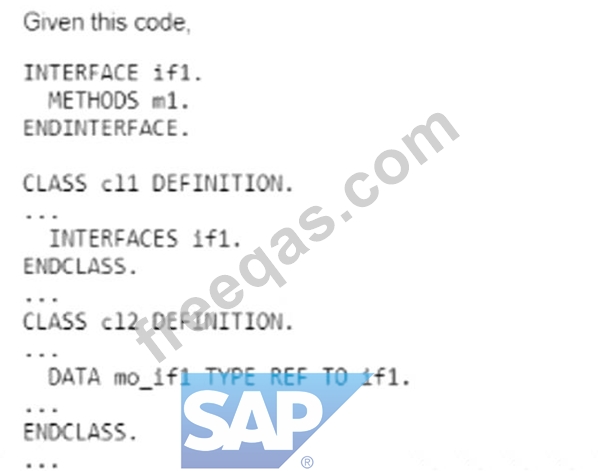
What are valid statements? Note: There are 3 correct answers to this question
Correct Answer: C,D,E
The following are the explanations for each statement: * C: This statement is valid. Class CL1 uses the interface. This is because class CL1 implements the interface ifl using the INTERFACES statement in the public section of the class definition. The INTERFACES statement makes the class compatible with the interface and inherits all the components of the interface. The class can then use the interface components, such as the method ml, by using the interface component selector ~, such as ifl~ml12 * E: This statement is valid. Class CL1 implements the interface. This is because class CL1 implements the interface ifl using the INTERFACES statement in the public section of the class definition. The INTERFACES statement makes the class compatible with the interface and inherits all the components of the interface. The class must then provide an implementation for the interface method ml in the implementation part of the class, unless the method is declared as optional or abstract12 * D: This statement is valid. In class CL2, the interface method is named ifl~ml. This is because class CL2 has a data member named m0_ifl of type REF TO ifl, which is a reference to the interface ifl. The interface ifl defines a method ml, which can be called using the reference variable m0_ifl. The interface method ml has the name ifl~ml in the class, where ifl is the name of the interface and the character ~ is the interface component selector12 The other statements are not valid, as they have syntax errors or logical errors. These statements are: * A: This statement is not valid. In class CL1, the interface method is named ifl~ml, not if-ml. This is because class CL1 implements the interface ifl using the INTERFACES statement in the public section of the class definition. The interface ifl defines a method ml, which can be called using the class name or a reference to the class. The interface method ml has the name ifl~ml in the class, where ifl is the name of the interface and the character ~ is the interface component selector. Using the character - instead of the character ~ will cause a syntax error12 * B: This statement is not valid. Class CL2 does not use the interface, but only has a reference to the interface. This is because class CL2 has a data member named m0_ifl of type REF TO ifl, which is a reference to the interface ifl. The interface ifl defines a method ml, which can be called using the reference variable m0_ifl. However, class CL2 does not implement the interface ifl, nor does it inherit the interface components. Therefore, class CL2 does not use the interface, but only references the interface12 References: INTERFACES - ABAP Keyword Documentation, CLASS - ABAP Keyword Documentation