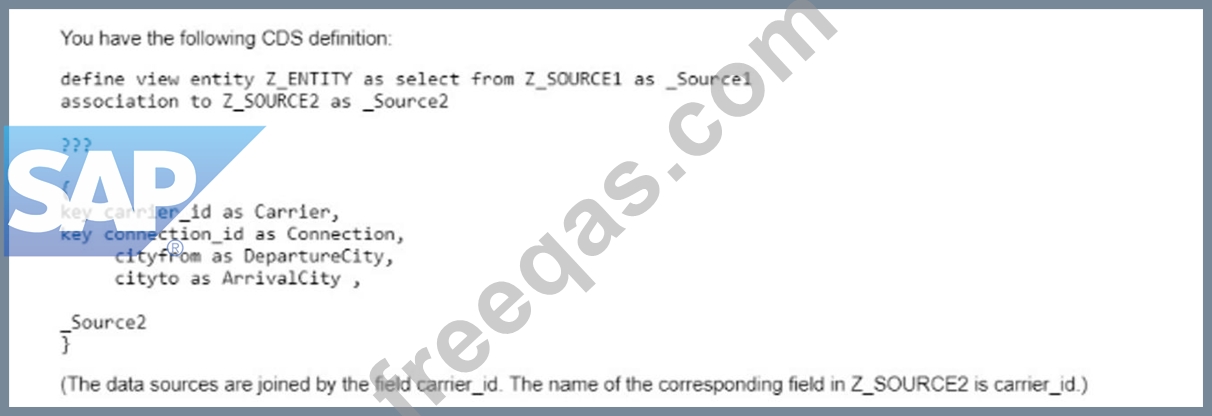
In a subclass subl you want to redefine a component of a superclass superl. How do you achieve this? Note: There are 2 correct answers to this question.
Correct Answer: A,C
To redefine a component of a superclass in a subclass, you need to do the following12: * You add the clause REDEFINITION to the component declaration in the subclass. This indicates that the component is inherited from the superclass and needs to be reimplemented in the subclass. The redefinition must happen in the same visibility section as the component declaration in the superclass. For example, if the superclass has a public method m1, the subclass must also declare the redefined method m1 as public with the REDEFINITION clause. * You implement the redefined component in the subclass. This means that you provide the new logic or behavior for the component that is specific to the subclass. The redefined component in the subclass will override the original component in the superclass when the subclass object is used. For example, if the superclass has a method m1 that returns 'Hello', the subclass can redefine the method m1 to return 'Hi' instead. You cannot do any of the following: * You implement the redefined component for a second time in the superclass. This is not possible, because the superclass already has an implementation for the component that is inherited by the subclass. The subclass is responsible for providing the new implementation for the redefined component, not the superclass. * You add the clause REDEFINITION to the component in the superclass. This is not necessary, because the superclass does not need to indicate that the component can be redefined by the subclass. The subclass is the one that needs to indicate that the component is redefined by adding the REDEFINITION clause to the component declaration in the subclass. References: 1: METHODS - REDEFINITION - ABAP Keyword Documentation - SAP Online Help 2: Redefining Methods - ABAP Keyword Documentation - SAP Online Help
Question 32
You want to define the following CDS view entity with an input parameter: Define view entity Z_CONVERT With parameters currency : ??? Which of the following can you use to replace "???? Note: There are 2 correct answers to this question.
Correct Answer: A,C
The possible replacements for "???" in the CDS view entity definition with an input parameter are A. built-in ABAP type and C. A data element. These are the valid types that can be used to specify the data type of an input parameter in a CDS view entity. A built-in ABAP type is a predefined elementary type in the ABAP language, such as abap.char, abap.numc, abap.dec, etc. A data element is a reusable semantic element in the ABAP Dictionary that defines the technical attributes and the meaning of a field12. For example: * The following code snippet defines a CDS view entity with an input parameter currency of type abap. cuky, which is a built-in ABAP type for currency key: Define view entity Z_CONVERT With parameters currency : abap.cuky as select from ... { ... } * The following code snippet defines a CDS view entity with an input parameter currency of type waers, which is a data element for currency key: Define view entity Z_CONVERT With parameters currency : waers as select from ... { ... } You cannot do any of the following: * B. A built-in ABAP Dictionary type: This is not a valid type for an input parameter in a CDS view entity. A built-in ABAP Dictionary type is a predefined elementary type in the ABAP Dictionary, such as CHAR, NUMC, DEC, etc. However, these types cannot be used directly in a CDS view entity definition. Instead, they have to be prefixed with abap. to form a built-in ABAP type, as explained above12. * D. A component of an ABAP Dictionary structure: This is not a valid type for an input parameter in a CDS view entity. A component of an ABAP Dictionary structure is a field that belongs to a structure type, which is a complex type that consists of multiple fields. However, an input parameter in a CDS view entity can only be typed with an elementary type, which is a simple type that has no internal structure12. References: 1: ABAP CDS - SELECT, parameter_list - ABAP Keyword Documentation - SAP Online Help 2: ABAP Data Types - ABAP Keyword Documentation - SAP Online Help
Question 33
What is the sequence priority when evaluating a logical expression?
Correct Answer: C
The sequence priority when evaluating a logical expression is C. A C B, which means NOT, AND, OR. This is the order of precedence of the Boolean operators in ABAP, which determines how the system implicitly parenthesizes all logical expressions that are not closed by explicit parentheses. The operator with the highest priority is evaluated first, and the operator with the lowest priority is evaluated last. The order of precedence of the Boolean operators in ABAP is as follows12: * NOT: The NOT operator is a unary operator that negates the logical expression that follows it. It has the highest priority and is evaluated before any other operator. For example, in the expression NOT a AND b, the NOT operator is applied to a first, and then the AND operator is applied to the result and b. * AND: The AND operator is a binary operator that returns true if both logical expressions on its left and right are true, and false otherwise. It has the second highest priority and is evaluated before the OR and EQUIV operators. For example, in the expression a AND b OR c, the AND operator is applied to a and b first, and then the OR operator is applied to the result and c. * OR: The OR operator is a binary operator that returns true if either or both logical expressions on its left and right are true, and false otherwise. It has the third highest priority and is evaluated after the NOT and AND operators, but before the EQUIV operator. For example, in the expression a OR b EQUIV c, the OR operator is applied to a and b first, and then the EQUIV operator is applied to the result and c. * EQUIV: The EQUIV operator is a binary operator that returns true if both logical expressions on its left and right have the same truth value, and false otherwise. It has the lowest priority and is evaluated after all other operators. For example, in the expression a AND b EQUIV c OR d, the EQUIV operator is applied to a AND b and c last, after the AND and OR operators are applied. References: 1: log_exp - Boolean Operators and Parentheses - ABAP Keyword Documentation - SAP Online Help 2: Logical Expressions (log_exp) - ABAP Keyword Documentation - SAP Online Help
Question 34
Refer to the Exhibit. Which of the following ON conditions must you insert in place of "???"?
Correct Answer: D
The correct ON condition that must be inserted in place of "???" is: ON Sprojection.carrier_id=Z_Source2.carrier_id This ON condition specifies the join condition between the CDS view Sprojection and the database table Z_Source2. The join condition is based on the field carrier_id, which is the primary key of both the CDS view and the database table. The ON condition ensures that only the records that have the same value for the carrier_id field are joined together1. The other options are not valid ON conditions, because: A) ON Z_Sourcel.camer_id = 7_Source2 carrier_id is not valid because Z_Sourcel and 7_Source2 are not valid data sources in the given code. There is no CDS view or database table named Z_Sourcel or 7_Source2. The correct names are Z_Source1 and Z_Source2. Moreover, the field camer_id is not a valid field in the given code. There is no field named camer_id in any of the data sources. The correct name is carrier_id. B) ON Sprojection Camer=Source2 carrier_id is not valid because Sprojection and Source2 are not valid data sources in the given code. There is no CDS view or database table named Sprojection or Source2. The correct names are Sprojection and Z_Source2. Moreover, the field Camer is not a valid field in the given code. There is no field named Camer in any of the data sources. The correct name is carrier_id. Furthermore, the ON condition is missing the dot (.) operator between the data source name and the field name, which is required to access the fields of the data source1. C) ON Sprojection. Carrier Source2.carrier is not valid because Carrier and carrier are not valid fields in the given code. There is no field named Carrier or carrier in any of the data sources. The correct name is carrier_id. Moreover, the ON condition is missing the dot (.) operator between the data source name and the field name, which is required to access the fields of the data source1.
Question 35
After you created a database table in the RESTful Application Programming model, what do you create next?
Correct Answer: B
After you created a database table in the RESTful Application Programming model (RAP), the next step is to create a projection view on the database table. A projection view is a CDS artefact that defines a view on one or more data sources, such as tables, views, or associations. A projection view can select, rename, or aggregate the fields of the data sources, but it cannot change the properties of the fields, such as whether they are read-only or not. The properties of the fields are inherited from the data sources or the behaviour definitions of the business objects12. For example: * The following code snippet defines a projection view ZI_AGENCY on the database table /DMO/AGENCY: define view ZI_AGENCY as select from /dmo/agency { key agency_id, agency_name, street, city, region, postal_code, country, phone_number, url } The projection view is used to expose the data of the database table to the service definition, which is the next step in the RAP. The service definition is a CDS artefact that defines the interface and the binding of a service. A service is a CDS entity that exposes the data and the functionality of one or more business objects as OData, InA, or SQL services. A service definition can specify the properties of the fields of a service, such as whether they are filterable, sortable, or aggregatable12. For example: * The following code snippet defines a service definition ZI_AGENCY_SRV that exposes the projection view ZI_AGENCY as an OData service: define service ZI_AGENCY_SRV { expose ZI_AGENCY as Agency; } You cannot do any of the following: * A. A metadata extension: A metadata extension is a CDS artefact that defines additional annotations for a CDS entity, such as a business object, a service, or a projection view. A metadata extension can specify the properties of the fields of a CDS entity for UI or analytical purposes, such as whether they are visible, editable, or hidden. However, a metadata extension is not the next step after creating a database table in the RAP, as it is not required to expose the data of the database table to the service definition. A metadata extension can be created later to customize the UI or analytical application that uses the service12. * C. A data model view: A data model view is a CDS artefact that defines a view on one or more data sources, such as tables, views, or associations. A data model view can select, rename, or aggregate the fields of the data sources, and it can also change the properties of the fields, such as whether they are read-only or not. The properties of the fields are defined by the annotations or the behaviour definitions of the data model view. A data model view is used to define the data model of a business object, which is a CDS entity that represents a business entity or concept, such as a customer, an order, or a product. However, a data model view is not the next step after creating a database table in the RAP, as it is not required to expose the data of the database table to the service definition. A data model view can be created later to define a business object that uses the database table as a data source12. * D. A service definition: A service definition is a CDS artefact that defines the interface and the binding of a service. A service is a CDS entity that exposes the data and the functionality of one or more business objects as OData, InA, or SQL services. A service definition can specify the properties of the fields of a service, such as whether they are filterable, sortable, or aggregatable. However, a service definition is not the next step after creating a database table in the RAP, as it requires a projection view * or a data model view to expose the data of the database table. A service definition can be created after creating a projection view or a data model view on the database table12. References: 1: ABAP CDS - Data Definitions - ABAP Keyword Documentation - SAP Online Help 2: ABAP CDS - Service Definitions - ABAP Keyword Documentation - SAP Online Help