In the assignment, data (gv_result) = 1/8. what will be the data type of gv_result?
Correct Answer: B
The data type of gv_result in the assignment data (gv_result) = 1/8 will be TYPE DECFLOAT 16. This is because the assignment operator (=) in ABAP performs an implicit type conversion from the source type to the target type, according to the following rules12: If the target type is specified explicitly, the source value is converted to the target type. If the target type is not specified explicitly, the source type is used as the target type, unless the source type is a literal or an expression, in which case the target type is determined by the following priority order: DECFLOAT34, DECFLOAT16, P, F, I, C, N, X, STRING, XSTRING. In this case, the target type is not specified explicitly, and the source type is an expression (1/8). Therefore, the target type is determined by the priority order, and the first matching type is DECFLOAT16, which is a decimal floating point type with 16 digits of precision12.
Question 37
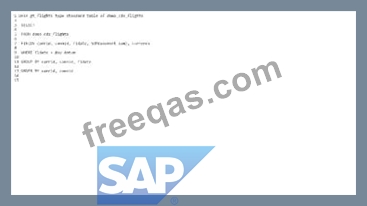
To adhere to the most recent ABAP SQL syntax conventions from SAP, on which line must you insert the "INTO TABLE @gt flights" clause to complete the SQL statement?
Correct Answer: B
Explanation To adhere to the most recent ABAP SQL syntax conventions from SAP, you must insert the "INTO TABLE @gt flights" clause on line #4 to complete the SQL statement. This is because the INTO or APPENDING clause should be specified immediately after the SELECT clause, according to the ABAP SQL syntax conventions1. The INTO or APPENDING clause defines the data object to which the results set of the SELECT statement is assigned. The data object can be an internal table, a work area, or an inline declaration. In this case, the data object is an internal table named gt_flights, which is created using the inline declaration operator @DATA. The inline declaration operator allows you to declare and create a data object in the same statement where it is used, without the need for a separate DATA statement2. The other lines are not suitable for inserting the "INTO TABLE @gt flights" clause, as they would violate the ABAP SQL syntax conventions or cause syntax errors. These lines are: #6: This line is not suitable for inserting the "INTO TABLE @gt flights" clause, as it would cause a syntax error. This is because the FROM clause must be specified before the INTO or APPENDING clause, according to the ABAP SQL syntax conventions1. The FROM clause defines the data sources from which the data is read, such as database tables, CDS view entities, or CDS DDIC-based views. In this case, the data source is the database table flights. #8: This line is not suitable for inserting the "INTO TABLE @gt flights" clause, as it would cause a syntax error. This is because the ORDER BY clause must be specified after the INTO or APPENDING clause, according to the ABAP SQL syntax conventions1. The ORDER BY clause defines the sort order of the results set of the SELECT statement. In this case, the results set is sorted by the fields carrid, connid, and fltime. #15: This line is not suitable for inserting the "INTO TABLE @gt flights" clause, as it would violate the ABAP SQL syntax conventions. This is because the INTO or APPENDING clause should be specified as close as possible to the SELECT clause, according to the ABAP SQL syntax conventions1. The INTO or APPENDING clause should not be separated from the SELECT clause by other clauses, such as the WHERE clause, the GROUP BY clause, the HAVING clause, the UNION clause, or the ORDER BY clause. This is to improve the readability and maintainability of the ABAP SQL statement. References: SELECT - ABAP Keyword Documentation, Inline Declarations - ABAP Keyword Documentation
Question 38
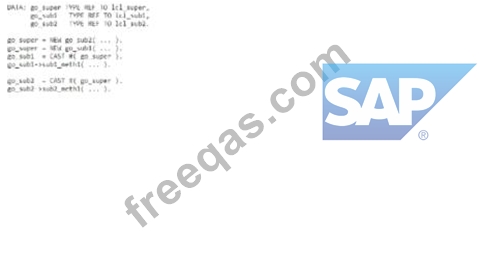
Exhibit: With Icl_super being superclass for Icl_subl and Icl_sub2 and with methods subl_methl and sub2_methl being subclass-specific methods of Id_subl or Icl_sub2, respectivel. What will happen when executing these casts? Note: There are 2 correct answers to this question
Correct Answer: A,D
Explanation The following are the explanations for each statement: A: This statement is correct. go_subl = CAST #(go_super) will not work. This is because go_subl is a data object of type REF TO cl_subl, which is a reference to the subclass cl_subl. go_super is a data object of type REF TO cl_super, which is a reference to the superclass cl_super. The CAST operator is used to perform a downcast or an upcast of a reference variable to another reference variable of a compatible type. A downcast is a conversion from a more general type to a more specific type, while an upcast is a conversion from a more specific type to a more general type. In this case, the CAST operator is trying to perform a downcast from go_super to go_subl, but this is notpossible, as go_super is not pointing to an instance of cl_subl, but to an instance of cl_super. Therefore, the CAST operator will raise an exception CX_SY_MOVE_CAST_ERROR at runtime12 B: This statement is incorrect. go_sub2 = CAST #(go_super) will work. go_subl = CAST #(go_super) will not work. This is because go_sub2 is a data object of type REF TO cl_sub2, which is a reference to the subclass cl_sub2. go_super is a data object of type REF TO cl_super, which is a reference to the superclass cl_super. The CAST operator is used to perform a downcast or an upcast of a reference variable to another reference variable of a compatible type. A downcast is a conversion from a more general type to a more specific type, while an upcast is a conversion from a more specific type to a more general type. In this case, the CAST operator is trying to perform a downcast from go_super to go_sub2, and this is possible, as go_super is pointing to an instance of cl_sub2, which is a subclass of cl_super. Therefore, the CAST operator will assign the reference of go_super to go_sub2 without raising an exception. However, the CAST operator will not work for go_subl, as explained in statement A12 C: This statement is incorrect. go_sub2 = CAST #(go_super) will work. go_sub2->sub2_meth1(...) will not work. This is because go_sub2 is a data object of type REF TO cl_sub2, which is a reference to the subclass cl_sub2. go_super is a data object of type REF TO cl_super, which is a reference to the superclass cl_super. The CAST operator is used to perform a downcast or an upcast of a reference variable to another reference variable of a compatible type. A downcast is a conversion from a more general type to a more specific type, while an upcast is a conversion from a more specific type to a more general type. In this case, the CAST operator is trying to perform a downcast from go_super to go_sub2, and this is possible, as go_super is pointing to an instance of cl_sub2, which is a subclass of cl_super. Therefore, the CAST operator will assign the reference of go_super to go_sub2 without raising an exception. However, the method call go_sub2->sub2_meth1(...) will not work, as sub2_meth1 is a subclass-specific method of cl_sub2, which is not inherited by cl_super. Therefore, the method call will raise an exception CX_SY_DYN_CALL_ILLEGAL_METHOD at runtime123 D: This statement is correct. go_subl->subl_meth1(...) will work. This is because go_subl is a data object of type REF TO cl_subl, which is a reference to the subclass cl_subl. subl_meth1 is a subclass-specific method of cl_subl, which is not inherited by cl_super. Therefore, the method call go_subl->subl_meth1(...) will work, as go_subl is pointing to an instance of cl_subl, which has the method subl_meth1123 References: NEW - ABAP Keyword Documentation, CAST - ABAP Keyword Documentation, Method Call - ABAP Keyword Documentation
Question 39
Which of the following actions cause an indirect change to a database table requiring a table conversion? Note: There are 2 correct answers to this question.
Correct Answer: A,C
The following are the explanations for each action: * A: Renaming a field in a structure that is included in the table definition causes an indirect change to the database table, as the field name in the table is derived from the structure. This change requires a table conversion, as the existing data in the table must be copied to a new table with the new field name, and the old table must be deleted. * B: Changing the field labels of a data element that is used in the table definition does not cause an indirect change to the database table, as the field labels are only used for documentation and display purposes. This change does not require a table conversion, as the existing data in the table is not affected by the change. * C: Deleting a field from a structure that is included in the table definition causes an indirect change to the database table, as the field is removed from the table as well. This change requires a table conversion, as the existing data in the table must be copied to a new table without the deleted field, and the old table must be deleted. * D: Shortening the length of a domain used in a data element that is used in the table definition causes an indirect change to the database table, as the field length in the table is derived from the domain. This change requires a table conversion, as the existing data in the table must be checked for compatibility with the new field length, and any data that exceeds the new length must be truncated or rejected. References: Converting Database Tables - ABAP Keyword Documentation, Adjustment of Database Structures - ABAP Keyword Documentation
Question 40
Which patterns raise an exception? Note: There are 3 correct answers to this question.
Correct Answer: A,C,E
Explanation The patterns that raise an exception are those that use the constructor operator EXACT to perform a lossless assignment or calculation, but the result cannot be converted to the target data type without data loss. The following are the explanations for each pattern: A: This pattern raises the exception CX_SY_CONVERSION_LOST because the result of the calculation 2 * 3 is 6, which cannot be assigned to a packed number with two decimal places without losing the integer part. The operator -U is used to perform a lossless calculation with the calculation type decfloat34. B: This pattern does not raise an exception because the result of the substring expression gco_string+5(5) is '6789A', which can be assigned to a string without data loss. The operator EXACT # is used to perform a lossless assignment with the data type of the argument. C: This pattern raises the exception CX_SY_CONVERSION_LOST because the result of the substring expression gco_string+5(6) is '6789AB', which cannot be assigned to a character field with length 5 without losing the last character. The operator EXACT is used to perform a lossless assignment with the data type of the target field. D: This pattern does not raise an exception because the result of the calculation 2 / 2 is 1, which can be assigned to a packed number with three decimal places without data loss. The operator -U is used to perform a lossless calculation with the calculation type decfloat34. E: This pattern raises the exception CX_SY_CONVERSION_ERROR because the constant gco_date contains an invalid value '20331233' for a date data type, which cannot be converted to a valid date. The operator EXACT is used to perform a lossless assignment with the data type of the target field. References: EXACT - Lossless Operator - ABAP Keyword Documentation, Lossless Assignments - ABAP Keyword Documentation