You, as the Chief Enterprise Architect of Wanderlust GmbH, have been trying to formulate the Business Strategy Map. You are currently working on the strategic objective to "Increase supply reliability of Lithium batteries". Arrange the elements of the Business Strategy Map into the right order that shows the dependencies between these elements.
Correct Answer:
Question 42
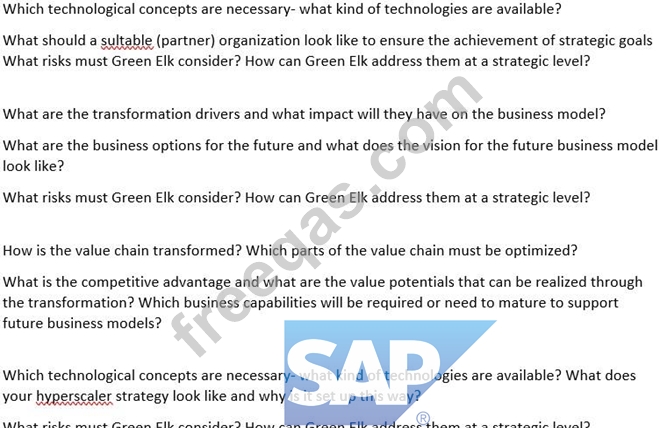
Green Elk & Company is the world's leading manufacturer of agricultural and forestry machinery. The former company slogan "Elk always runs has recently been changed to "Elk feeds the world" One of Green Elk's strategic goals is to increase its revenue in the emerging markets of China, India, and other parts of Asia by 80 % within three years. This requires a new business model that caters to significantly smaller farms with limited budgets. You are the Chief Enterprise Architect and the CIO asked you to conduct interviews with the key stakeholders of Green Elk to assess the business strategy. You are planning to interview the owner of the business unit of finished goods. Which of the following sets of questions would you ask?
Correct Answer: B
When assessing the business strategy as the Chief Enterprise Architect, the following set of questions would be pertinent to ask the owner of the business unit of finished goods: What are the transformation drivers, and what impact will they have on the business model? Understanding the forces driving change is critical to aligning the business strategy and the enterprise architecture. What are the business options for the future, and what does the vision for the future business model look like? This will provide insights into potential pathways for growth and innovation. What risks must Green Elk consider, and how can Green Elk address them at a strategic level? Risk assessment and mitigation are essential components of strategic planning, particularly in the context of ambitious growth targets. This set of questions is designed to uncover the strategic direction of the business unit and to ensure that the enterprise architecture will support the achievement of strategic goals. Reference = The methodology for conducting such stakeholder interviews is encompassed within the SAP Enterprise Architecture Framework and the business strategy assessment process, which includes stakeholder engagement and alignment with business objectives.
Question 43
Which programming model would you suggest that ABAP developers use when SAP extensions should be built following the clean-core strategy?
Correct Answer: C
For ABAP developers looking to build SAP extensions that adhere to the clean-core strategy, the recommended programming model is the RESTful Application Programming (RAP) model. RAP is designed specifically for developing SAP Fiori applications and services with a focus on maintaining a clean and stable core while allowing for extensions. RESTful Application Programming (RAP) offers a modern ABAP programming model that supports development both in the cloud and on-premise. It is centered around services that are exposed through RESTful APIs, making it ideal for creating clean, decoupled extensions that do not interfere with the core S/4HANA system. This approach supports the clean-core strategy by enabling developers to create extensions that communicate with the core system via stable, well-defined APIs without modifying the core system itself. Option A, SAP Cloud Application Programming (CAP), although a robust model for cloud-native application development, is not specific to ABAP and does not inherently align with the ABAP developer environment. Option B, the SAP Classic Extensibility model, often involves direct modifications to the core system, which contradicts the principles of the clean-core strategy. : SAP documentation on RESTful Application Programming Model. SAP community articles and guides on developing with RAP.
Question 44
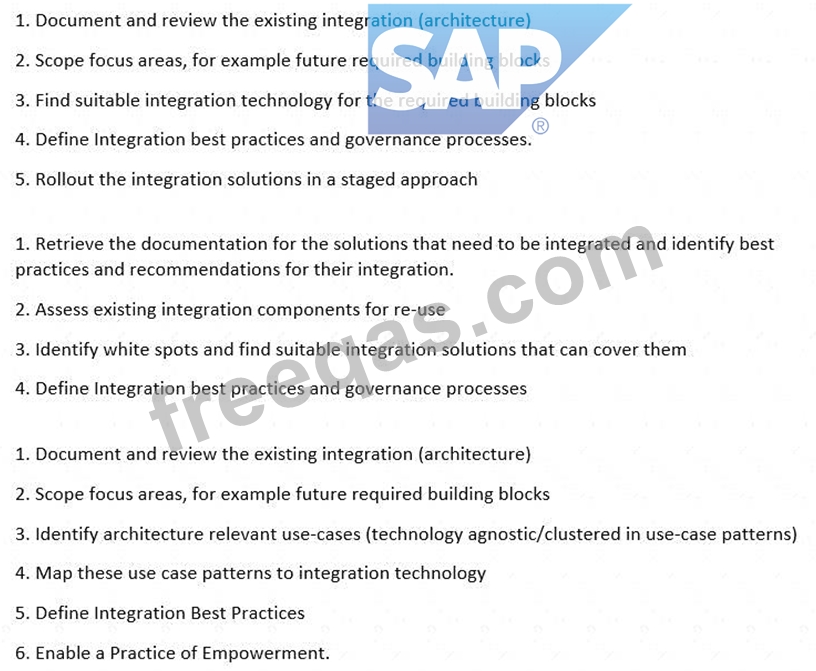
Your company adapts SAP's Integration Solution Advisory Methodology (ISA-M) as an Integration Solution Playbook. In your role as Lead Enterprise Architect, you are asked to decide which integration approach to take for this solution. Which of the following approaches is recommended by SAP ISA-M for identifying an integration solution and strategy?
Correct Answer: C
Explanation The best answer for the integration approach to take for this solution is C. According to the SAP Integration Solution Advisory Methodology (ISA-M), which is a methodology offered by SAP that helps enterprise architects define an integration strategy for their organizations and derive related integration guidelines, the recommended approach for identifying an integration solution and strategy is: Document and review the existing integration (architecture). This step involves documenting and analyzing the current state of the integration landscape, including the integration scenarios, technologies, patterns, standards, and governance processes. The goal is to understand the strengths and weaknesses of the existing integration (architecture) and identify the gaps and improvement areas. Scope focus areas, for example future required building blocks. This step involves defining and prioritizing the focus areas for the integration project, such as new or changed business requirements, integration scenarios, or technologies. The focus areas are derived from the gaps and improvement areas identified in the previous step, as well as from the business goals and drivers of the organization. The focus areas are also mapped to future required building blocks, which are logical components that represent the desired capabilities or functionalities of the integration solution. Identify architecture relevant use-cases (technology agnostic/clustered in use-case patterns). This step involves identifying and describing the use-cases that are relevant for the integration project, such as process integration, data integration, user integration, or thing integration. The use-cases are technology agnostic, meaning that they do not specify any particular technology or service for implementation. The use-cases are also clustered in use-case patterns, which are generic templates that capture the common characteristics and requirements of similar use-cases. Map these use case patterns to integration technology. This step involves mapping the use-case patterns to suitable integration technologies or services that can implement them. The mapping is based on a set of criteria and decision tables that consider various aspects of the use-case patterns, such as complexity, performance, security, or scalability. The mapping also takes into account the existing or planned integration technologies or services in the organization's landscape. Define Integration Best Practices. This step involves defining and documenting the best practices and guidelines for designing, developing, testing, deploying, monitoring, and governing the integration solutions. The best practices and guidelines are based on SAP's recommendations and industry standards, as well as on the organization's specific needs and preferences. The best practices and guidelines also cover various aspects of the integration project, such as naming conventions, error handling, logging, tracing, or versioning. Enable a Practice of Empowerment. This step involves enabling and empowering the different roles and personas involved in the integration project, such as integration architects, developers, testers, operators, or business users. The goal is to foster a culture of collaboration and innovation among the stakeholders, and to provide them with the necessary skills, tools, and resources to execute their tasks effectively and efficiently. The other options (A and B) are not correct for the integration approach to take for this solution, because they either skip or misrepresent some of the steps in the SAP Integration Solution Advisory Methodology (ISA-M). For example: Option A is not correct because it does not include identifying architecture relevant use-cases (technology agnostic/clustered in use-case patterns), which is a key step to define and categorize the integration requirements in a generic way. It also does not include enabling a practice of empowerment, which is a key step to ensure the success and sustainability of the integration project. Option B is not correct because it does not include documenting and reviewing the existing integration (architecture), which is a key step to understand the current state of the integration landscape and identify the gaps and improvement areas. It also does not include scoping focus areas or mapping use case patterns to integration technology, which are key steps to define and prioritize the future state of the integration solution. For more information on the SAP Integration Solution Advisory Methodology (ISA-M) and its steps, you can refer to SAP Integration Solution Advisory Methodology: Template version 4.0 available now | SAP Blogs or Integration Solution Advisory Methodology (ISA-M): Define Integration Guidelines for Your Organization | SAP Blogs.
Question 45
The online marketing channel is targeted only to individual customers, who should be able to choose any of the 50 combinations that Wanderlust offers for its electric cars. Every confirmed online order must be first checked for ready stock availability and, if unavailable, must go for production scheduling. As Chief Enterprise Architect of Wanderlust, along with the SAP Enterprise Architect, you have identified Lead to Cash (L2C) as the key E2E process. However, you have found out that the SAP Reference Business Architecture content has several Business Process Variants of the L2C process, from which you are supposed to choose one suitable variant for Wanderlust's product range and business model. Which of the following combinations of L2C Business Process Variants and business reasons are the most suitable? Note: There are 2 correct answers to this question.