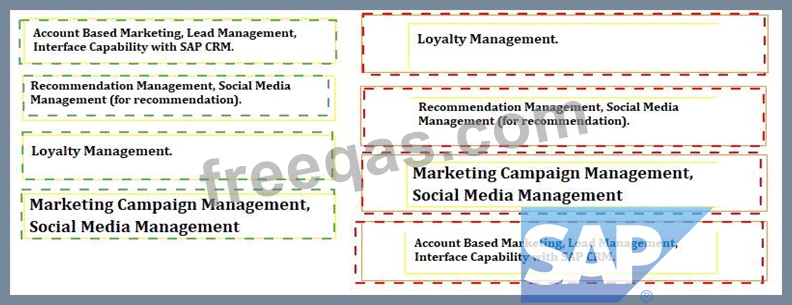
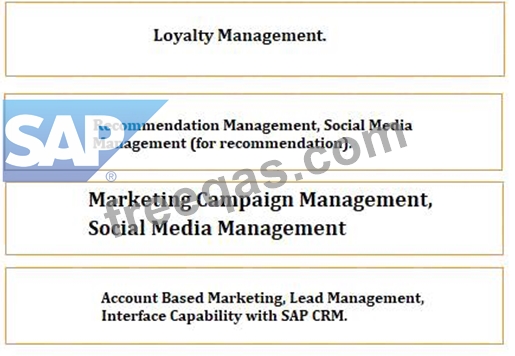
Select the most appropriate sequence of critical Business Capabilities for the Business Architecture Roadmap.
Correct Answer:
Question 22
Which integration styles does SAP's Integration Advisory Methodology (ISA-M) cover in general?
Correct Answer: A
The Integration Advisory Methodology (ISA-M) is a framework that helps organizations to design, build, and manage their integration landscape. ISA-M covers a wide range of integration styles, including: Process Integration: This style of integration involves the integration of business processes across different systems and applications. Data Integration: This style of integration involves the integration of data from different sources into a single data repository. Analytics Integration: This style of integration involves the integration of data from different sources for the purpose of analytics. User Integration: This style of integration involves the integration of user interfaces from different systems and applications. Thing Integration: This style of integration involves the integration of things, such as sensors and actuators, with other systems and applications. ISA-M also includes a number of other integration styles, such as event-driven integration, service-oriented integration, and enterprise application integration. By covering a wide range of integration styles, ISA-M provides organizations with a flexible framework that can be used to meet their specific integration needs. SAP's Integration Solution Advisory Methodology (ISA-M) is a framework that helps enterprise architects to define and execute an integration strategy for their organization. ISA-M covers five integration styles that represent different aspects of integration in a hybrid landscape. These integration styles are3: Process Integration: This integration style enables end-to-end business processes across different applications and systems, such as SAP S/4HANA, SAP SuccessFactors, or third-party solutions. Process integration typically involves orchestrating or choreographing multiple services or APIs to achieve a business outcome. Data Integration: This integration style enables data exchange and synchronization between different data sources and targets, such as SAP HANA, SAP Data Warehouse Cloud, or third-party databases. Data integration typically involves extracting, transforming, and loading (ETL) data to support analytical or operational scenarios. Analytics Integration: This integration style enables data visualization and exploration across different data sources and targets, such as SAP Analytics Cloud, SAP BusinessObjects BI Platform, or third-party tools. Analytics integration typically involves creating dashboards, reports, or stories to provide insights and recommendations for decision making. User Integration: This integration style enables user interaction and collaboration across different applications and systems, such as SAP Fiori Launchpad, SAP Jam, or third-party portals. User integration typically involves creating consistent and seamless user experiences that integrate multiple UI technologies and frameworks. Thing Integration: This integration style enables device connectivity and management across different applications and systems, such as SAP IoT, SAP Edge Services, or third-party platforms. Thing integration typically involves connecting physical devices or sensors to the cloud or the edge and enabling data ingestion, processing, and action. Verified Reference: 3: https://help.sap.com/docs/btp/architecture-and-development-guide-for-industry-cloud-solutions/runtimes-environments-and-programming-models
Question 23
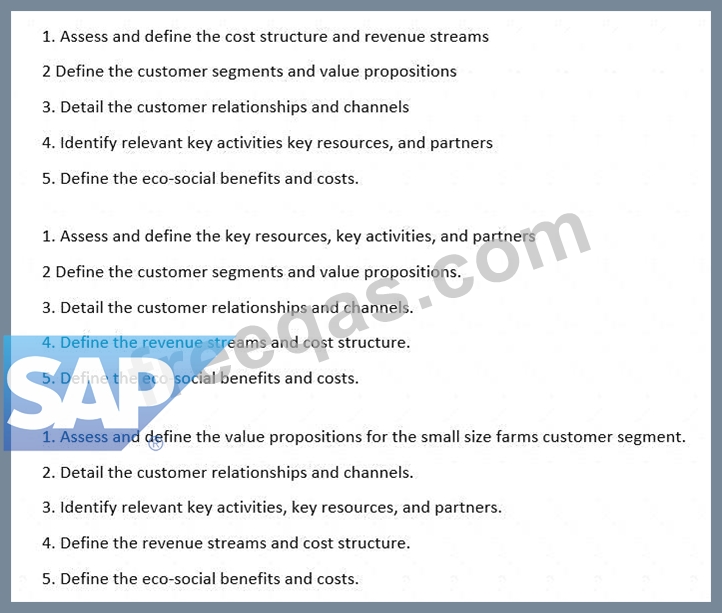
Green Elk & Company is the world's leading manufacturer of agricultural and forestry machinery. The former company slogan "Elk always runs" has recently been changed to "Elk feeds the world". One of Green Elk's strategic goals is to increase its revenue in the emerging markets of China, India, and other parts of Asia by 80 % within three years. This requires a new business model that caters to significantly smaller farms with limited budgets. You are the Chief Enterprise Architect and the CIO asks you to assess the now business model for smaller farms with smaller budgets. By applying the Sustainable Business Model Canvas, which sequence of steps is best practice?
Correct Answer: C
Explanation According to the Sustainable Business Model Canvas, which is a tool that helps entrepreneurs to design and communicate their business models in a sustainable way, the recommended sequence of steps is: Assess and define the value propositions for the small size farms customer segment. This step involves defining and describing the products or services that Green Elk & Company offers to its target customers, and how they create value for them. The value propositions should address the needs, problems, or desires of the customers, and highlight the benefits or advantages of Green Elk & Company's solutions over the alternatives. Detail the customer relationships and channels. This step involves defining and describing how Green Elk & Company interacts with its customers, and how it reaches and delivers its products or services to them. The customer relationships should reflect the type and level of engagement that Green Elk & Company wants to establish and maintain with its customers, such as self-service, personal assistance, or community. The channels should reflect the most effective and efficient ways to communicate and distribute Green Elk & Company's value propositions to its customers, such as online platforms, physical stores, or partners. Identify relevant key activities, key resources, and partners. This step involves identifying and describing the main activities, resources, and partners that Green Elk & Company needs to perform and leverage to create and deliver its value propositions to its customers. The key activities should reflect the most important tasks or processes that Green Elk & Company undertakes to execute its business model, such as production, marketing, or sales. The key resources should reflect the most essential assets or inputs that Green Elk & Company requires to execute its business model, such as human, physical, financial, or intellectual resources. The key partners should reflect the most strategic relationships or collaborations that Green Elk & Company establishes with other entities to execute its business model, such as suppliers, distributors, or competitors. Define the revenue streams and cost structure. This step involves defining and describing how Green Elk & Company generates income from its customers, and how much it spends to execute its business model. The revenue streams should reflect the sources and mechanisms of income that Green Elk & Company obtains from selling its products or services to its customers, such as sales, subscriptions, or fees. The cost structure should reflect the types and amounts of expenses that Green Elk & Company incurs to execute its business model, such as fixed costs, variable costs, or economies of scale. Define the eco-social benefits and costs. This step involves defining and describing how Green Elk & Company contributes to or affects the environment and society through its business model. The eco-social benefits should reflect the positive impacts or externalities that Green Elk & Company creates for the environment and society through its products or services, such as reducing emissions, improving health, or enhancing education. The eco-social costs should reflect the negative impacts or externalities that Green Elk & Company causes for the environment and society through its products or services, such as increasing waste, depleting resources, or harming biodiversity. The other options (A and B) are not correct for the sequence of steps to apply the Sustainable Business Model Canvas, because they either skip or misrepresent some of the steps in this tool. For example: Option A is not correct because it does not include assessing and defining the value propositions for the small size farms customer segment, which is a crucial step to understand and communicate how Green Elk & Company creates value for its customers. It also suggests defining the cost structure and revenue streams before defining the customer segments and value propositions, which is not a logical order since the latter determine the former. Option B is not correct because it does not include identifying relevant key activities, key resources, and partners, which are important aspects of executing a business model. It also suggests retrieving the documentation for the solutions that need to be integrated instead of assessing and defining the value propositions for the small size farms customer segment, which is not relevant for designing a new business model. For more information on the Sustainable Business Model Canvas and its steps, you can refer to The Sustainable Business Canvas or Sustainable Business Model Canvas: A Review And Framework Development.
Question 24
As part of the mapping of a Business Architecture to the Solution Architecture, an Environment & Location Diagram must be developed in the Technology Architecture phase. In this context, numerous architecture decisions have to be made. Among other things, you must check which SAP BTP services and which SAP SaaS solutions are available as part of the Solution Architecture in which data center of the desired hyperscaler. How do you go about this validation?
Correct Answer: B
Explanation According to the SAP Discovery Center 1 and the SAP Trust Center 2, the steps involved in this validation are: Use the SAP Discovery Center to check which of the selected SAP BTP services are offered by which hyperscaler. The SAP Discovery Center is a platform that provides access to SAP BTP services, events, and related resources, and helps you to implement your use cases on SAP BTP with step-by-step guidance and support from topic experts and SAP Community. In the Service Catalog section of the SAP Discovery Center, you can browse and filter the available SAP BTP services by category, region, or hyperscaler. You can also compare the features and pricing of different services, and learn how to use them in your projects. Use the SAP Trust Center to check in which data center the involved SAP SaaS solutions are available. The SAP Trust Center is a platform that provides information on cloud performance, security, privacy, and compliance. In the Certification and Compliance section of the SAP Trust Center, you can find certificates, reports, and attestations that show how SAP meets various industry standards and regulatory requirements. You can also filter the documents by solution, region, or hyperscaler, and download them for your reference. The other options (A and C) are not correct for how to validate the availability of SAP BTP services and SAP SaaS solutions in the desired hyperscaler's data center, because they either do not exist or do not provide the required information. For example: Option A is not correct because there is no such platform as SAP Business Accelerator Hub (api.sap.com) that provides all the required information regarding SAP BTP service and SAP SaaS solution availability for each hyperscaler. The correct name of the platform is SAP API Business Hub (api.sap.com), which is a platform that provides access to SAP APIs, events, and related resources, but it does not provide any information on the availability of SAP BTP services or SAP SaaS solutions for each hyperscaler or data center. Option C is not correct because the SAP Discovery Center does not provide any information on the availability of SAP SaaS solutions for each hyperscaler or data center. The SAP Discovery Center only provides information on the availability of SAP BTP services for each hyperscaler or region, but not for specific data centers. To check the availability of SAP SaaS solutions for each data center, you need to use the SAP Trust Center instead.
Question 25
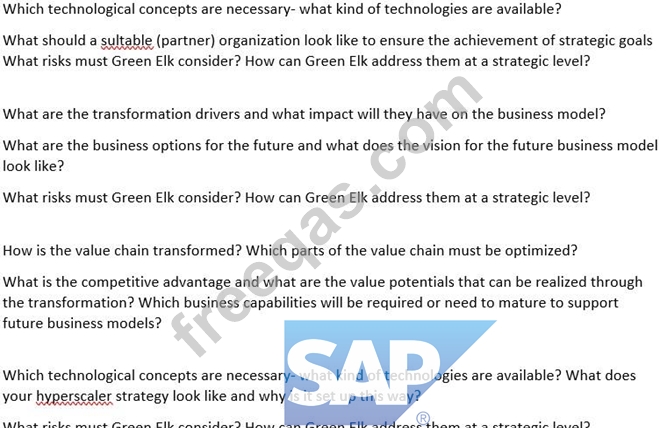
Green Elk & Company is the world's leading manufacturer of agricultural and forestry machinery. The former company slogan "Elk always runs has recently been changed to "Elk feeds the world" One of Green Elk's strategic goals is to increase its revenue in the emerging markets of China, India, and other parts of Asia by 80 % within three years. This requires a new business model that caters to significantly smaller farms with limited budgets. You are the Chief Enterprise Architect and the CIO asked you to conduct interviews with the key stakeholders of Green Elk to assess the business strategy. You are planning to interview the owner of the business unit of finished goods. Which of the following sets of questions would you ask?
Correct Answer: B
When assessing the business strategy as the Chief Enterprise Architect, the following set of questions would be pertinent to ask the owner of the business unit of finished goods: What are the transformation drivers, and what impact will they have on the business model? Understanding the forces driving change is critical to aligning the business strategy and the enterprise architecture. What are the business options for the future, and what does the vision for the future business model look like? This will provide insights into potential pathways for growth and innovation. What risks must Green Elk consider, and how can Green Elk address them at a strategic level? Risk assessment and mitigation are essential components of strategic planning, particularly in the context of ambitious growth targets. This set of questions is designed to uncover the strategic direction of the business unit and to ensure that the enterprise architecture will support the achievement of strategic goals. = The methodology for conducting such stakeholder interviews is encompassed within the SAP Enterprise Architecture Framework and the business strategy assessment process, which includes stakeholder engagement and alignment with business objectives.