Refer to Exhibit.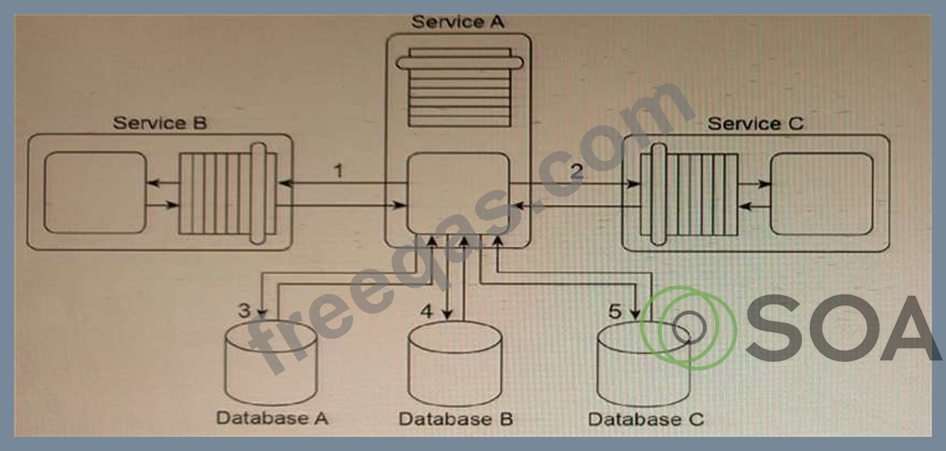
Service A is an entity service that provides a set of generic and reusable service capabilities. In order to carry out the functionality of any one of its service capabilities, Service A is required to compose Service B (1) and Service C (2), and Service A is required to access Database A (3), Database B (4), and Database C (5). These three databases are shared by other applications within the IT enterprise.
All of service capabilities provided by Service A are synchronous, which means that for each request a service consumer makes, Service A is required to issue a response message after all of the processing has completed.
Service A is one of many entity services that reside In a highly normalized service Inventory. Because Service A provides agnostic logic, it is heavily reused and is currently part of many service compositions.
You are told that Service A has recently become unstable and unreliable. The problem has been traced to two issues with the current service architecture. First, Service B, which Is also an entity service, is being increasingly reused and has itself become unstable and unreliable. When Service B fails, the failure is carried over to Service A.
Secondly, shared Database B has a complex data model. Some of the queries issued by Service A to shared Database B can take a very long time to complete.
What steps can be taken to solve these problems without compromising the normalization of the service inventory?
Refer to Exhibit.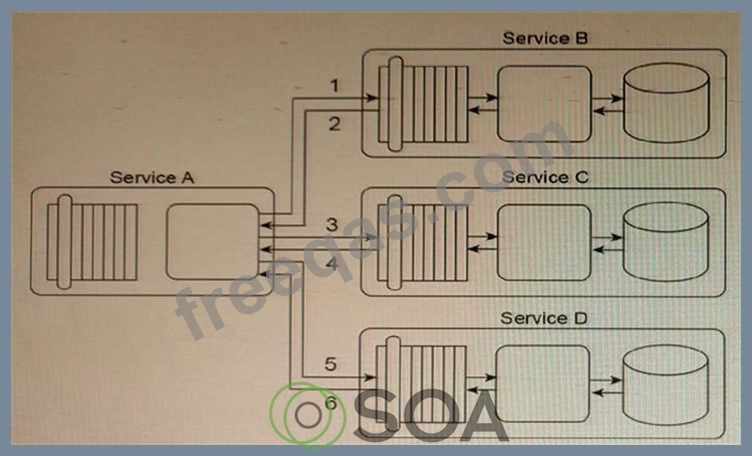
Service A is a task service that is required to carry out a series of updates to a set of databases in order to complete a task. To perform the database updates. Service A must interact with three other services that each provides standardized data access capabilities.
Service A sends its first update request message to Service B (1), which then responds with a message containing either a success or failure code (2). Service A then sends its second update request message to Service C (3), which also responds with a message containing either a success or failure code (4). Finally, Service A sends a request message to Service D (5), which responds with its own message containing either a success or failure code (6).
Services B, C and D are agnostic services that are reused and shared by multiple service consumers. This has caused unacceptable performance degradation for the service consumers of Service A as it is taking too long to complete its overall task. You've been asked to enhance the service composition architecture so that Service A provides consistent and predictable runtime performance. You are furthermore notified that a new type of data will be introduced to all three databases. It is important that this data is exchanged in a standardized manner so that the data model used for the data in inter-service messages is the same.
What steps can be taken to fulfill these requirements?
Refer to Exhibit.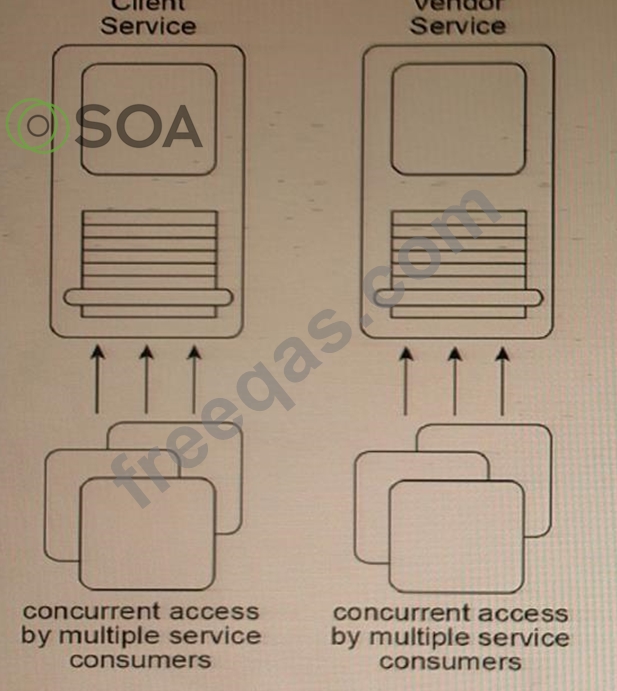
The Client and Vendor services are agnostic services that are both currently part of multiple service compositions. As a result, these services are sometimes subjected to concurrent access by multiple service consumers.
The Client service primarily provides data access logic to a client database but also coordinates with other services to determine a clients credit rating. The Vendor service provides some data access logic but can also generate various dynamic reports based on specialized business requirements.
After reviewing historical statistics about the runtime activity of the two services, it is discovered that the Client service is serving an ever-increasing number of service consumers. It is regularly timing out, which in turn increases its call rate as service consumers retry their requests. The Vendor service occasionally has difficulty meeting its service-level agreement (SLA) and when this occurs, penalties are assessed.
Recently, the custodian of the Client service was notified that the Client service will be made available to new service consumers external to its service inventory. The Client service will be providing free credit rating scores to any service consumer that connects to the service via the Internet. The Vendor service will remain internal to the service inventory and will not be exposed to external access.
Which of the following statements describes a solution that addresses these issues and requirements?
Refer to Exhibit.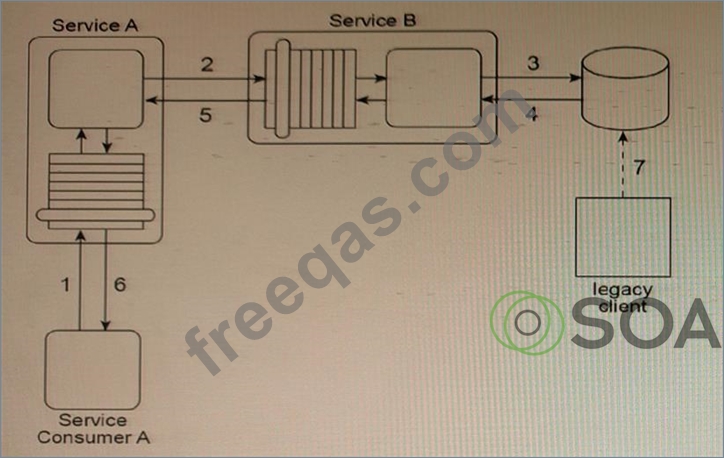
Service A is an entity service that provides a Get capability which returns a data value that is frequently changed.
Service Consumer A invokes Service A in order to request this data value (1). For Service A to carry out this request, it must invoke Service B (2), a utility service that interacts (3, 4) with the database in which the data value is stored. Regardless of whether the data value changed, Service B returns the latest value to Service A (5), and Service A returns the latest value to Service Consumer A (6).
The data value is changed when the legacy client program updates the database (7). When this change will occur is not predictable. Note also that Service A and Service B are not always available at the same time.
Any time the data value changes, Service Consumer A needs to receive It as soon as possible. Therefore, Service Consumer A initiates the message exchange shown In the figure several times a day. When it receives the same data value as before, the response from Service A Is ignored. When Service A provides an updated data value, Service Consumer A can process it to carry out its task.
The current service composition architecture is using up too many resources due to the repeated invocation of Service A by Service Consumer A and the resulting message exchanges that occur with each invocation.
What steps can be taken to solve this problem?
Refer to Exhibit.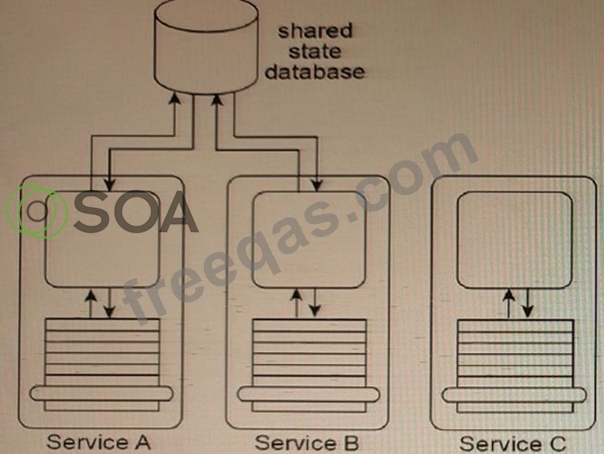
Services A, B, and C are non-agnostic task services. Service A and Service B use the same shared state database to defer their state data at runtime.
An assessment of the three services reveals that each contains some agnostic logic that cannot be made available for reuse because it is bundled together with non-agnostic logic.
The assessment also determines that because Service A, Service B and the shared state database are each located in physically separate environments, the remote communication required for Service A and Service B to interact with the shared state database is causing an unreasonable decrease in runtime performance.
How can the application of the Orchestration pattern improve this architecture?

