A Mule application is designed to periodically synchronize 1 million records from a source system to a SaaS target system using a Batch Job scope. The current application design includes using the default Batch Job scope to process records while managing high throughput requirements.
However, what actually happens is the application takes too long to process records even with the application deployed to a customer-hosted cluster of two Mule runtime 4.3 instances.
What must occur to achieve the required high throughput, considering the Mule runtimes' CPU and memory requirements are met with no expected contentions from other applications running under the same cluster?
What is an effective method to analyze and counteract potential security vulnerabilities in Mule applications?
Why is it important to differentiate between disaster recovery and high availability? (Choose Two)
Which technologies are essential for event-driven API integration in modern architectures? (Choose Two)
Refer to the exhibit.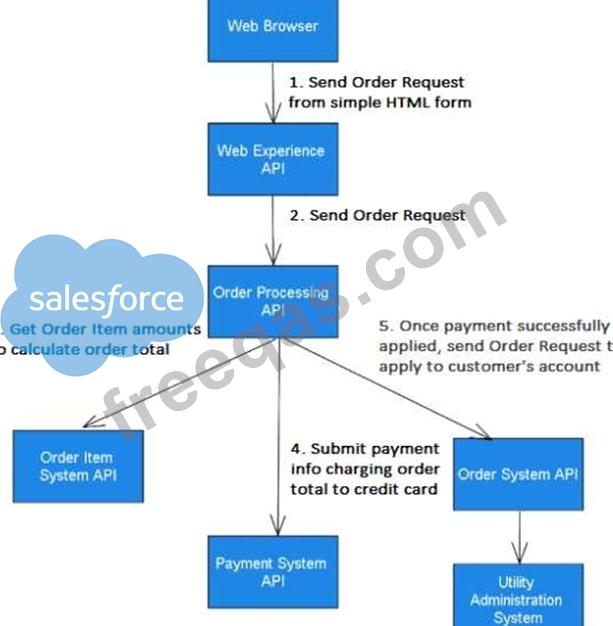
A telecommunications company receives orders (bill payments) from customers who submit a simple HTML form (no JavaScript or Web Assembly). Currently the process is synchronous and the customer is notified after everything is complete. The requirement is that the customer is notified of payment (charging the customer's credit card) through the response to the browser, but the customer can also be notified when the order is applied to the customer's account at a later time. Due to an increase in customers, the system has been unable to handle the load and the solution has been experiencing performance and reliability issues. Which request point could be replaced with an event-driven API using a JMS queue to help mitigate the performance issues, increase the fault tolerance, and meet the requirements?
Enter your email address to download Salesforce.Mule-Arch-202.v2026-10-13.q64 Dumps

