A company is planning on sending orders from Salesforce to a fulfillment system. The integration architect has been asked to plan for the integration.
Which two questions should the integration architect consider? Choose 2 answers
How do redelivery policies enhance message reliability in Mule applications? (Choose Two)
A client system sends marketing-related data to a legacy system within the company data center. The Center for Enablement team has identified that this marketing data has no reuse by any other system.
How should the APIs be designed most efficiently using API-led connectivity?
Refer to the exhibit.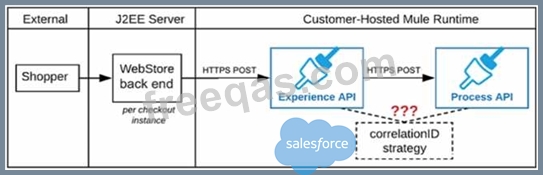
A shopping cart checkout process consists of a web store back end that sends a sequence of HTTPS POST requests to an Experience API, which in turn invokes a Process API using HTTPS. The web store back end executes in a Java EE application server. All API implementations are Mule applications executing in a customer-hosted Mule runtime. End-to-end correlation of all HTTP requests and responses belonging to each checkout instance is required. This is to be done through a common correlation ID so that all log entries written by the web store back end, Experience API implementation, and Process API implementation include the same correlation ID for all requests and responses belonging to the same checkout instance. What is the most efficient way (using the least amount of custom coding or configuration) for the web store back end and the implementations of the Experience API and Process API to participate in end-to-end correlation of the API invocations for each checkout instance?
Enter your email address to download Salesforce.Mule-Arch-202.v2026-10-13.q64 Dumps

