FreeQAs
 Request Exam  Contact
  • Home
  • View All Exams
  • New QA's
  • Upload
PRACTICE EXAMS:
  • Oracle
  • Fortinet
  • IBM
  • Juniper
  • Microsoft
  • Cisco
  • Citrix
  • CompTIA
  • VMware
  • ISC
  • SAP
  • EMC
  • PMI
  • HP
  • Salesforce
  • Other
  • Oracle
    Oracle
  • Fortinet
    Fortinet
  • IBM
    IBM
  • Juniper
    Juniper
  • Microsoft
    Microsoft
  • Cisco
    Cisco
  • Citrix
    Citrix
  • CompTIA
    CompTIA
  • VMware
    VMware
  • ISC
    ISC
  • SAP
    SAP
  • EMC
    EMC
  • PMI
    PMI
  • HP
    HP
  • Salesforce
    Salesforce
  1. Home
  2. Salesforce Certification
  3. MuleSoft-Integration-Architect-I Exam
  4. Salesforce.MuleSoft-Integration-Architect-I.v2026-03-30.q190 Dumps
  • ««
  • «
  • …
  • 25
  • 26
  • 27
  • 28
  • 29
  • 30
  • 31
  • 32
  • 33
  • 34
  • …
  • »
  • »»
Download Now

Question 141

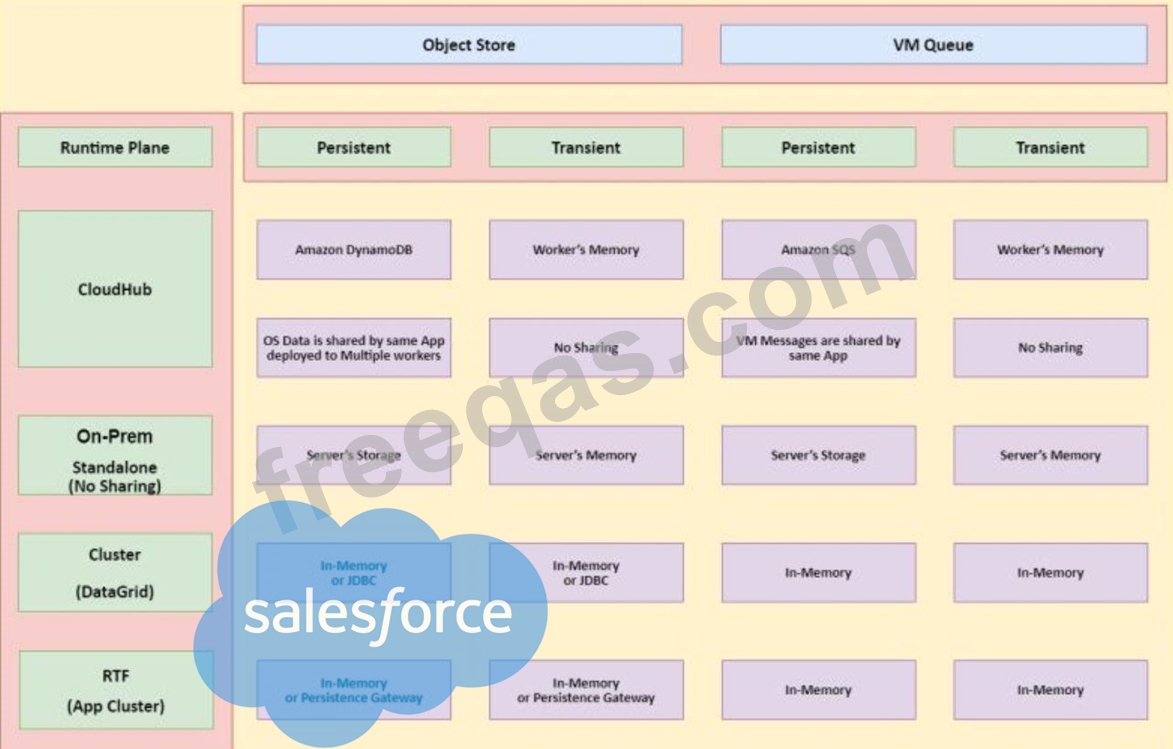
A Mule application name Pub uses a persistence object store. The Pub Mule application is deployed to Cloudhub and it configured to use Object Store v2.
Another Mule application name sub is being developed to retrieve values from the Pub Mule application persistence object Store and will also be deployed to cloudhub.
What is the most direct way for the Sub Mule application to retrieve values from the Pub Mule application persistence object store with the least latency?
Correct Answer: D
* The Object Store V2 API enables API access to Anypoint Platform Object Store v2.
* You can configure a Mule app to use the Object Store REST API to store and retrieve values from an object store in another Mule app. However, Object Store v2 is not designed for app-to-app communication. To share data between two Mule4 apps, use a queue in Anypoint MQ.
* The Object Store v2 APIs enable you to use REST to perform the following:
- Retrieve a list of object stores and keys associated with an application.
- Store and retrieve key-value pairs in an object store.
- Delete key-value pairs from an object store.
- Retrieve Object Store usage statistics for your organization.
- Object Store provides these APIs:
Object Store API
Object Store Stats API
Reference:
Additional Info:
When to use Object Store and when to use VM
insert code

Question 142

An organization is not meeting its growth and innovation objectives because IT cannot deliver projects last enough to keep up with the pace of change required by the business.
According to MuleSoft's IT delivery and operating model, which step should the organization lake to solve this problem?

Correct Answer: C
MuleSoft's IT delivery and operating model suggests adopting an approach that decouples core IT projects from the innovation within each line of business. This approach, often referred to as API-led connectivity, allows different lines of business to innovate and deliver projects independently by using reusable APIs that provide access to core systems and data. This decoupling enhances agility, speeds up delivery, and ensures that core IT maintains control over critical systems and data while enabling rapid innovation.
References:
* API-led Connectivity: Build Your Digital Platform for Change
* MuleSoft's API-led Connectivity Approach
insert code

Question 143

Refer to the exhibit.
A Mule application is deployed to a multi-node Mule runtime cluster. The Mule application uses the competing consumer pattern among its cluster replicas to receive JMS messages from a JMS queue. To process each received JMS message, the following steps are performed in a flow:
Step l: The JMS Correlation ID header is read from the received JMS message.
Step 2: The Mule application invokes an idempotent SOAP webservice over HTTPS, passing the JMS Correlation ID as one parameter in the SOAP request.
Step 3: The response from the SOAP webservice also returns the same JMS Correlation ID.
Step 4: The JMS Correlation ID received from the SOAP webservice is validated to be identical to the JMS Correlation ID received in Step 1.
Step 5: The Mule application creates a response JMS message, setting the JMS Correlation ID message header to the validated JMS Correlation ID and publishes that message to a response JMS queue.
Where should the Mule application store the JMS Correlation ID values received in Step 1 and Step 3 so that the validation in Step 4 can be performed, while also making the overall Mule application highly available, fault-tolerant, performant, and maintainable?

Correct Answer: C
* If we store Correlation id value in step 1 as Mule event variables/attributes, the values will be cleared after server restart and we want system to be fault tolerant.
* The Correlation ID value in Step 1 should be stored in a persistent object store.
* We don't need to store Correlation ID value in Step 3 to persistent object store. We can store it but as we also need to make application performant. We can avoid this step of accessing persistent object store.
* Accessing persistent object stores slow down the performance as persistent object stores are by default stored in shared file systems.
* As the SOAP service is idempotent in nature. In case of any failures , using this Correlation ID saved in first step we can make call to SOAP service and validate the Correlation ID.
Top of Form
Additional Information:
* Competing Consumers are multiple consumers that are all created to receive messages from a single Point- to-Point Channel. When the channel delivers a message, any of the consumers could potentially receive it.
The messaging system's implementation determines which consumer actually receives the message, but in effect the consumers compete with each other to be the receiver. Once a consumer receives a message, it can delegate to the rest of its application to help process the message.
* In case you are unaware about term idempotent re is more info:
Idempotent operations means their result will always same no matter how many times these operations are invoked.
Bottom of Form
insert code

Question 144

An organization will deploy Mule applications to Cloudhub, Business requirements mandate that all application logs be stored ONLY in an external splunk consolidated logging service and NOT in Cloudhub.
In order to most easily store Mule application logs ONLY in Splunk, how must Mule application logging be configured in Runtime Manager, and where should the log4j2 splunk appender be defined?

Correct Answer: B
By default, CloudHub replaces a Mule application's log4j2.xml file with a CloudHub log4j2.xml file. In CloudHub, you can disable the CloudHub provided Mule application log4j2 file. This allows integrating Mule application logs with custom or third-party log management systems
insert code

Question 145

An auto mobile company want to share inventory updates with dealers Dl and D2 asynchronously and concurrently via queues Q1 and Q2. Dealer Dl must consume the message from the queue Q1 and dealer D2 to must consume a message from the queue Q2.
Dealer D1 has implemented a retry mechanism to reprocess the transaction in case of any errors while processing the inventers updates. Dealer D2 has not implemented any retry mechanism.
How should the dealers acknowledge the message to avoid message loss and minimize impact on the current implementation?

Correct Answer: D
after successful processing
insert code
  • ««
  • «
  • …
  • 25
  • 26
  • 27
  • 28
  • 29
  • 30
  • 31
  • 32
  • 33
  • 34
  • …
  • »
  • »»
[×]

Download PDF File

Enter your email address to download Salesforce.MuleSoft-Integration-Architect-I.v2026-03-30.q190 Dumps


Email:

FreeQAs

Our website provides the Largest and the most Latest vendors Certification Exam materials around the world.

Using dumps we provide to Pass the Exam, we has the Valid Dumps with passing guranteed just which you need.

  • DMCA
  • About
  • Contact Us
  • Privacy Policy
  • Terms & Conditions
©2026 FreeQAs

www.freeqas.com materials do not contain actual questions and answers from Cisco's certification exams.