FreeQAs
 Request Exam  Contact
  • Home
  • View All Exams
  • New QA's
  • Upload
PRACTICE EXAMS:
  • Oracle
  • Fortinet
  • IBM
  • Juniper
  • Microsoft
  • Cisco
  • Citrix
  • CompTIA
  • VMware
  • ISC
  • SAP
  • EMC
  • PMI
  • HP
  • Salesforce
  • Other
  • Oracle
    Oracle
  • Fortinet
    Fortinet
  • IBM
    IBM
  • Juniper
    Juniper
  • Microsoft
    Microsoft
  • Cisco
    Cisco
  • Citrix
    Citrix
  • CompTIA
    CompTIA
  • VMware
    VMware
  • ISC
    ISC
  • SAP
    SAP
  • EMC
    EMC
  • PMI
    PMI
  • HP
    HP
  • Salesforce
    Salesforce
  1. Home
  2. Salesforce Certification
  3. MuleSoft-Integration-Architect-I Exam
  4. Salesforce.MuleSoft-Integration-Architect-I.v2026-03-30.q190 Dumps
  • ««
  • «
  • …
  • 29
  • 30
  • 31
  • 32
  • 33
  • 34
  • 35
  • 36
  • 37
  • 38
  • …
  • »
  • »»
Download Now

Question 161

Refer to the exhibit.
A customer is running Mule applications on Runtime Fabric for Self-Managed Kubernetes (RTF-BYOKS) in a multi-cloud environment.
Based on this configuration, how do Agents and Runtime Manager
communicate, and what Is exchanged between them?

Correct Answer: D
In the context of Mule applications running on Runtime Fabric for Self-Managed Kubernetes (RTF-BYOKS) in a multi-cloud environment, understanding the thread pools used for communication between Agents and Runtime Manager is crucial:
* Shared NIO Selector Pool: This pool is responsible for handling non-blocking IO operations, such as network communication. It ensures efficient handling of IO operations by using a small number of threads to manage multiple IO tasks simultaneously.
* CPU_LITE: This thread pool is used for lightweight CPU operations. It is designed to handle tasks that do not require significant computational resources, ensuring that lightweight operations are processed efficiently without overwhelming the system.
The combination of the Shared NIO Selector Pool and CPU_LITE thread pool ensures efficient and reliable communication between Agents and Runtime Manager in the RTF environment.
MuleSoft Threading and Thread Pools
Runtime Fabric Architecture
insert code

Question 162

According to MuleSoft, which major benefit does a Center for Enablement (C4E) provide for an enterprise and its lines of business?

Correct Answer: D
insert code

Question 163

A Mule application contains a Batch Job with two Batch Steps (Batch_Step_l and Batch_Step_2). A payload with 1000 records is received by the Batch Job.
How many threads are used by the Batch Job to process records, and how does each Batch Step process records within the Batch Job?
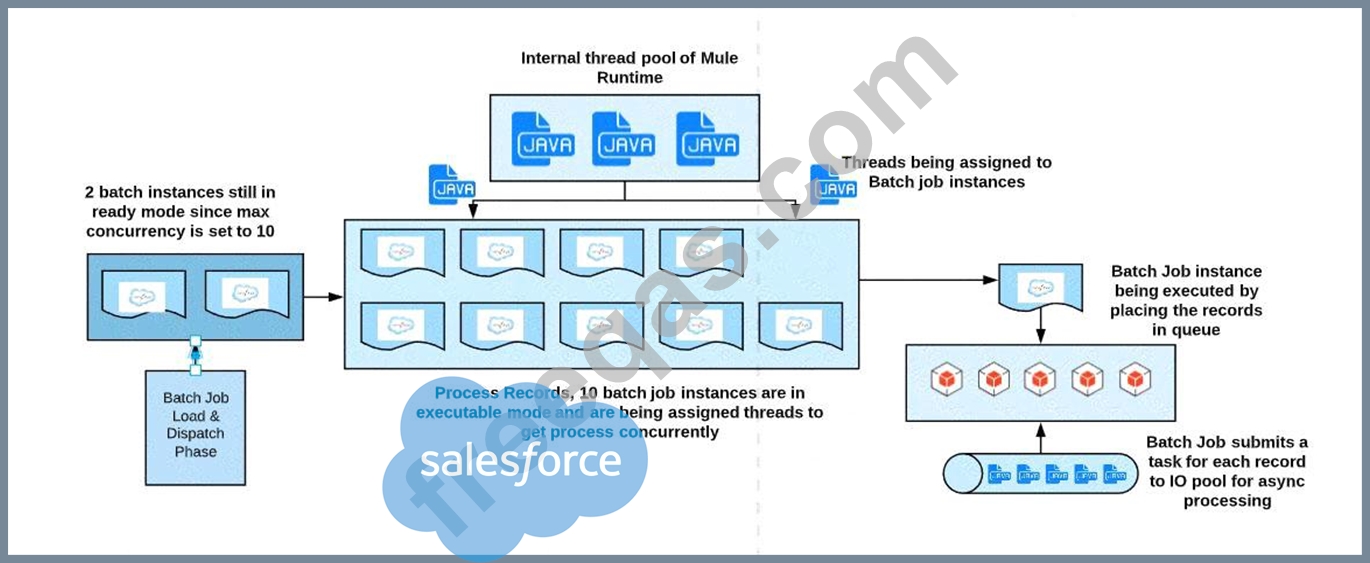
Correct Answer: A
* Each Batch Job uses SEVERAL THREADS for the Batch Steps
* Each Batch Step instance receives ONE record at a time as the payload. It's not received in a block, as it does not wait for multiple records to be completed before moving to next batch step. (So Option D is out of choice)
* RECORDS are processed IN PARALLEL within and between the two Batch Steps.
* RECORDS are not processed in order. Let's say if second record completes batch_step_1 before record 1, then it moves to batch_step_2 before record 1. (So option C and D are out of choice)
* A batch job is the scope element in an application in which Mule processes a message payload as a batch of records. The term batch job is inclusive of all three phases of processing: Load and Dispatch, Process, and On Complete.
* A batch job instance is an occurrence in a Mule application whenever a Mule flow executes a batch job.
Mule creates the batch job instance in the Load and Dispatch phase. Every batch job instance is identified internally using a unique String known as batch job instance id.
insert code

Question 164

As part of a growth strategy, a supplier signs a trading agreement with a large customer. The customer sends purchase orders to the supplier according to the ANSI X12 EDI standard, and the supplier creates the orders in its ERP system using the information in the EDI document.
The agreement also requires that the supplier provide a new RESTful API to process request from the customer for current product inventory level from the supplier' s ERP system.
Which two fundamental integration use cases does the supplier need to deliver to provide an end-to-end solution for this business scenario? (Choose two.)

Correct Answer: A,D
insert code

Question 165

An external API frequently invokes an Employees System API to fetch employee data from a MySQL database. The architect must design a caching strategy to query the database only when there Is an update to the Employees table or else return a cached response in order to minimize the number of redundant transactions being handled by the database.

Correct Answer: C
insert code
  • ««
  • «
  • …
  • 29
  • 30
  • 31
  • 32
  • 33
  • 34
  • 35
  • 36
  • 37
  • 38
  • …
  • »
  • »»
[×]

Download PDF File

Enter your email address to download Salesforce.MuleSoft-Integration-Architect-I.v2026-03-30.q190 Dumps


Email:

FreeQAs

Our website provides the Largest and the most Latest vendors Certification Exam materials around the world.

Using dumps we provide to Pass the Exam, we has the Valid Dumps with passing guranteed just which you need.

  • DMCA
  • About
  • Contact Us
  • Privacy Policy
  • Terms & Conditions
©2026 FreeQAs

www.freeqas.com materials do not contain actual questions and answers from Cisco's certification exams.