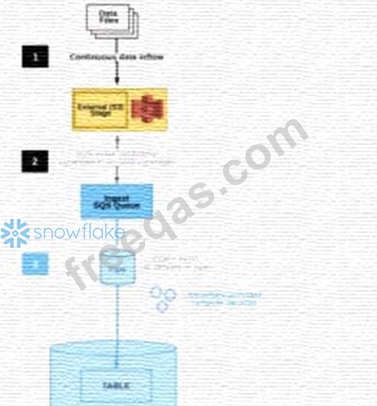
The diagram shows the process flow for Snowpipe auto-ingest with Amazon Simple Notification Service (SNS) with the following steps: Step 1: Data files are loaded in a stage. Step 2: An Amazon S3 event notification, published by SNS, informs Snowpipe - by way of Amazon Simple Queue Service (SQS) - that files are ready to load. Snowpipe copies the files into a queue. Step 3: A Snowflake-provided virtual warehouse loads data from the queued files into the target table based on parameters defined in the specified pipe. If an AWS Administrator accidentally deletes the SQS subscription to the SNS topic in Step 2, what will happen to the pipe that references the topic to receive event messages from Amazon S3?
Correct Answer: D
If an AWS Administrator accidentally deletes the SQS subscription to the SNS topic in Step 2, the pipe that references the topic to receive event messages from Amazon S3 will no longer be able to receive the messages. This is because the SQS subscription is the link between the SNS topic and the Snowpipe notification channel. Without the subscription, the SNS topic will not be able to send notifications to the Snowpipe queue, and the pipe will not be triggered to load the new files. To restore the system immediately, the user needs to manually create a new SNS topic with a different name and then recreate the pipe by specifying the new SNS topic name in the pipe definition. This will create a new notification channel and a new SQS subscription for the pipe. Alternatively, the user can also recreate the SQS subscription to the existing SNS topic and then alter the pipe to use the same SNS topic name in the pipe definition. This will also restore the notification channel and the pipe functionality. References: * Automating Snowpipe for Amazon S3 * Enabling Snowpipe Error Notifications for Amazon SNS * HowTo: Configuration steps for Snowpipe Auto-Ingest with AWS S3 Stages
Question 42
Assuming all Snowflake accounts are using an Enterprise edition or higher, in which development and testing scenarios would be copying of data be required, and zero-copy cloning not be suitable? (Select TWO).
Correct Answer: A,C
Zero-copy cloning is a feature that allows creating a clone of a table, schema, or database without physically copying the data. Zero-copy cloning is suitable for scenarios where the cloned object needs to have the same data and metadata as the original object, and where the cloned object does not need to be modified or updated frequently. Zero-copy cloning is also suitable for scenarios where the cloned object needs to be shared within the same Snowflake account or across different accounts in the same cloud region2 However, zero-copy cloning is not suitable for scenarios where the cloned object needs to have different data or metadata than the original object, or where the cloned object needs to be modified or updated frequently. Zero-copy cloning is also not suitable for scenarios where the cloned object needs to be shared across different accounts in different cloud regions. In these scenarios, copying of data would be required, either by using the COPY INTO command or by using data sharing with secure views3 The following are examples of development and testing scenarios where copying of data would be required, and zero-copy cloning would not be suitable: Developers create their own datasets to work against transformed versions of the live data. This scenario requires copying of data because the developers need to modify the data or metadata of the cloned object to perform transformations, such as adding, deleting, or updating columns, rows, or values. Zero-copy cloning would not be suitable because it would create a read-only clone that shares the same data and metadata as the original object, and any changes made to the clone would affect the original object as well4 Data is in a production Snowflake account that needs to be provided to Developers in a separate development/testing Snowflake account in the same cloud region. This scenario requires copying of data because the data needs to be shared across different accounts in the same cloud region. Zero-copy cloning would not be suitable because it would create a clone within the same account as the original object, and it would not allow sharing the clone with another account. To share data across different accounts in the same cloud region, data sharing with secure views or COPY INTO command can be used5 The following are examples of development and testing scenarios where zero-copy cloning would be suitable, and copying of data would not be required: Production and development run in different databases in the same account, and Developers need to see production-like data but with specific columns masked. This scenario can use zero-copy cloning because the data needs to be shared within the same account, and the cloned object does not need to have different data or metadata than the original object. Zero-copy cloning can create a clone of the production database in the development database, and the clone can have the same data and metadata as the original database. To mask specific columns, secure views can be created on top of the clone, and the developers can access the secure views instead of the clone directly6 Developers create their own copies of a standard test database previously created for them in the development account, for their initial development and unit testing. This scenario can use zero-copy cloning because the data needs to be shared within the same account, and the cloned object does not need to have different data or metadata than the original object. Zero-copy cloning can create a clone of the standard test database for each developer, and the clone can have the same data and metadata as the original database. The developers can use the clone for their initial development and unit testing, and any changes made to the clone would not affect the original database or other clones7 The release process requires pre-production testing of changes with data of production scale and complexity. For security reasons, pre-production also runs in the production account. This scenario can use zero-copy cloning because the data needs to be shared within the same account, and the cloned object does not need to have different data or metadata than the original object. Zero-copy cloning can create a clone of the production database in the pre-production database, and the clone can have the same data and metadata as the original database. The pre-production testing can use the clone to test the changes with data of production scale and complexity, and any changes made to the clone would not affect the original database or the production environment8 References: 1: SnowPro Advanced: Architect | Study Guide 9 2: Snowflake Documentation | Cloning Overview 3: Snowflake Documentation | Loading Data Using COPY into a Table 4: Snowflake Documentation | Transforming Data During a Load 5: Snowflake Documentation | Data Sharing Overview 6: Snowflake Documentation | Secure Views 7: Snowflake Documentation | Cloning Databases, Schemas, and Tables 8: Snowflake Documentation | Cloning for Testing and Development : SnowPro Advanced: Architect | Study Guide : Cloning Overview : Loading Data Using COPY into a Table : Transforming Data During a Load : Data Sharing Overview : Secure Views : Cloning Databases, Schemas, and Tables : Cloning for Testing and Development
Question 43
What considerations need to be taken when using database cloning as a tool for data lifecycle management in a development environment? (Select TWO).
Correct Answer: A,D
Database cloning is a feature of Snowflake that allows creating a copy of a database, schema, table, or view without consuming any additional storage space. Database cloning can be used as a tool for data lifecycle management in a development environment, where developers and testers can work on isolated copies of production data without affecting the original data or each other1. However, there are some considerations that need to be taken when using database cloning in a development environment, such as: Any pipes in the source are not cloned. Pipes are objects that load data from a stage into a table continuously. Pipes are not cloned because they are associated with a specific stage and table, and cloning them would create duplicate data loading and potential conflicts2. The clone inherits all granted privileges of all child objects in the source object, including the database. Privileges are the permissions that control the access and actions that can be performed on an object. When a database is cloned, the clone inherits all the privileges that were granted on the source database and its child objects, such as schemas, tables, and views. This means that the same roles that can access and modify the source database can also access and modify the clone, unless the privileges are explicitly revoked or modified3. The other options are not correct because: B). Any pipes in the source referring to internal stages are not cloned. This is a subset of option A, which states that any pipes in the source are not cloned, regardless of the type of stage they refer to. C). Any pipes in the source referring to external stages are not cloned. This is also a subset of option A, which states that any pipes in the source are not cloned, regardless of the type of stage they refer to. E). The clone inherits all granted privileges of all child objects in the source object, excluding the database. This is incorrect, as the clone inherits all granted privileges of the source object, including the database. References: 1: Database Cloning | Snowflake Documentation 2: Pipes | Snowflake Documentation 3: Access Control Privileges | Snowflake Documentation
Question 44
A company has a table with that has corrupted data, named Data. The company wants to recover the data as it was 5 minutes ago using cloning and Time Travel. What command will accomplish this?
Correct Answer: C
This is the correct command to create a clone of the table Data as it was 5 minutes ago using cloning and Time Travel. Cloning is a feature that allows creating a copy of a database, schema, table, or view without duplicating the data or metadata. Time Travel is a feature that enables accessing historical data (i.e. data that has been changed or deleted) at any point within a defined period. To create a clone of a table at a point in time in the past, the syntax is: CREATE TABLE <clone_name> CLONE <source_table> AT (OFFSET => <offset_in_seconds>); The OFFSET parameter specifies the time difference in seconds from the present time. A negative value indicates a point in the past. For example, -60*5 means 5 minutes ago. Alternatively, the TIMESTAMP parameter can be used to specify an exact timestamp in the past. The clone will contain the data as it existed in the source table at the specified point in time12. References: Snowflake Documentation: Cloning Objects Snowflake Documentation: Cloning Objects at a Point in Time in the Past
Question 45
An Architect is troubleshooting a query with poor performance using the QUERY_HIST0RY function. The Architect observes that the COMPILATIONJHME is greater than the EXECUTIONJTIME. What is the reason for this?
Correct Answer: B
Compilation time is the time it takes for the optimizer to create an optimal query plan for the efficient execution of the query. It also involves some pruning of partition files, making the query execution efficient2 If the compilation time is greater than the execution time, it means that the optimizer spent more time analyzing the query than actually running it. This could indicate that the query has overly complex logic, such as multiple joins, subqueries, aggregations, or expressions. The complexity of the query could also affect the size and quality of the query plan, which could impact the performance of the query3 To reduce the compilation time, the Architect can try to simplify the query logic, use views or common table expressions (CTEs) to break down the query into smaller parts, or use hints to guide the optimizer. The Architect can also use the EXPLAIN command to examine the query plan and identify potential bottlenecks or inefficiencies4 References: 1: SnowPro Advanced: Architect | Study Guide 5 2: Snowflake Documentation | Query Profile Overview 6 3: Understanding Why Compilation Time in Snowflake Can Be Higher than Execution Time 7 4: Snowflake Documentation | Optimizing Query Performance 8 : SnowPro Advanced: Architect | Study Guide : Query Profile Overview : Understanding Why Compilation Time in Snowflake Can Be Higher than Execution Time : Optimizing Query Performance