FreeQAs
 Request Exam  Contact
  • Home
  • View All Exams
  • New QA's
  • Upload
PRACTICE EXAMS:
  • Oracle
  • Fortinet
  • IBM
  • Juniper
  • Microsoft
  • Cisco
  • Citrix
  • CompTIA
  • VMware
  • ISC
  • SAP
  • EMC
  • PMI
  • HP
  • Salesforce
  • Other
  • Oracle
    Oracle
  • Fortinet
    Fortinet
  • IBM
    IBM
  • Juniper
    Juniper
  • Microsoft
    Microsoft
  • Cisco
    Cisco
  • Citrix
    Citrix
  • CompTIA
    CompTIA
  • VMware
    VMware
  • ISC
    ISC
  • SAP
    SAP
  • EMC
    EMC
  • PMI
    PMI
  • HP
    HP
  • Salesforce
    Salesforce
  1. Home
  2. Snowflake Certification
  3. ARA-R01 Exam
  4. Snowflake.ARA-R01.v2024-10-29.q82 Dumps
  • ««
  • «
  • …
  • 2
  • 3
  • 4
  • 5
  • 6
  • 7
  • 8
  • 9
  • 10
  • 11
  • …
  • »
  • »»
Download Now

Question 26

The following table exists in the production database:
A regulatory requirement states that the company must mask the username for events that are older than six months based on the current date when the data is queried.
How can the requirement be met without duplicating the event data and making sure it is applied when creating views using the table or cloning the table?

Correct Answer: C
A masking policy is a feature of Snowflake that allows masking sensitive data in query results based on the role of the user and the condition of the data. A masking policy can be applied to a column in a table or a view, and it can use another column in the same table or view as a conditional column. A conditional column is a column that determines whether the masking policy is applied or not based on its value1.
In this case, the requirement can be met by using a masking policy on the username column with event_timestamp as a conditional column. The masking policy can use a function that masks the username if the event_timestamp is older than six months based on the current date, and returns the original username otherwise. The masking policy can be applied to the user_events table, and it will also be applied when creating views using the table or cloning the table2.
The other options are not correct because:
A). Using a masking policy on the username column using an entitlement table with valid dates would require creating another table that stores the valid dates for each username, and joining it with the user_events table in the masking policy function. This would add complexity and overhead to the masking policy, and it would not use the event_timestamp column as the condition for masking.
B). Using a row level policy on the user_events table using an entitlement table with valid dates would require creating another table that stores the valid dates for each username, and joining it with the user_events table in the row access policy function. This would filter out the rows that have event_timestamp older than six months based on the valid dates, instead of masking the username column. This would not meet the requirement of masking the username, and it would also reduce the visibility of the event data.
D). Using a secure view on the user_events table using a case statement on the username column would require creating a view that uses a case expression to mask the username column based on the event_timestamp column. This would meet the requirement of masking the username, but it would not be applied when cloning the table. A secure view is a view that prevents the underlying data from being exposed by queries on the view. However, a secure view does not prevent the underlying data from being exposed by cloning the table3.
References:
1: Masking Policies | Snowflake Documentation
2: Using Conditional Columns in Masking Policies | Snowflake Documentation
3: Secure Views | Snowflake Documentation
insert code

Question 27

A company needs to have the following features available in its Snowflake account:
1. Support for Multi-Factor Authentication (MFA)
2. A minimum of 2 months of Time Travel availability
3. Database replication in between different regions
4. Native support for JDBC and ODBC
5. Customer-managed encryption keys using Tri-Secret Secure
6. Support for Payment Card Industry Data Security Standards (PCI DSS)
In order to provide all the listed services, what is the MINIMUM Snowflake edition that should be selected during account creation?

Correct Answer: C
According to the Snowflake documentation1, the Business Critical edition offers the following features that are relevant to the question:
* Support for Multi-Factor Authentication (MFA): This is a standard feature available in all Snowflake editions1.
* A minimum of 2 months of Time Travel availability: This is an enterprise feature that allows users to
* access historical data for up to 90 days1.
* Database replication in between different regions: This is an enterprise feature that enables users to replicate databases across different regions or cloud platforms1.
* Native support for JDBC and ODBC: This is a standard feature available in all Snowflake editions1.
* Customer-managed encryption keys using Tri-Secret Secure: This is a business critical feature that provides enhanced security and data protection by allowing customers to manage their own encryption keys1.
* Support for Payment Card Industry Data Security Standards (PCI DSS): This is a business critical feature that ensures compliance with PCI DSS regulations for handling sensitive cardholder data1.
Therefore, the minimum Snowflake edition that should be selected during account creation to provide all the listed services is the Business Critical edition.
References:
* Snowflake Editions | Snowflake Documentation
insert code

Question 28

What is a characteristic of Role-Based Access Control (RBAC) as used in Snowflake?

Correct Answer: C
Role-Based Access Control (RBAC) is the Snowflake Access Control Framework that allows privileges to be granted by object owners to roles, and roles, in turn, can be assigned to users to restrict or allow actions to be performed on objects. A characteristic of RBAC as used in Snowflake is:
* Privileges can be granted at the database level and can be inherited by all underlying objects. This means that a role that has a certain privilege on a database, such as CREATE SCHEMA or USAGE, can also perform the same action on any schema, table, view, or other object within that database, unless explicitly revoked. This simplifies the access control management and reduces the number of grants required.
* A user can create managed access schemas to support future grants and ensure only schema owners can grant privileges to other roles. This means that a user can create a schema with the MANAGED ACCESS option, which changes the default behavior of object ownership and privilege granting within the schema. In a managed access schema, object owners lose the ability to grant privileges on their objects to other roles, and only the schema owner or a role with the MANAGE GRANTS privilege can do so. This enhances the security and governance of the schema and its objects.
The other options are not characteristics of RBAC as used in Snowflake:
* A user can use a "super-user" access along with securityadmin to bypass authorization checks and access all databases, schemas, and underlying objects. This is not true, as there is no such thing as a
"super-user" access in Snowflake. The securityadmin role is a predefined role that can manage users and
* roles, but it does not have any privileges on any database objects by default. To access any object, the securityadmin role must be explicitly granted the appropriate privilege by the object owner or another role with the grant option.
* A user can create managed access schemas to support current and future grants and ensure only object owners can grant privileges to other roles. This is not true, as this contradicts the definition of a managed access schema. In a managed access schema, object owners cannot grant privileges on their objects to other roles, and only the schema owner or a role with the MANAGE GRANTS privilege can do so.
References:
* Overview of Access Control
* A Functional Approach For Snowflake's Role-Based Access Controls
* Snowflake Role-Based Access Control simplified
* Snowflake RBAC security prefers role inheritance to role composition
* Overview of Snowflake Role Based Access Control
insert code

Question 29

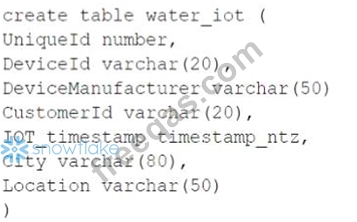
A table for IOT devices that measures water usage is created. The table quickly becomes large and contains more than 2 billion rows.
The general query patterns for the table are:
1. DeviceId, lOT_timestamp and Customerld are frequently used in the filter predicate for the select statement
2. The columns City and DeviceManuf acturer are often retrieved
3. There is often a count on Uniqueld
Which field(s) should be used for the clustering key?

Correct Answer: C
A clustering key is a subset of columns or expressions that are used to co-locate the data in the same micro-partitions, which are the units of storage in Snowflake. Clustering can improve the performance of queries that filter on the clustering key columns, as it reduces the amount of data that needs to be scanned. The best choice for a clustering key depends on the query patterns and the data distribution in the table. In this case, the columns DeviceId, IOT_timestamp, and CustomerId are frequently used in the filter predicate for the select statement, which means they are good candidates for the clustering key. The columns City and DeviceManufacturer are often retrieved, but not filtered on, so they are not as important for the clustering key.
The column UniqueId is used for counting, but it is not a good choice for the clustering key, as it is likely to have a high cardinality and a uniform distribution, which means it will not help to co-locate the data.
Therefore, the best option is to use DeviceId and CustomerId as the clustering key, as they can help to prune the micro-partitions and speed up thequeries. References: Clustering Keys & Clustered Tables, Micro-partitions & Data Clustering, A Complete Guide to Snowflake Clustering
insert code

Question 30

A company has several sites in different regions from which the company wants to ingest data.
Which of the following will enable this type of data ingestion?


Correct Answer: D
This is the correct answer because it allows the company to ingest data from different regions using a storage integration for the external stage. A storage integration is a feature that enables secure and easy access to files in external cloud storage from Snowflake. A storage integration can be used to create an external stage, which is a named location that references the files in the external storage. An external stage can be used to load data into Snowflake tables using the COPY INTO command, or to unload data from Snowflake tables using the COPY INTO LOCATION command. A storage integration can support multiple regions and cloud platforms, as long as the external storage service is compatible with Snowflake12.
References:
Snowflake Documentation: Storage Integrations
Snowflake Documentation: External Stages
insert code
  • ««
  • «
  • …
  • 2
  • 3
  • 4
  • 5
  • 6
  • 7
  • 8
  • 9
  • 10
  • 11
  • …
  • »
  • »»
[×]

Download PDF File

Enter your email address to download Snowflake.ARA-R01.v2024-10-29.q82 Dumps

Email:

FreeQAs

Our website provides the Largest and the most Latest vendors Certification Exam materials around the world.

Using dumps we provide to Pass the Exam, we has the Valid Dumps with passing guranteed just which you need.

  • DMCA
  • About
  • Contact Us
  • Privacy Policy
  • Terms & Conditions
©2026 FreeQAs

www.freeqas.com materials do not contain actual questions and answers from Cisco's certification exams.