FreeQAs
 Request Exam  Contact
  • Home
  • View All Exams
  • New QA's
  • Upload
PRACTICE EXAMS:
  • Oracle
  • Fortinet
  • IBM
  • Juniper
  • Microsoft
  • Cisco
  • Citrix
  • CompTIA
  • VMware
  • ISC
  • SAP
  • EMC
  • PMI
  • HP
  • Salesforce
  • Other
  • Oracle
    Oracle
  • Fortinet
    Fortinet
  • IBM
    IBM
  • Juniper
    Juniper
  • Microsoft
    Microsoft
  • Cisco
    Cisco
  • Citrix
    Citrix
  • CompTIA
    CompTIA
  • VMware
    VMware
  • ISC
    ISC
  • SAP
    SAP
  • EMC
    EMC
  • PMI
    PMI
  • HP
    HP
  • Salesforce
    Salesforce
  1. Home
  2. The Open Group Certification
  3. OGEA-103 Exam
  4. TheOpenGroup.OGEA-103.v2025-09-15.q126 Dumps
  • ««
  • «
  • …
  • 7
  • 8
  • 9
  • 10
  • 11
  • 12
  • 13
  • 14
  • 15
  • 16
  • …
  • »
  • »»
Download Now

Question 51

Please read this scenario prior to answering the question
You are working as the Chief Enterprise Architect within a law firm specializing in personal injury cases.
Many of the firm's competitors have improved their litigation strategies, and efficiency by streamlining their processes using Artificial Intelligence {Al).
The CIO has approved a Request for Architecture Work to examine the use of Machine Learning in defining a new Al-driven litigation and finance process for the firm. This process would instruct the lawyers and analysts as to what tasks and portfolio they should work on. The key objectives are to increase task profitability, maximize staff utilization, and increase individual profitability.
The CIO has emphasized that the architecture should enable the fast implementation of continuous Machine Learning. The solution will need to be constantly measured for delivered value and be quickly iterated to success.
Some of the partners have expressed concerns about letting the Al make the decisions, others about the risks associated with use of it for the type of service they deliver. The CIO wants to know if these concerns can be addressed, and how risks will be covered by a new architecture enabling Al and Machine Learning.
Refer to the scenario
You have been asked to respond to the CIO recommending an approach that would enable the development of an architecture that addresses the concerns of the CIO and the concerns of the partners.
Based on the TOGAF standard which of the following is the best answer?

Correct Answer: B
A Stakeholder Map is a technique that can be used to identify and classify the stakeholders of the architecture work, and to document their key interests, requirements, and concerns. A stakeholder is any person, group, or organization that has a stake in the outcome of the architecture work, such as the sponsor, the client, the users, the suppliers, the regulators, or the competitors. A Stakeholder Map can help to understand the needs and expectations of the stakeholders, and to communicate and engage with them effectively1 The steps for creating a Stakeholder Map are:
* Identify the stakeholders of the architecture work, using various sources and methods, such as interviews, surveys, workshops, or existing documents.
* Classify the stakeholders according to their roles, responsibilities, and relationships, using various criteria and dimensions, such as power, influence, interest, attitude, or impact.
* Define the concerns and relevant views for each stakeholder group, using various techniques, such as business scenarios, use cases, or value propositions. A concern is a key interest or issue that is relevant to the stakeholder, such as a goal, a problem, a need, or a risk. A view is a representation of the system of interest from the perspective of one or more stakeholders and their concerns.
* Record the stakeholders and their concerns in a Stakeholder Map, which shows the mapping between the stakeholder groups, the concerns, and the views. The Stakeholder Map also shows the dependencies, assumptions, and issues related to each stakeholder and concern.
Therefore, the best answer is B, because it recommends the approach that would enable the development of an architecture that addresses the concerns of the CIO and the partners, using the Stakeholder Map technique. The answer covers the following aspects:
* An analysis of the stakeholders is undertaken, which involves identifying, classifying, and defining the stakeholders and their concerns.
* The stakeholders and their concerns are documented in a Stakeholder Map, which provides a clear and comprehensive picture of the stakeholder landscape and their interests.
* The concerns and relevant views are recorded in the Architecture Vision document, which is the output
* of Phase A: Architecture Vision of the Architecture Development Method (ADM), which is the core process of the TOGAF standard that guides the development and management of the enterprise architecture. The Architecture Vision defines the scope and approach of the architecture work, and establishes the business goals and drivers that motivate the architecture work. The Architecture Vision also involves obtaining the approval and commitment of the sponsors and other key stakeholders, and initiating the Architecture Governance process2
* The requirements include risk mitigation through regular assessments, which involves identifying, analyzing, and evaluating the risks that may affect the architecture, and determining the appropriate measures or actions to prevent, reduce, or mitigate the risks. Risk mitigation can also involve monitoring and reviewing the risk situation, and communicating and reporting the risk status and actions3
* This approach also allows a supervised agile implementation of the continuous Machine Learning, which involves applying agile principles and practices to the architecture development and implementation, such as iterative and incremental delivery, frequent feedback, collaboration, and adaptation. A supervised agile implementation can help to ensure the quality, value, and alignment of the architecture, and to respond to the changing needs and expectations of the stakeholders.
References: 1: The TOGAF Standard, Version 9.2, Part III: ADM Guidelines and Techniques, Chapter 24:
Stakeholder Management 2: The TOGAF Standard, Version 9.2, Part II: Architecture Development Method (ADM), Chapter 18: Phase A: Architecture Vision 3: The TOGAF Standard, Version 9.2, Part III: ADM Guidelines and Techniques, Chapter 32: Risk Management : The TOGAF Standard, Version 9.2, Part III:
ADM Guidelines and Techniques, Chapter 29: Applying Iteration to the ADM
insert code

Question 52

What is the purpose of the Preliminary Phase?

Correct Answer: A
An Enterprise Architecture Capability is the ability of the organization to perform effective and efficient architecture work, including the definition, governance, and management of its architectures2. The Preliminary Phase involves the following activities1:
* Reviewing the organizational context, scope, and drivers for conducting Enterprise Architecture
* Establishing the Architecture Capability desired by the organization, including the maturity level, roles, responsibilities, processes, and tools
* Defining and establishing the Organizational Model for Enterprise Architecture, which describes how the architecture function is organized and integrated within the enterprise
* Defining and establishing the Architecture Governance framework, which provides the mechanisms for ensuring the quality, consistency, and compliance of the architecture work
* Selecting and implementing the tools that support the Architecture Capability, such as repositories, modeling tools, and communication tools
* Defining the Architecture Principles that will guide and constrain the architecture work, based on the business principles, goals, and drivers of the organization
* Defining the Organization-Specific Architecture Framework, which is an adaptation of the generic TOGAF ADM to suit the specific requirements, standards, and practices of the organization The Preliminary Phase is essential for preparing the organization for the successful development and implementation of its architectures, as well as for ensuring the alignment of the architecture work with the business strategy and objectives1.
insert code

Question 53

Scenario
You are working as an Enterprise Architect within an Enterprise Architecture (EA) team at a large government agency. The agency has multiple divisions.
The agency has a well-established EA practice and follows the TOGAF standard as its method for architecture development. Along with the EA program, the agency also uses various management frameworks, including business planning, project/portfolio management, and operations management. The EA program is sponsored by the Chief Information Officer (CIO), who has actively promoted architecting with agility within the EA department as her preferred approach for projects.
The government has mandated that the agency prepare themselves for an Artificial Intelligence (AI)-first world, which they have called their "AI-first" plan. As a result, the agency is looking to determine the impact and role that AI will play moving forward. The CIO has approved a Request for Architecture Work to look at how AI can be used for services across the agency. She has noted that digital platforms will be a priority for investment in order to scale the AI applications planned. Using AI to automate tasks and make things run smoother is seen as a big advantage. Process automation and improved efficiency from manual, repetitive activities have been identified as the key benefits of applying generative AI to their agency's business. This will include back-office automation, for example, for help center agents who receive hundreds of email inquiries. This should also improve services for citizens by making them more efficient and personalized, tailored to each individual's needs.
Many of the agency leaders are worried about relying too much on AI. Some leaders think their employees will need to learn new skills. Some employees are worried they might lose their jobs to AI. Other leaders worry about security and cyber resilience in the digital platforms needed for AI to be successful.
The leader of the Enterprise Architecture team has asked for your suggestions on how to address the concerns, and how to manage the risks of a new architecture for the AI-first project.
Based on the TOGAF standard, which of the following is the best answer?

Correct Answer: C
Comprehensive and Detailed Step-by-Step Explanation
Context of the Scenario
The agency is initiating a strategic "AI-first" plan to transform processes using AI and improve efficiency while ensuring service improvements for citizens. Several stakeholder concerns have been raised, such as:
* Job security for employees.
* Skill development for adapting to new technologies.
* Cybersecurity and resilience risks due to reliance on digital platforms.
TOGAF emphasizes the importance of stakeholder management, communication, and risk management to ensure successful adoption and implementation of new architecture. These concerns need to be addressed methodically by gathering requirements, analyzing stakeholder positions, and ensuring proper communication of risks and benefits.
Option Analysis
Option A:
* Strengths:
* Proposes creating an Organization Map to identify the links between different parts of the agency and the impact of the strategic change.
* Suggests holding stakeholder meetings to address concerns.
* Includes managing risks as part of Security Architecture development.
* Weaknesses:
* Focusing solely on creating business models and teaching stakeholders how to interpret them does not directly address cultural and positional concerns about job loss, skill development, and security.
* Risk management is addressed as part of Security Architecture development but lacks broader integration into stakeholder requirements.
* Conclusion: Incorrect, as it fails to systematically document stakeholder concerns and map them into requirements and architecture decisions.
Option B:
* Strengths:
* Highlights the importance of formal stakeholder identification and creating a Communication Plan.
* Suggests addressing stakeholder concerns through communication and risk management.
* Weaknesses:
* Does not go into detail on analyzing stakeholder concerns, cultural positions, or specific requirements.
* Lacks the inclusion of stakeholder feedback in architecture artifacts like the Architecture Vision or Requirements Specification, which are critical TOGAF outputs.
* Conclusion: Incorrect, as it does not include a systematic and structured approach for stakeholder analysis and integration into architecture deliverables.
Option C:
* Strengths:
* Emphasizes conducting a thorough stakeholder analysis to document concerns, positions, and cultural factors, which aligns with TOGAF's approach in Phase A (Architecture Vision).
* Ensures stakeholder views and requirements are recorded in the Architecture Vision document and reflected in the Architecture Requirements Specification.
* Includes continuous assessment and feedback, ensuring concerns are addressed and risks managed effectively.
* Aligns with TOGAF's principle of involving stakeholders in architecture development to ensure alignment and success.
* Weaknesses:
* Could further detail how risk management is included across all phases, but this is implied through integration into the Architecture Requirements Specification.
* Conclusion: Correct, as it provides a structured and detailed approach for addressing stakeholder concerns and managing risks within TOGAF's framework.
Option D:
* Strengths:
* Suggests categorizing stakeholders into groups and creating models for each category.
* Proposes arranging meetings to verify that concerns have been addressed.
* Includes risk management as part of the process.
* Weaknesses:
* Dividing stakeholders into generic categories (e.g., corporate functions, project team) may not adequately capture specific cultural factors and concerns raised in the scenario.
* Lacks integration of stakeholder feedback into architecture deliverables such as the Architecture Vision and Architecture Requirements Specification.
* Conclusion: Incorrect, as it provides a generalized and less targeted approach to stakeholder concerns compared to Option C.
TOGAF References
* Stakeholder Management (Phase A): TOGAF emphasizes analyzing stakeholders' positions, concerns, and issues to shape architecture development and communication (TOGAF 9.2, Section 24.2).
* Architecture Vision: Captures high-level requirements and stakeholder views to ensure alignment with business goals (TOGAF 9.2, Section 6.2).
* Architecture Requirements Specification: Records detailed requirements, including those related to risk management, to guide the development of target architectures (TOGAF 9.2, Section 35.5).
* Iterative Feedback: Regular assessments and feedback loops are critical to ensure stakeholder concerns are addressed effectively throughout the ADM cycle.
By selecting Option C, the approach adheres to TOGAF's principles of stakeholder analysis, communication, and integration of concerns into architecture development.
insert code

Question 54

Consider the following ADM phases objectives.
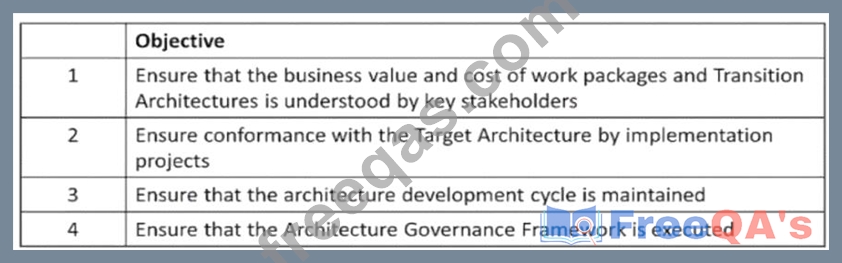
Which phase does each objective match?

Correct Answer: B
According to the TOGAF Standard, Version 9.2, the ADM phases and their objectives are as follows1:
Preliminary Phase: To prepare and initiate the architecture development cycle, including defining the architecture framework, principles, and governance.
Phase A: Architecture Vision: To define the scope, vision, and stakeholders of the architecture initiative, and to obtain approval to proceed.
Phase B: Business Architecture: To describe the baseline and target business architecture, and to identify the gaps between them.
Phase C: Information Systems Architectures: To describe the baseline and target data and application architectures, and to identify the gaps between them.
Phase D: Technology Architecture: To describe the baseline and target technology architecture, and to identify the gaps between them.
Phase E: Opportunities and Solutions: To identify and evaluate the opportunities and solutions for implementing the target architecture, and to define the work packages and transition architectures.
Phase F: Migration Planning: To finalize the implementation and migration plan, and to ensure alignment with the enterprise portfolio and project management.
Phase G: Implementation Governance: To provide architecture oversight and guidance for the implementation projects, and to manage any architecture change requests.
Phase H: Architecture Change Management: To monitor the changes in the business and technology environment, and to assess the impact and performance of the architecture.
Requirements Management: To manage the architecture requirements throughout the ADM cycle, and to ensure alignment with the business requirements.
Based on the above definitions, we can match each objective with the corresponding phase as follows:
Objective 1: Ensure that the business value and cost of work packages and transition architectures is understood by key stakeholders. This objective is achieved in Phase H: Architecture Change Management, where the value realization and cost-benefit analysis of the architecture are performed2.
Objective 2: Ensure conformance with the Target Architecture by implementation projects. This objective is achieved in Phase F: Migration Planning, where the conformance requirements and criteria for the implementation projects are defined3.
Objective 3: Ensure that the architecture development cycle is maintained. This objective is achieved in Phase F: Migration Planning, where the architecture roadmap and iteration cycle are maintained3.
Objective 4: Ensure that the Architecture Governance Framework is executed. This objective is achieved in Phase G: Implementation Governance, where the architecture governance processes and procedures are applied to the implementation projects4.
References:
1: The TOGAF Standard, Version 9.2, Chapter 5: Architecture Development Method (ADM)
2: The TOGAF Standard, Version 9.2, Chapter 21: Architecture Change Management
3: The TOGAF Standard, Version 9.2, Chapter 20: Migration Planning
4: The TOGAF Standard, Version 9.2, Chapter 19: Implementation Governance
insert code

Question 55

Please read this scenario prior to answering the question
Your role is that of a senior architect, reporting to the Chief Enterprise Architect, at a medium-sized company with 400 employees. The nature of the business is such that the data and the information stored on the company systems is their major asset and is highly confidential.
The company employees travel extensively for work and must communicate over public infrastructure using message encryption, VPNs, and other standard safeguards. The company has invested in cybersecurity awareness training for all its staff. However, it is recognized that even with good education as well as system security, there is a dependency on third-parly suppliers of infrastructure and software.
The company uses the TOGAF standard as the method and guiding framework for its Enterprise Architecture (EA) practice. The CTO is the sponsor of the activity.
The Chief Security Officer (CSO) has noted an increase in ransomware (malicious software used in ransom demands) attacks on companies with a similar profile. The CSO recognizes that no matter how much is spent on education, and support, it is likely just a matter of time before the company suffers a significant attack that could completely lock them out of their information assets.
A risk assessment has been done and the company has sought cyber insurance that includes ransomware coverage. The quotation for this insurance is hugely expensive. The CTO has recently read a survey that stated that one in four organizations paying ransoms were still unable to recover their data, while nearly as many were able to recover the data without paying a ransom. The CTO has concluded that taking out cyber insurance in case they need to pay a ransom is not an option.
Refer to the scenario
You have been asked to describe the steps you would take to improve the resilience of the current architecture?
Based on the TOGAF standard which of the following is the best answer?

Correct Answer: A
Business continuity is the ability of an organization to maintain essential functions during and after a disaster or disruption. Business continuity requirements are the specifications and criteria that define the acceptable level of performance and availability of the business processes and services in the event of a disaster or disruption. A gap analysis is a technique that compares the current state of the architecture with the desired state, and identifies the gaps or differences that need to be addressed. A change request is a formal proposal for an amendment to some product or system, such as the architecture. A Request for Architecture Work is a document that describes the scope, approach, and expected outcomes of an architecture project123 The best answer is A, because it describes the steps that would improve the resilience of the current architecture, which is the ability to withstand and recover from a ransomware attack or any other disruption. The steps are:
Determine the business continuity requirements, which specify the minimum acceptable level of performance and availability of the business processes and services in case of a ransomware attack. This would involve identifying the critical business functions, the recovery time objectives, the recovery point objectives, and the dependencies and resources needed for recovery.
Undertake a gap analysis of the current Enterprise Architecture, which compares the current state of the architecture with the desired state based on the business continuity requirements. This would involve assessing the strengths and weaknesses of the current architecture, the risks and opportunities for improvement, and the gaps or differences that need to be addressed.
Make recommendations for change requirements to address the situation and create a change request. This would involve proposing solutions and alternatives to close the gaps, enhance the resilience, and mitigate the risks of the current architecture. The change request would document the rationale, scope, impact, and benefits of the proposed changes, and seek approval from the relevant stakeholders.
Manage a meeting of the Architecture Board to assess and approve the change request. The Architecture Board is a governance body that oversees the architecture work and ensures compliance with the architecture principles, standards, and goals. The meeting would involve presenting the change request, discussing the pros and cons, resolving any issues or conflicts, and obtaining the approval or rejection of the change request.
Once approved, produce a new Request for Architecture Work to activate an ADM cycle to carry out a project to define the change. The Request for Architecture Work would describe the scope, approach, and expected outcomes of the architecture project that would implement the approved change request. The Request for Architecture Work would initiate a new cycle of the Architecture Development Method (ADM), which is the core process of the TOGAF standard that guides the development and management of the enterprise architecture.
insert code
  • ««
  • «
  • …
  • 7
  • 8
  • 9
  • 10
  • 11
  • 12
  • 13
  • 14
  • 15
  • 16
  • …
  • »
  • »»
[×]

Download PDF File

Enter your email address to download TheOpenGroup.OGEA-103.v2025-09-15.q126 Dumps

Email:

FreeQAs

Our website provides the Largest and the most Latest vendors Certification Exam materials around the world.

Using dumps we provide to Pass the Exam, we has the Valid Dumps with passing guranteed just which you need.

  • DMCA
  • About
  • Contact Us
  • Privacy Policy
  • Terms & Conditions
©2026 FreeQAs

www.freeqas.com materials do not contain actual questions and answers from Cisco's certification exams.
