Scenario:
You are working as an Enterprise Architect within a company providing legal services. The company operates in many countries and has a complicated structure. Every office must follow the local regulations in their country.
The company's Enterprise Architecture (EA) department has been operating for several years and has mature, well-developed architecture governance and development processes based on the TOGAF standard. In addition to the EA program, the company has several management frameworks, including business planning, project/portfolio management, and operations management. The Architecture Board includes representatives from all parts of the company.
The Chief Information Officer (CIO) is the sponsor of the Enterprise Architecture program. The CIO has actively encouraged architecting with agility within the EA department as the preferred approach for projects.
The CIO has given approval for a Request for Architecture Work to explore the adoption of an AI-powered system for managing legal cases and financial processes.
Senior management has become more concerned about business performance, especially with the advancements in Artificial Intelligence (AI). Many of the company's competitors have started using AI to assist with legal strategies, streamline processes, and boost productivity. One of the most important benefits AI has for the business is its ability to increase accuracy and minimize mistakes.
Some of the top managers are worried about a change in the way of working, and if it will achieve the business goals. Their staff also fear that management will use the AI system to measure their performance.
The CIO wants to know how to address these concerns and reduce risks.
The new system is expected to guide legal professionals and analysts on which tasks to focus on. The main goals are to improve productivity and make better use of staff. In addition, the CIO hopes these changes will lead to higher customer satisfaction.
Refer to the scenario:
You have been asked to respond to the Chief Information Officer (CIO) recommending an approach that would enable the development of an architecture that addresses the concerns of the top managers and the multiple branches in different parts of the company.
Based on the TOGAF standard, which of the following is the best answer?
Please read this scenario prior to answering the question
You are the Lead Enterprise Architect at a major agribusiness company. The company's main annual harvest is lentils, a highly valued food grown worldwide. The lentil parasite, broomrape, has been an increasing concern for many years and is now becoming resistant to chemical controls. In addition, changes in climate favor the propagation and growth of the parasite. As a result, the parasite cannot realistically be exterminated, and it has become pandemic, with lentil yields falling globally.
The CEO appreciates the seriousness of the situation and has set out a change in direction that is effectively a new business for the company. There are opportunities for new products, and new markets. The company will use the fields for another harvest and will cease to process third-party lentils. Thus, the target market will change, and the end-products will be different and more varied. This is a major decision and the CEO has stated a desire to repurpose rather than replace so as to manage the risks and limit the costs.
The company has a mature Enterprise Architecture practice based in its headquarters and uses the TOGAF standard as the method and guiding framework. The practice has an established Architecture Capability, and uses iteration for architecture development. The CIO is the sponsor of the activity.
The CIO has assigned the Enterprise Architecture team to this activity. At this stage there is no shared vision, or requirements.
Refer to the scenario
You have been asked to propose the best approach for architecture development to realize the CEO's change in direction for the company.
Based on the TOGAF standard which of the following is the best answer?
Which of the following statements about architecture partitioning is correct?
Consider the illustration.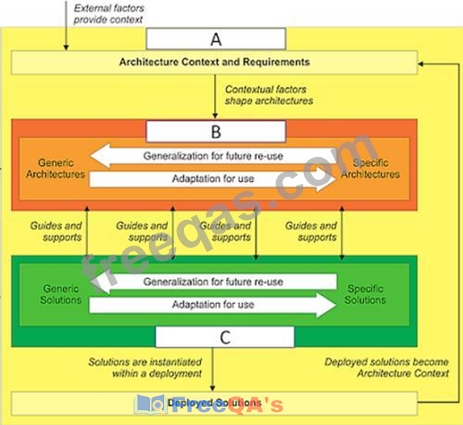
What are the items labelled A, B and C?
Complete the sentence. The key purpose of Gap Analysis is to _____
Enter your email address to download TheOpenGroup.OGEA-103.v2025-09-15.q126 Dumps

