FreeQAs
 Request Exam  Contact
  • Home
  • View All Exams
  • New QA's
  • Upload
PRACTICE EXAMS:
  • Oracle
  • Fortinet
  • IBM
  • Juniper
  • Microsoft
  • Cisco
  • Citrix
  • CompTIA
  • VMware
  • ISC
  • SAP
  • EMC
  • PMI
  • HP
  • Salesforce
  • Other
  • Oracle
    Oracle
  • Fortinet
    Fortinet
  • IBM
    IBM
  • Juniper
    Juniper
  • Microsoft
    Microsoft
  • Cisco
    Cisco
  • Citrix
    Citrix
  • CompTIA
    CompTIA
  • VMware
    VMware
  • ISC
    ISC
  • SAP
    SAP
  • EMC
    EMC
  • PMI
    PMI
  • HP
    HP
  • Salesforce
    Salesforce
  1. Home
  2. The Open Group Certification
  3. OGEA-103 Exam
  4. TheOpenGroup.OGEA-103.v2025-09-15.q126 Dumps
  • ««
  • «
  • …
  • 5
  • 6
  • 7
  • 8
  • 9
  • 10
  • 11
  • 12
  • 13
  • 14
  • …
  • »
  • »»
Download Now

Question 41


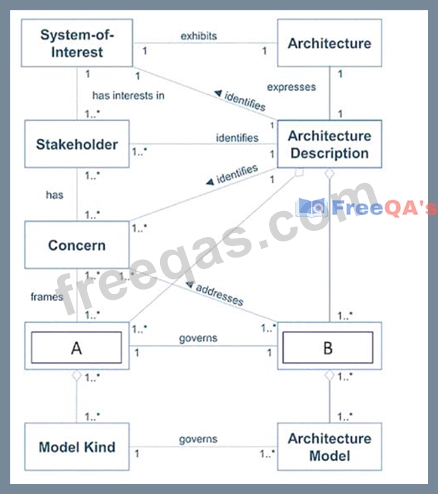
Consider the image showing basic architectural concepts.
What are items A and B?

Correct Answer: A
The image shows a diagram that illustrates the basic concepts of architecture description as defined by the ISO/IEC/IEEE 42010:2011 standard1, which is also adopted by the TOGAF standard2.
According to the ISO/IEC/IEEE 42010:2011 standard, an architecture description is a work product used to express an architecture, and it consists of one or more architecture views1.
An architecture view is a representation of a system from the perspective of a related set of concerns, and it conforms to an architecture viewpoint1.
An architecture viewpoint is a specification of the conventions for constructing and using an architecture view to address specific stakeholder concerns1.
Therefore, the correct answer is option A, which identifies the items labeled as "A" and "B" in the image as an architecture viewpoint and an architecture view, respectively. References:
1: ISO/IEC/IEEE 42010:2011 - Systems and software engineering - Architecture description1
2: TOGAF Standard, Version 9.2 - Part IV: Architecture Content Framework - 31. Architectural Artifacts2
insert code

Question 42

Consider the following statement.
Projects may cycle between ADM phases, in planned cycles covering multiple phases.
What does it illustrate?

Correct Answer: B
The statement "Projects may cycle between ADM phases, in planned cycles covering multiple phases" illustrates the concept of iteration, which is the process of repeating the ADM phases or steps within a phase to refine the architecture outputs and address the changing requirements and stakeholder concerns. Iteration can occur at different levels of granularity and scope, such as within a single phase, across multiple phases, or across the entire ADM cycle. Iteration can also be applied to different architecture domains, such as business, data, application, and technology. Iteration is a key feature of the ADM that enables the development of architectures that are fit for purpose, adaptable, and responsive to change. Reference: : The TOGAF Standard, Version 9.2, Part III: ADM Guidelines and Techniques, Chapter 24: Applying Iteration to the ADM
insert code

Question 43

Complete the sentence Business Transformation Readiness Assessment is_________________.

Correct Answer: A
Explanation
Business Transformation Readiness Assessment is a joint effort between corporate staff lines of business and IT planners to evaluate the readiness of the organization to undergo change. It involves assessing factors such as vision, commitment, capacity, capability, culture, and motivation that may influence the success of a business transformation initiative. Reference: The TOGAF Standard | The Open Group Website, Section
3.3.2 Business Transformation Readiness Assessment.
insert code

Question 44

Please read this scenario prior to answering the question
You are working as an Enterprise Architect within a healthcare and life science company. The company is a leading player in its industry, dedicated to transforming healthcare with new ideas and advancements. The company has multiple divisions that cover different aspects of the business.
The company's Enterprise Architecture (EA) department has been operating for several years and has mature, well-developed architecture governance and development processes following the TOGAF Standard. In addition to the EA program, the company has a number of management frameworks in use.
The Architecture Board includes representatives from each division of the company.
Many of the company's rivals have begun utilizing Artificial Intelligence (Al) in their operations, and the indications are that this will be transformative for healthcare delivery. This is something the EA department has been interested in for a while, and they had recently submitted an architecture Change Request which was approved. As a result, the CIO has approved a Request for Architecture Work to investigate the implementation of Al in the company.
Areas for evaluation include:
How can staff use Al daily in their current role?
How Al can enhance access to care for patients, and how to make that experience seamless?
How Al can offer new workplace platforms and tools to increase efficiency?
Some of the top managers are worried about a change in the way of working, and if it will achieve the goals.
Many are not confident that the company's risk management processes are adequate for a company-wide integration of generative Al. There are also questions from staff about whether enough specific guidelines and polices have been put in place for responsible use of Al.
The Chief Information Officer (CIO) is the sponsor of the Enterprise Architecture program. The CIO has actively encouraged architecting with agility within the EA department as her preferred approach for projects.
The CIO wants to know how to address these concerns and reduce risks.
Refer to the scenario
You have been tasked with starting the architecture development. How do you begin?
Based on the TOGAF standard which of the following is the best answer?

Correct Answer: A
Key aspects of the scenario:
* Objective:
* Integrating Artificial Intelligence (AI) into healthcare delivery, with a focus on improving patient care, enhancing workplace efficiency, and enabling seamless experiences.
* Challenges:
* Stakeholder concerns about risk management, adaptability to change, and ensuring alignment with regulations and policies.
* Addressing the concerns of staff and top management about AI integration and achieving the desired goals.
* CIO's Perspective:
* Encouraging an agile approach to architecture development.
* Addressing risks and ensuring stakeholder concerns are managed.
* Areas for Evaluation:
* AI usage by staff and impact on workflows.
* Patient experience enhancement via AI.
* New workplace platforms and tools powered by AI.
Option Analysis:
Option 1: Analysis of stakeholders and development of a Stakeholder Map
* Pros:
* Stakeholder analysis is critical for identifying concerns, viewpoints, and requirements.
* TOGAF emphasizes stakeholder engagement early in the process to mitigate risks and align expectations.
* Developing a Stakeholder Map ensures clear alignment with their interests and creates a foundation for regular feedback loops.
* Cons:
* Does not explicitly address the creation of architecture models or policies upfront.
Option 2: Creation of a Communications Plan
* Pros:
* A communications plan fosters effective stakeholder engagement by addressing their concerns and ensuring transparent reporting.
* Risk mitigation as part of communication aligns with TOGAF's stakeholder management practices.
* Cons:
* This focuses more on communication mechanics rather than advancing architectural development directly.
Option 3: Models for Draft Business, Data, Application, and Technology Architectures
* Pros:
* Aligns with the Architecture Development Method (ADM), ensuring compliance with requirements and regulations.
* Helps formalize stakeholder feedback by verifying their concerns against tangible models.
* Cons:
* Developing detailed models early on may delay immediate resolution of stakeholder concerns and risk mitigation.
Option 4: Set of reusable business models for AI-related projects
* Pros:
* Standardized models ensure consistency and portability across the organization's AI-related efforts.
* Cons:
* Too narrow in focus for the initial architecture development phase; does not address risk management or stakeholder concerns adequately.
Recommended answer:
Option 1: You recommend that an analysis of the stakeholders is undertaken.
Reasoning:
* The scenario highlights stakeholder concerns about risks, adaptability, and compliance. Addressing these concerns requires stakeholder analysis as the first step.
* A Stakeholder Map aligns with TOGAF's emphasis on stakeholder engagement, providing a structured way to manage their concerns and expectations.
* Identifying concerns early and integrating feedback into the Architecture Vision document ensures alignment with goals and smooth progress.
Option 1 sets the foundation for collaboration and risk management, making it the best fit for the current phase.
insert code

Question 45

What is used lo structure architectural information in an orderly way so that it can be processed to meet stakeholder needs?

Correct Answer: B
An Architecture Framework is used to structure architectural information in an orderly way so that it can be processed to meet stakeholder needs. An Architecture Framework provides a common language and taxonomy for describing architectures; a set of tools and techniques for creating architectures; a method for defining views and viewpoints for different stakeholders; a metamodel for representing architecture artifacts; a repository for storing and managing architecture artifacts; and a governance framework for controlling architecture development and evolution. Reference: The TOGAF Standard | The Open Group Website, Section 2 Core Concepts.
insert code
  • ««
  • «
  • …
  • 5
  • 6
  • 7
  • 8
  • 9
  • 10
  • 11
  • 12
  • 13
  • 14
  • …
  • »
  • »»
[×]

Download PDF File

Enter your email address to download TheOpenGroup.OGEA-103.v2025-09-15.q126 Dumps

Email:

FreeQAs

Our website provides the Largest and the most Latest vendors Certification Exam materials around the world.

Using dumps we provide to Pass the Exam, we has the Valid Dumps with passing guranteed just which you need.

  • DMCA
  • About
  • Contact Us
  • Privacy Policy
  • Terms & Conditions
©2026 FreeQAs

www.freeqas.com materials do not contain actual questions and answers from Cisco's certification exams.