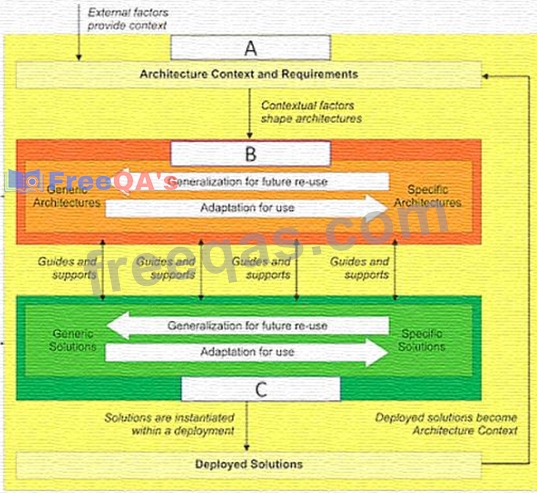
Consider the illustration. What are the items labelled A, B and C?
Correct Answer: A
The illustration shows the relationship between the Enterprise Continuum, the Architecture Continuum, and the Solutions Continuum, which are key concepts in the TOGAF framework. TheEnterprise Continuum is a view of the Architecture Repository that shows how generic foundation architectures can be leveraged and specialized to support the requirements of an individual organization. The Architecture Continuum specifies a structured classification for architectural artifacts, such as models, patterns, and descriptions, that can be reused and adapted across different domains and levels of abstraction. The Solutions Continuum identifies implemented solutions that support various stages of business and IT capability evolution, such as common systems, industry solutions, and organization-specific solutions. The illustration also shows how the architecture context and requirements are influenced by external factors, such as business drivers, stakeholders, and standards, and how they shape the generic and specific architectures and solutions. The illustration also shows how the deployed solutions become part of the architecture context for future iterations of the architecture development cycle. References: *TOGAF Standard, 10th Edition, Part II: Architecture Development Method, Chapter 6: Architecture Repository, Section 6.2 Enterprise Continuum. *TOGAF Standard, 10th Edition, Part IV: Architecture Content Framework, Chapter 35: Enterprise Continuum and Tools, Section 35.1 Introduction.
Question 37
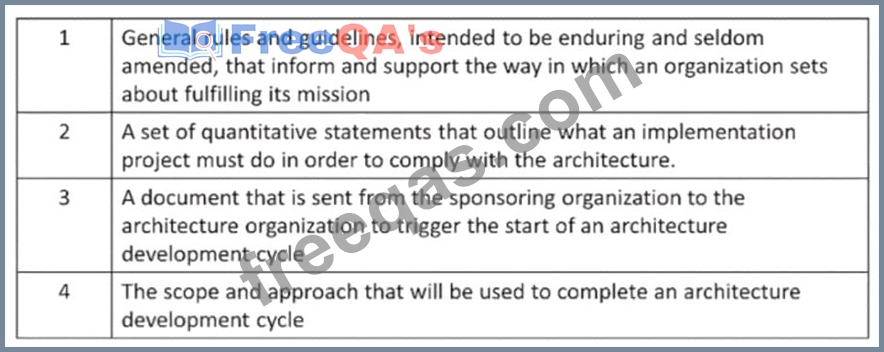
Consider the following descriptions of deliverables consumed and produced across the TOGAF ADM cycle. Which deliverables match these descriptions?
Correct Answer: D
The Request for Architecture Work is a deliverable that is sent from the sponsor and triggers the start of an architecture development cycle. It defines the scope, budget, schedule, and deliverables for a specific architecture project. The Statement of Architecture Work is a deliverable that is produced by the architect and defines the approach and resources needed to complete an architecture project. It forms the basis of a contractual agreement between the sponsor and the architecture organization. The Architecture Principles are a deliverable that is produced by the architect and defines the general rules and guidelines for the architecture work. They reflect the business principles, business goals, and business drivers of the organization. The Architecture Requirements Specification is a deliverable that is produced by the architect and defines the requirements that govern the architecture work. It covers both functional and non-functional requirements as well as constraints and assumptions.
Question 38
Consider the following ADM phases objectives. Which phase does each objective match?
Correct Answer: A
* The objectives listed in the question correspond to the objectives of different phases of the TOGAF ADM (Architecture Development Method), which is a method for developing and managing an enterprise architecture1. * The ADM consists of nine phases, each with a specific purpose and output. The phases are1: * Preliminary Phase: To prepare and initiate the architecture development cycle, including defining the architecture framework, principles, and governance. * Phase A: Architecture Vision: To define the scope, vision, and stakeholders of the architecture initiative, and to obtain approval to proceed. * Phase B: Business Architecture: To describe the baseline and target business architecture, and to identify the gaps between them. * Phase C: Information Systems Architectures: To describe the baseline and target data and application architectures, and to identify the gaps between them. * Phase D: Technology Architecture: To describe the baseline and target technology architecture, and to identify the gaps between them. * Phase E: Opportunities and Solutions: To identify and evaluate the opportunities and solutions for implementing the target architecture, and to define the work packages and transition architectures. * Phase F: Migration Planning: To finalize the implementation and migration plan, and to ensure alignment with the enterprise portfolio and project management. * Phase G: Implementation Governance: To provide architecture oversight and guidance for the implementation projects, and to manage any architecture change requests. * Phase H: Architecture Change Management: To monitor the changes in the business and technology environment, and to assess the impact and performance of the architecture. * Based on the above definitions, we can match each objective with the corresponding phase as follows: * Objective 1: Develop the Target Data Architecture that enables the Business Architecture and the Architecture Vision. This objective is achieved in Phase C: Information Systems Architectures, where the data architecture is defined as a subset of the information systems architecture2. * Objective 2: Develop the Target Business Architecture that describes how the enterprise needs to operate to achieve the business goals. This objective is achieved in Phase B: Business Architecture, where the business architecture is defined as a subset of the enterprise architecture3. * Objective 3: Develop a high-level aspirational vision of the capabilities and business value to be delivered as a result of the proposed Enterprise Architecture. This objective is achieved in Phase A: Architecture Vision, where the architecture vision is defined as a high-level description of the target architecture and its benefits4. * Objective 4: Develop the Target Application Architecture that enables the Business Architecture and the Architecture Vision, in a way that addresses the Statement of Architecture Work and stakeholder concerns. This objective is achieved in Phase C: Information Systems Architectures, where the application architecture is defined as a subset of the information systems architecture2. References: * 1: The TOGAF Standard, Version 9.2, Chapter 5: Architecture Development Method (ADM) * 2: The TOGAF Standard, Version 9.2, Chapter 9: Phase C: Information Systems Architectures * 3: The TOGAF Standard, Version 9.2, Chapter 8: Phase B: Business Architecture * 4: The TOGAF Standard, Version 9.2, Chapter 7: Phase A: Architecture Vision
Question 39
Consider the following ADM phases objectives. Which phase does each objective match?
Correct Answer: A
Explanation 1F: To define an Implementation and Migration Strategy that will achieve an orderly transition from the Baseline to Target Architectures 2G: To perform appropriate governance functions while the solution is being implemented 3G: To ensure conformance with the Target Architecture by implementation projects 4H: To establish procedures for continual monitoring and assessment of the performance of the solution in operation Reference: The TOGAF Standard | The Open Group Website, Section 3.2 ADM Phases.
Question 40
You are working as an Enterprise Architect at a large company. The company runs many retail stores as well as an online marketplace that allows hundreds of brands to partner with the company. The company has a mature Enterprise Architecture (EA) practice and uses the TOGAF standard for its architecture development method. The EA practice is involved in all aspects of the business, with oversight provided by an Architecture Board with representatives from different parts of the business. The EA program is sponsored by the Chief Information Officer (CIO). Many of the stores remain open all day and night. Each store uses a standard method to track sales and inventory, which involves sending accurate, timely sales data to a central AI-based inventory management system that can predict demand, adjust stock levels, and automate reordering. The central inventory management system is housed at the company's central data center. The company has acquired a major rival. The Chief Executive Officer (CEO) believes that the merger will enable growth through combined offerings and cost savings. The decision has been made to fully integrate the two organizations, including merging retail operations and systems. Duplicated systems will be replaced with one standard retail management system. The CIO expects significant savings from these changes across the newly merged company. The rival company has successfully implemented the use of hand-held devices within stores for both customers and staff, which has increased satisfaction due to time savings. The CIO has approved the rollout of these devices to all stores but has stated that training should be brief, as there are many part-time employees. You have been asked to confirm the most relevant architecture principles for this transformation. Based on the TOGAF Standard, which of the following is the best answer?
Correct Answer: D
In this scenario, the enterprise is undergoing significant transformation due to a merger and the adoption of new technology (hand-held devices). Several key principles from TOGAF's ADM Techniques-particularly those focused on promoting enterprise-wide standardization, adaptability, and data utilization-are pertinent here: Maximize Benefit to the Enterprise: This principle emphasizes that all architectural decisions should deliver maximum business value. Given that the company is integrating systems to cut costs and improve offerings, maximizing the benefit is crucial. Ensuring that the EA efforts align with enterprise-wide benefits supports the goal of optimizing costs and enhancing offerings, which aligns with the CEO's vision for the merger. Common Use Applications: Standardizing applications across the merged entity will be essential to achieve cost savings and to simplify operations. The goal of reducing the number of applications fits with this principle, ensuring that reusable and widely adopted applications support business functions across the organization. Adopting this principle will also aid in harmonizing the systems from both organizations and avoiding unnecessary diversity. Data is an Asset: Data plays a central role in the company's operations, especially with the use of AI-driven inventory management and the integration of systems. Treating data as an asset is essential for reliable and accurate decision-making. This principle ensures that data is viewed as a critical enterprise resource and is managed with care, maintaining integrity, accuracy, and value. Responsive Change Management: The organization's ability to adapt quickly and effectively to changes, such as integrating new handheld devices and merging systems, is essential. This principle will facilitate the smooth transition required for integrating the new handheld devices and the merger-related system updates while minimizing disruption to store operations. Technology Independence: Since the enterprise will likely encounter varied technologies from the merger, it is crucial to maintain flexibility. This principle advocates for using technology solutions that are adaptable and not bound to a single vendor or specific technology. This ensures that the enterprise can integrate various technological components from both organizations and evolve with minimal constraints. These principles align well with TOGAF's broader recommendations for guiding architectural changes, as found in Section 2.6 of the TOGAF ADM Techniques. They ensure that the EA practice is aligned with business objectives while maintaining flexibility, data integrity, and a focus on enterprise-wide benefits. These guiding principles are critical for the successful execution of the integration and adoption of new technologies while achieving cost efficiencies and improving service delivery. For reference, TOGAF's ADM Techniques highlight the importance of architectural principles in guiding transformational initiatives, ensuring that decisions are made consistently across the enterprise. Each principle supports organizational agility, system integration, and the efficient use of technology resources, all of which are vital for the enterprise's stated objectives.