FreeQAs
 Request Exam  Contact
  • Home
  • View All Exams
  • New QA's
  • Upload
PRACTICE EXAMS:
  • Oracle
  • Fortinet
  • IBM
  • Juniper
  • Microsoft
  • Cisco
  • Citrix
  • CompTIA
  • VMware
  • ISC
  • SAP
  • EMC
  • PMI
  • HP
  • Salesforce
  • Other
  • Oracle
    Oracle
  • Fortinet
    Fortinet
  • IBM
    IBM
  • Juniper
    Juniper
  • Microsoft
    Microsoft
  • Cisco
    Cisco
  • Citrix
    Citrix
  • CompTIA
    CompTIA
  • VMware
    VMware
  • ISC
    ISC
  • SAP
    SAP
  • EMC
    EMC
  • PMI
    PMI
  • HP
    HP
  • Salesforce
    Salesforce
  1. Home
  2. VMware Certification
  3. 2V0-41.23 Exam
  4. VMware.2V0-41.23.v2024-04-26.q104 Dumps
  • ««
  • «
  • …
  • 12
  • 13
  • 14
  • 15
  • 16
  • 17
  • 18
  • 19
  • 20
  • 21
  • …
  • »
  • »»
Download Now

Question 76

Which of the two following characteristics about NAT64 are true? (Choose two.)

Correct Answer: C,E
Explanation
NAT64 is a type of NAT that allows IPv6-only hosts to communicate with IPv4-only hosts by translating the IPv6 addresses to IPv4 addresses and vice versa.
C: NAT64 is supported on Tier-0 and Tier-1 gateways. This is stated in the first result1, which says
"Three types of NAT are supported, in addition to NAT64."
E: NAT64 requires the Tier-1 gateway to be configured in active-active mode. This is implied by the third result2, which says "Stateful NAT is not supported in active-active mode." Since NAT64 is stateless, it can be supported in active-active mode.
insert code

Question 77

Which three of the following describe the Border Gateway Routing Protocol (BGP) configuration on a Tier-0 Gateway? (Choose three.)

Correct Answer: A,B,D
The answer is A, B, and D.
A) Can be used as an Exterior Gateway Protocol. This is correct. BGP is a protocol that can be used to exchange routing information between different autonomous systems (AS). An AS is a network or a group of networks under a single administrative control. BGP can be used as an Exterior Gateway Protocol (EGP) to connect an AS to other ASes on the internet or other external networks1 B) It supports a 4-byte autonomous system number. This is correct. BGP supports both 2-byte and 4-byte AS numbers. A 2-byte AS number can range from 1 to 65535, while a 4-byte AS number can range from 65536 to 4294967295. NSX supports both 2-byte and 4-byte AS numbers for BGP configuration on a Tier-0 Gateway2 C) The network is divided into areas that are logical groups. This is incorrect. This statement describes OSPF, not BGP. OSPF is another routing protocol that operates within a single AS and divides the network into areas to reduce routing overhead and improve scalability. BGP does not use the concept of areas, but rather uses attributes, policies, and filters to control the routing decisions and traffic flow3 D) FIGRP Is disabled by default. This is correct. FIGRP stands for Fast Interior Gateway Routing Protocol, which is an enhanced version of IGRP, an obsolete routing protocol developed by Cisco. FIGRP is not supported by NSX and is disabled by default on a Tier-0 Gateway.
E) BGP is enabled by default. This is incorrect. BGP is not enabled by default on a Tier-0 Gateway. To enable BGP, you need to configure the local AS number and the BGP neighbors on the Tier-0 Gateway using the NSX Manager UI or API.
To learn more about BGP configuration on a Tier-0 Gateway in NSX, you can refer to the following resources:
VMware NSX Documentation: Configure BGP 1
VMware NSX 4.x Professional: BGP Configuration
insert code

Question 78

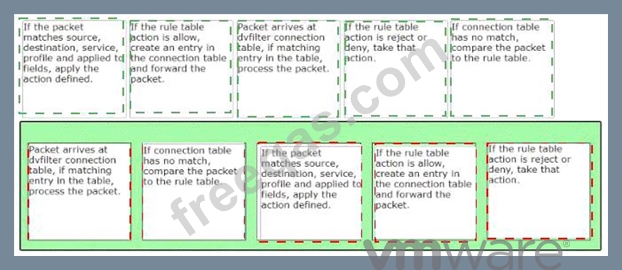
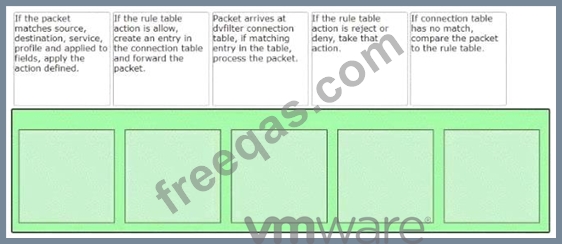
Sort the rule processing steps of the Distributed Firewall. Order responses from left to right.

Correct Answer:

Explanation
The correct order of the rule processing steps of the Distributed Firewall is as follows:
Packet arrives at vfilter connection table. If matching entry in the table, process the packet.
If connection table has no match, compare the packet to the rule table.
If the packet matches source, destination, service, profile and applied to fields, apply the action defined.
If the rule table action is allow, create an entry in the connection table and forward the packet.
If the rule table action is reject or deny, take that action.
This order is based on the description of how the Distributed Firewall works in the web search results1. The first step is to check if there is an existing connection entry for the packet in the vfilter connection table, which is a cache of flow entries for rules with an allow action. If there is a match, the packet is processed according to the connection entry. If there is no match, the packet is compared to the rule table, which contains all the security policy rules. The rules are evaluated from top to bottom until a match is found. The match criteria include source, destination, service, profile and applied to fields. The action defined by the matching rule is applied to the packet. The action can be allow, reject or deny. If the action is allow, a new connection entry is created for the packet and the packet is forwarded to its destination. If the action is reject or deny, the packet is dropped and an ICMP message or a TCP reset message is sent back to the source.
insert code

Question 79

What are two valid BGP Attributes that can be used to influence the route path traffic will take? (Choose two.)

Correct Answer: A,D
* AS-Path Prepend: This attribute allows you to prepend one or more AS numbers to the AS path of a route, making it appear longer and less preferable to other BGP routers. You can use this attribute to manipulate the inbound traffic from your BGP peers by advertising a longer AS path for some routes and a shorter AS path for others .
* MED: This attribute stands for Multi-Exit Discriminator and allows you to specify a preference value for a route among multiple exit points from an AS. You can use this attribute to manipulate the outbound traffic to your BGP peers by advertising a lower MED value for some routes and a higher MED value for others .
insert code

Question 80

Which CLI command does an NSX administrator run on the NSX Manager to generate support bundle logs if the NSX UI Is inaccessible?

Correct Answer: D
Explanation
To generate the support bundle logs on the NSX Manager via API, the NSX administrator needs to use the POST method with the URL https://nsxmgr_ip/api/1.0/appliance-management/techsupportlogs/NSX, where nsxmgr_ip is the IP address of the NSX Manager1. This will create a tech support bundle file with a name like vcpnv.tgz. To download the generated tech support bundle file via CLI, the NSX administrator needs to use the get support-bundle file vcpnv.tgz command on the NSX Manager1. The other commands are incorrect because they either do not generate or download the support bundle logs, or they are not related to the NSX Manager.
insert code
  • ««
  • «
  • …
  • 12
  • 13
  • 14
  • 15
  • 16
  • 17
  • 18
  • 19
  • 20
  • 21
  • …
  • »
  • »»
[×]

Download PDF File

Enter your email address to download VMware.2V0-41.23.v2024-04-26.q104 Dumps

Email:

FreeQAs

Our website provides the Largest and the most Latest vendors Certification Exam materials around the world.

Using dumps we provide to Pass the Exam, we has the Valid Dumps with passing guranteed just which you need.

  • DMCA
  • About
  • Contact Us
  • Privacy Policy
  • Terms & Conditions
©2026 FreeQAs

www.freeqas.com materials do not contain actual questions and answers from Cisco's certification exams.
