Which of the listed requirements would be classified as a recoverability non-functional requirement?
During a requirements gathering workshop, the customer provides the following information:
Each host has 2 × 10 GbE NIC
EtherChannel is not currently configured
No changes can be made to the physical network
Network throughput must be prioritized for defined critical services
Which two recommendations should the architect make with regard to virtual networking? (Choose two.)
An architect is tasked with expanding an existing VMware software-defined data center (SDDC) solution so that it can be used to deliver a virtual desktop infrastructure (VDI) service off-shore development activities.
The production environment is currently delivered across two geographically dispersed data centers. The two data centers are currently connected to each other through multiple diversely routed, high bandwidth and low latency links. The current operations management components are deployed to a dedicated management cluster that is configured with N+1 redundancy. The current VMware software-defined data center (SDDC) has a monthly availability target of 99.5%, which includes all management components.
The customer requires that the new solution scale to support the concurrent running of 500 persistent virtual desktops. The virtual desktops must not share the same virtual infrastructure as existing virtual machines, but can be managed using the same VMware operations management components. Any new VDI service management components must be installed into the management cluster. There is no requirement to back up the virtual desktops because all relevant user data is stored centrally. The VDI service is providing business critical services and must have an availability target of 99.9%.
Given the information from the customer, which two assumptions would the architect include in the design? (Choose two.)
A customer requests a review of its current vSphere platform design.
The following information is noted:
There are three different workload profiles for the virtual machines:
Tier-1 virtual machines operate resource-intensive applications and require dedicated allocations for CPU and RAM.
Tier-2 virtual machines operate internet-facing applications and require access to externally facing networks.
Tier-3 virtual machines operate platform management tools such as vCenter Server and have different lifecycle management requirements.
Tier-1, Tier-2 and Tier-3 virtual machines are all hosted on a single large vSphere cluster.
The Chief Information Security Officer (CISO) has raised concerns that hosting externally facing applications alongside management tools does not meet internal compliance standards.
The Operations team has raised concerns about Tier-1 virtual machines negatively impacting the performance of vCenter Server.
The Operations lead has stated that management changes have consistently been rejected by application teams.
As a result of the review, which recommendation should the architect make regarding the design of this platform?
Refer to the exhibit.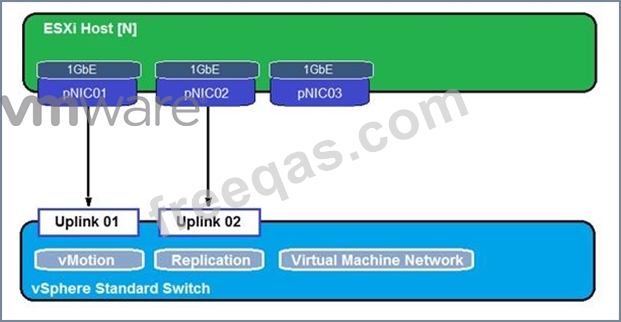
During a requirements gathering workshop, the customer shares the following about their existing ESXi host virtual networking infrastructure:
The customer confirms that:
Each ESXi host has approximately 200 virtual machines.
They want to maximize the number of concurrent virtual machine migrations.
When placing a host in maintenance mode, it takes a long time to evacuate the virtual machines.
Which two recommendations should the architect make in order to help the customer overcome their challenge? (Choose two.)

