FreeQAs
 Request Exam  Contact
  • Home
  • View All Exams
  • New QA's
  • Upload
PRACTICE EXAMS:
  • Oracle
  • Fortinet
  • IBM
  • Juniper
  • Microsoft
  • Cisco
  • Citrix
  • CompTIA
  • VMware
  • ISC
  • SAP
  • EMC
  • PMI
  • HP
  • Salesforce
  • Other
  • Oracle
    Oracle
  • Fortinet
    Fortinet
  • IBM
    IBM
  • Juniper
    Juniper
  • Microsoft
    Microsoft
  • Cisco
    Cisco
  • Citrix
    Citrix
  • CompTIA
    CompTIA
  • VMware
    VMware
  • ISC
    ISC
  • SAP
    SAP
  • EMC
    EMC
  • PMI
    PMI
  • HP
    HP
  • Salesforce
    Salesforce
  1. Home
  2. BCS Certification
  3. CTFL4 Exam
  4. BCS.CTFL4.v2025-05-12.q54 Dumps
  • «
  • 1
  • 2
  • 3
  • 4
  • 5
  • 6
  • 7
  • 8
  • 9
  • 10
  • …
  • »
  • »»
Download Now

Question 16

The statement: "Test activities should start in the early stages of the lifecycle, adhering to the testing principle of early testing" is relevant to which of the recognized software development models?

Correct Answer: D
The principle of early testing is applicable to all recognized software development models, including sequential, iterative, and incremental models. Starting test activities early in the lifecycle helps in identifying and addressing defects as soon as possible, which can save time and costs by preventing defects from propagating to later stages of development. This proactive approach enhances the overall quality and efficiency of the software development process. Reference: ISTQB CTFL Syllabus V4.0, Section 1.3
insert code

Question 17

You are testing a system that is used in motor vehicles to warn the driver of an obstacle when re-versing. Output is provided by a series of LED lights (green, yellow, and red), each illuminated based on clearly defined conditions.
The following summary describes the functionality:
* Object within 10 metres, green LED lit.
* Object within 5 metres, yellow LED lit.
* Object within 1 metre, red LED lit.
* Setting sensitivity mode to "ON" will result in only the red LED being lit when the object is within 1 metre.
The following decision table describes the rules associated with the functioning of this proximity warning system:
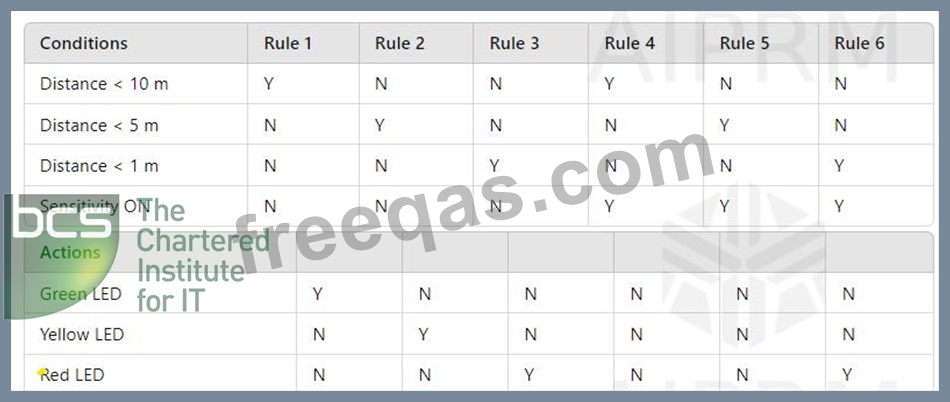
Which intended functionality is tested by Rule 5 in the decision table?

Correct Answer: D
Rule 5 in the decision table indicates that when the object is within 5 metres of the vehicle and the sensitivity mode is switched "on", no LED is lit. This matches the conditions and actions described in the decision table provided, ensuring that only the red LED is lit when the sensitivity mode is on and the object is within 1 metre, otherwise no LED is lit .
insert code

Question 18

A requirement specifies that a certain identifier (ID) must be between 5 and 10 characters long, must contain only alphanumenc characters, and its first character must be a letter As a tester, you want to apply one-dimensional equivalence partitioning to test this ID. This means that you have to apply equivalence partitioning individually: to the length of the ID, the type of characters contained within the ID, and the type of the first character of the ID. What is the number of partitions to cover?

Correct Answer: A
To apply one-dimensional equivalence partitioning to the ID requirement, we need to consider each condition individually:
Length of the ID: Valid partitions (5-10 characters), Invalid partitions (less than 5, more than 10) = 3 partitions.
Type of characters: Valid partitions (alphanumeric), Invalid partitions (non-alphanumeric) = 2 partitions.
First character: Valid partitions (letter), Invalid partitions (non-letter) = 2 partitions. Adding these partitions, we get a total of 3 (length) + 2 (character type) + 2 (first character) = 7 partitions. Thus, the correct answer is A.
insert code

Question 19

In Agile teams, testers closely collaborate with all other team members. This close collaboration could be problematic and result in testing-related organizational risks.
Which TWO of the following organization risks could be encountered?
I . Testers lose motivation and fail at their core tasks.
ii . Close interaction with developers causes a loss of the appropriate tester mindset.
iii . Testers are not able to keep pace with incoming changes in time-constrained iterations.
iv . Testers, once they have acquired technical development or business skills, leave the testing team.

Correct Answer: D
In Agile teams, close collaboration among testers and other team members can lead to organizational risks such as: ii . Close interaction with developers causes a loss of the appropriate tester mindset. iv . Testers, once they have acquired technical development or business skills, leave the testing team.
These risks highlight the potential issues of diminished testing perspective and team turnover when testers integrate closely with developers and other roles.
insert code

Question 20

Which of the following issues cannot be identified by static analysis tools?

Correct Answer: A
Static analysis tools are software tools that examine the source code of a program without executing it. They can detect various types of issues, such as syntax errors, coding standards violations, security vulnerabilities, and potential bugs12. However, static analysis tools cannot identify issues that depend on the runtime behavior or performance of the program, such as very low MTBF (Mean Time Between failure)3. MTBF is a measure of the reliability of a system or component. It is calculated by dividing the total operating time by the number of failures. MTBF reflects how often a system or component fails during its expected lifetime. Static analysis tools cannot measure MTBF because they do not run the program or observe its failures. MTBF can only be estimated by dynamic testing, which involves executing the program under various conditions and collecting data on its failures4. Therefore, very low MTBF is an issue that cannot be identified by static analysis tools. The other options, such as potentially endless loops, referencing a variable with an undefined value, and security vulnerabilities, are issues that can be identified by static analysis tools. Static analysis tools can detect potentially endless loops by analyzing the control flow and data flow of the program and checking for conditions that may never become false5. Static analysis tools can detect referencing a variable with an undefined value by checking the scope and initialization of variables and reporting any use of uninitialized variables6. Static analysis tools can detect security vulnerabilities by checking for common patterns of insecure code, such as buffer overflows, SQL injections, cross-site scripting, and weak encryption. Reference = What Is Static Analysis? Static Code Analysis Tools - Perforce Software, How Static Code Analysis Works | Perforce, Static Code Analysis: Techniques, Top 5 Benefits & 3 Challenges, What is MTBF? Mean Time Between Failures Explained | Perforce, Static analysis tools - Software Testing MCQs - CareerRide, ISTQB_Chapter3 | Quizizz, [Static Code Analysis for Security Vulnerabilities | Perforce].
insert code
  • «
  • 1
  • 2
  • 3
  • 4
  • 5
  • 6
  • 7
  • 8
  • 9
  • 10
  • …
  • »
  • »»
[×]

Download PDF File

Enter your email address to download BCS.CTFL4.v2025-05-12.q54 Dumps

Email:

FreeQAs

Our website provides the Largest and the most Latest vendors Certification Exam materials around the world.

Using dumps we provide to Pass the Exam, we has the Valid Dumps with passing guranteed just which you need.

  • DMCA
  • About
  • Contact Us
  • Privacy Policy
  • Terms & Conditions
©2026 FreeQAs

www.freeqas.com materials do not contain actual questions and answers from Cisco's certification exams.
