FreeQAs
 Request Exam  Contact
  • Home
  • View All Exams
  • New QA's
  • Upload
PRACTICE EXAMS:
  • Oracle
  • Fortinet
  • Juniper
  • Microsoft
  • Cisco
  • Citrix
  • CompTIA
  • VMware
  • ISC
  • SAP
  • EMC
  • PMI
  • HP
  • Salesforce
  • Other
  • Oracle
    Oracle
  • Fortinet
    Fortinet
  • Juniper
    Juniper
  • Microsoft
    Microsoft
  • Cisco
    Cisco
  • Citrix
    Citrix
  • CompTIA
    CompTIA
  • VMware
    VMware
  • ISC
    ISC
  • SAP
    SAP
  • EMC
    EMC
  • PMI
    PMI
  • HP
    HP
  • Salesforce
    Salesforce
  1. Home
  2. Cisco Certification
  3. 300-420 Exam
  4. Cisco.300-420.v2026-06-15.q443 Dumps
  • ««
  • «
  • …
  • 7
  • 8
  • 9
  • 10
  • 11
  • 12
  • 13
  • 14
  • 15
  • 16
  • …
  • »
  • »»
Download Now

Question 51

An architect is designing a network that will utilize the spanning tree protocol to ensure a loop-free topology.
The network will support an engineering environment where it is necessary for end users to connect their own network switches for testing purposes. Which feature should the architect include in the design to ensure the spanning tree topology is not affected by these rogue switches?

Correct Answer: D
Section: Advanced Enterprise Campus Networks
insert code

Question 52

Which two best practices must be followed when designing an out-of-band management network? (Choose two.)
Correct Answer: A,E
An out-of-band management network should be isolated from the production data network and protected with strict access control. Cisco SAFE design principles treat the management plane as a sensitive function because it provides administrative access to infrastructure devices. Isolation ensures that production outages, routing problems, or compromised user segments do not automatically remove the operator's ability to manage routers, switches, firewalls, and controllers. Access control ensures that only authorized administrators and management systems can reach the management interfaces and protocols. The management network should not be treated as a backup data path, because that undermines separation and can expose management devices to production traffic risks. It should also not be used as a general-purpose data backup network. "Facilitate network integration" is too vague and can conflict with the isolation requirement. Therefore, the best practices are to enforce access control and ensure network isolation. In a mature design, this normally includes dedicated management interfaces or VRFs, jump hosts, AAA, logging, and tightly controlled management protocol access.
insert code

Question 53


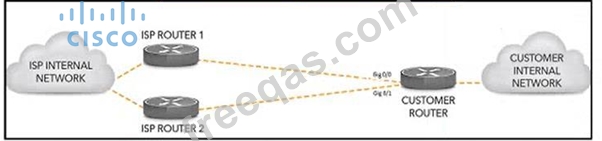
Refer to the exhibit. A customer has two eBGP peerings from a single CE router toward two service providers. The customer has hired an architect to design a solution to ensure certain traffic enters the customer
' s network through interface g¡g0/0. Which solution must the architect include in the design?

Correct Answer: C
Advertising more-specific prefixes toward the preferred service provider is the correct way to influence inbound traffic to enter through a chosen CE interface. BGP inbound path control is indirect: the enterprise cannot set local preference inside remote autonomous systems, and MED is honored only under specific provider policies. The most deterministic option available to the customer is to advertise a longer-prefix route to the preferred provider because Internet and BGP route selection generally prefer the longest matching prefix before BGP path attributes are considered. If the aggregate is advertised to both providers but a more- specific route is advertised to the provider connected to gig0/0, return traffic for that more- specific destination is attracted through that interface. Lowering MED toward the less preferred provider is the opposite of the desired effect. AS-path prepending toward the preferred provider would make that path less attractive. Local preference affects outbound path selection inside the local AS, not inbound traffic from external networks. Reference topics: BGP inbound traffic engineering, longest-prefix match, route aggregation, AS-path prepending, MED, local preference.
insert code

Question 54

What is the role of a control-plane node in a Cisco SD-Access architecture?

Correct Answer: B
The control-plane node in Cisco SD-Access acts as the map system that manages endpoint-to-device relationships. Cisco SD-Access documentation describes control-plane nodes as maintaining the host database that maps endpoint identifiers to the fabric edge devices where those endpoints are attached. This mapping function is based on LISP control-plane behavior. When an endpoint appears on an edge node, the edge registers the endpoint information with the control plane. When another fabric device needs to send traffic to that endpoint, it queries the control-plane node to resolve the endpoint location. A fabric edge node is the device that connects wired endpoints to the fabric, so option A describes an edge role. Wireless endpoints may attach through fabric AP and fabric WLC integration, but that is not the control-plane node's role.
External Layer 3 networks are connected through border nodes, not through the control-plane node.
Therefore, the correct role is endpoint-to-device mapping. Accurate control-plane design is essential for fabric scale, endpoint mobility, and fast location resolution.
insert code

Question 55

An engineer is tasked with designing a dual BGP peering solution with a service provider. The design must meet these conditions:
* The routers will not learn any prefix with a subnet mask greater than /24.
* The routers will determine the routes to include in the routing table based on the length of the mask alone.
* The routers will make this selection regardless of the service provider configuration.
Which solution should the engineer include in the design?


Correct Answer: D
An inbound IP prefix list is the correct tool because the routers must decide which prefixes to accept from the service provider based only on prefix length. Prefix lists are designed to match network prefixes and mask- length ranges using operators such as le and ge. Applying the prefix list inbound to the BGP neighbors prevents routes with masks longer than /24 from entering the local BGP table, regardless of what the service provider advertises. This conserves memory and ensures the customer routing policy is enforced locally. An access list is a poor fit because it does not natively express prefix-length logic as cleanly as a prefix list.
Applying the policy outbound would filter routes the customer sends to the provider, which is the wrong direction; the requirement is about routes the customer learns. A route map could reference a prefix list, but the simplest and most exact answer is to use an IP prefix list inbound. Therefore, the design should apply an inbound prefix list to both BGP peers to block prefixes greater than /24. Reference topics: BGP route filtering, prefix lists, inbound policy, maximum accepted prefix length.
insert code
  • ««
  • «
  • …
  • 7
  • 8
  • 9
  • 10
  • 11
  • 12
  • 13
  • 14
  • 15
  • 16
  • …
  • »
  • »»
[×]

Download PDF File

Enter your email address to download Cisco.300-420.v2026-06-15.q443 Dumps

Email:

FreeQAs

Our website provides the Largest and the most Latest vendors Certification Exam materials around the world.

Using dumps we provide to Pass the Exam, we has the Valid Dumps with passing guranteed just which you need.

  • DMCA
  • About
  • Contact Us
  • Privacy Policy
  • Terms & Conditions
©2026 FreeQAs

www.freeqas.com materials do not contain actual questions and answers from Cisco's certification exams.