FreeQAs
 Request Exam  Contact
  • Home
  • View All Exams
  • New QA's
  • Upload
PRACTICE EXAMS:
  • Oracle
  • Fortinet
  • Juniper
  • Microsoft
  • Cisco
  • Citrix
  • CompTIA
  • VMware
  • ISC
  • SAP
  • EMC
  • PMI
  • HP
  • Salesforce
  • Other
  • Oracle
    Oracle
  • Fortinet
    Fortinet
  • Juniper
    Juniper
  • Microsoft
    Microsoft
  • Cisco
    Cisco
  • Citrix
    Citrix
  • CompTIA
    CompTIA
  • VMware
    VMware
  • ISC
    ISC
  • SAP
    SAP
  • EMC
    EMC
  • PMI
    PMI
  • HP
    HP
  • Salesforce
    Salesforce
  1. Home
  2. Cisco Certification
  3. 300-420 Exam
  4. Cisco.300-420.v2026-06-15.q443 Dumps
  • ««
  • «
  • …
  • 69
  • 70
  • 71
  • 72
  • 73
  • 74
  • 75
  • 76
  • 77
  • 78
  • …
  • »
  • »»
Download Now

Question 361

An architect is designing a network solution for a customer The network is IPv6-only with 1000 hosts. The design must provide external access to up to 10 concurrent IPv6 hosts to allow communication with legacy IPv4 devices on an adjacent network. The customer set aside 10 IPv4 addresses to allow for one-to-one communication between hosts. Which solution must the architect select ?

Correct Answer: A
Stateful NAT64 is the correct design because IPv6-only hosts must communicate with legacy IPv4 devices and only a small pool of IPv4 addresses is available for concurrent sessions. NAT64 translates IPv6 client traffic into IPv4 traffic, allowing IPv6-only endpoints to reach IPv4-only resources. A stateful implementation maintains translation state and can use a pool of IPv4 addresses for multiple IPv6 clients, which fits the requirement for up to 10 concurrent IPv6 hosts using 10 reserved IPv4 addresses. Static NAT- PT would require fixed one-to-one mappings and is less suitable for a pool-based concurrent access model. NAT66 translates between IPv6 prefixes and does not solve access to IPv4-only devices. Dynamic NAT-PT is an older transition mechanism and is not the preferred modern answer when NAT64 is available. The design should also include DNS64 when clients access IPv4-only services by name. Reference topics: IPv6 transition, stateful NAT64, DNS64, IPv6-only hosts, IPv4 legacy reachability.
insert code

Question 362

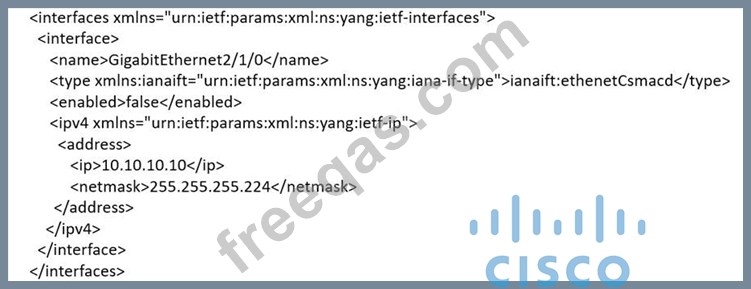
An engineer must use YANG with an XML representation to configure a Cisco IOS XE switch with these specifications:
* IP address 10.10.10.10/27 configured on the interface GigabitEthernet2/1/0
* connectivity from a directly connected host 10.10.10.1/27
Which YANG data model set must the engineer choose?
A)
B)

C)

D)

Correct Answer: C
insert code

Question 363

Which consideration must be made when designing a Cisco SD-Access fabric underlay?

Correct Answer: C
insert code

Question 364


Refer to the exhibit. A network engineer must design a BGP solution based on:
* The route reflector must have one or more direct physical connections to the core routers (R3 and R4).
* The route reflector must have full redundancy and avoid a single point of failure.
* R2 to R1 link utilization is 90%. and the remaining links are less than 50% utilized.
Which two solutions must the design Include? (Choose two.)

Correct Answer: B,E
The route-reflector design should make R2 a client of R1 and R4, and R5 a client of R3 and R4. The requirement states that the route reflector must have direct physical connections to the core routers R3 and R4, must avoid a single point of failure, and must account for high utilization on the R2-to-R1 link. In BGP route- reflector design, clients peer with redundant route reflectors so they can continue receiving reflected routes if one route reflector or path fails. Placing R5 as a client of R3 and R4 satisfies the direct-core requirement and provides redundant reflection through the core. Placing R2 as a client of R1 and R4 provides redundancy while reducing dependence on the heavily utilized R2-to-R1 link by including R4 as an alternate reflector.
Making a router a client of two reflectors is a standard design technique for route-reflector high availability.
The other combinations either fail the direct-core requirement, do not provide balanced redundancy, or keep traffic tied to the congested link. Reference topics: BGP route reflectors, client redundancy, iBGP scaling, route-reflector placement, core resiliency.
insert code

Question 365

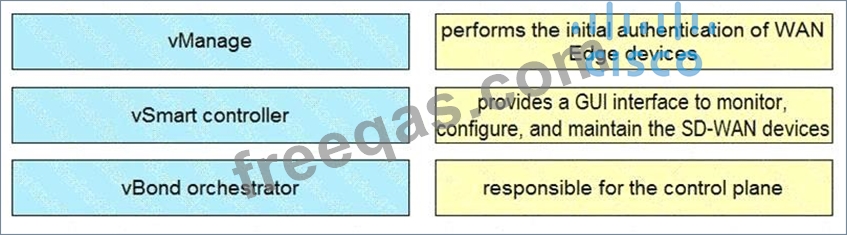
Drag and drop the elements from the left onto the functions they perform in the Cisco SD-WAN architecture on the right.
Correct Answer:

Explanation:
The Cisco SD-WAN architecture mapping follows the standard controller and edge roles. WAN Edge devices are the data-plane routers that forward user traffic, build secure IPsec tunnels, participate in local routing, and apply QoS and security policies at sites. vSmart controllers provide the centralized control plane. They maintain overlay routing and policy information and distribute it to WAN Edge routers through OMP. vBond orchestrators provide the initial orchestration function, including device authentication assistance, control connection coordination, and NAT traversal support so devices can join the overlay. Depending on the exact drag-and-drop labels in the exhibit, the selected mapping assigns each element to its architectural function rather than to a deployment location. The important design principle is that vManage, vSmart, vBond, and WAN Edge have separate responsibilities and should be scaled and secured accordingly. vManage manages and monitors, vSmart controls routing and policy, vBond helps devices join and traverse NAT, and WAN Edge forwards traffic. Reference topics: Cisco SD-WAN architecture, WAN Edge, vSmart, vBond, OMP, control and data plane separation.
insert code
  • ««
  • «
  • …
  • 69
  • 70
  • 71
  • 72
  • 73
  • 74
  • 75
  • 76
  • 77
  • 78
  • …
  • »
  • »»
[×]

Download PDF File

Enter your email address to download Cisco.300-420.v2026-06-15.q443 Dumps

Email:

FreeQAs

Our website provides the Largest and the most Latest vendors Certification Exam materials around the world.

Using dumps we provide to Pass the Exam, we has the Valid Dumps with passing guranteed just which you need.

  • DMCA
  • About
  • Contact Us
  • Privacy Policy
  • Terms & Conditions
©2026 FreeQAs

www.freeqas.com materials do not contain actual questions and answers from Cisco's certification exams.
