FreeQAs
 Request Exam  Contact
  • Home
  • View All Exams
  • New QA's
  • Upload
PRACTICE EXAMS:
  • Oracle
  • Fortinet
  • Juniper
  • Microsoft
  • Cisco
  • Citrix
  • CompTIA
  • VMware
  • ISC
  • SAP
  • EMC
  • PMI
  • HP
  • Salesforce
  • Other
  • Oracle
    Oracle
  • Fortinet
    Fortinet
  • Juniper
    Juniper
  • Microsoft
    Microsoft
  • Cisco
    Cisco
  • Citrix
    Citrix
  • CompTIA
    CompTIA
  • VMware
    VMware
  • ISC
    ISC
  • SAP
    SAP
  • EMC
    EMC
  • PMI
    PMI
  • HP
    HP
  • Salesforce
    Salesforce
  1. Home
  2. Cisco Certification
  3. 300-420 Exam
  4. Cisco.300-420.v2026-06-15.q443 Dumps
  • ««
  • «
  • …
  • 73
  • 74
  • 75
  • 76
  • 77
  • 78
  • 79
  • 80
  • 81
  • 82
  • …
  • »
  • »»
Download Now

Question 381

An engineer must design a large Layer 2 domain that contains hundreds of switches and VLANs. The engineer's primary goals are to:
* Efficiently utilize the bandwidth of all links
* Avoid Layer 2 loops
* Cause minimal impact on switch CPU and memory
Which technology should the engineer include in the design?
Correct Answer: B
insert code

Question 382


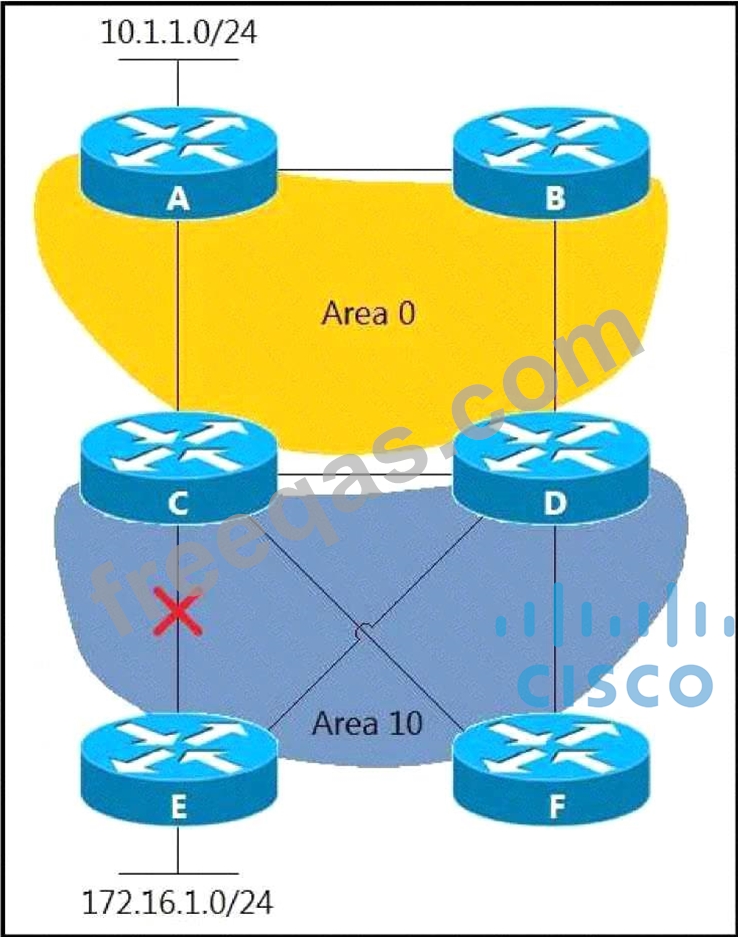
Refer to the exhibit. Area 10 is a regular OSPF area and networks 10.1.1.0/24 and 172.16.1.0/24 are internal.
Which design provides optimal routing between both networks when the link between routers C and E fails?

Correct Answer: D
insert code

Question 383

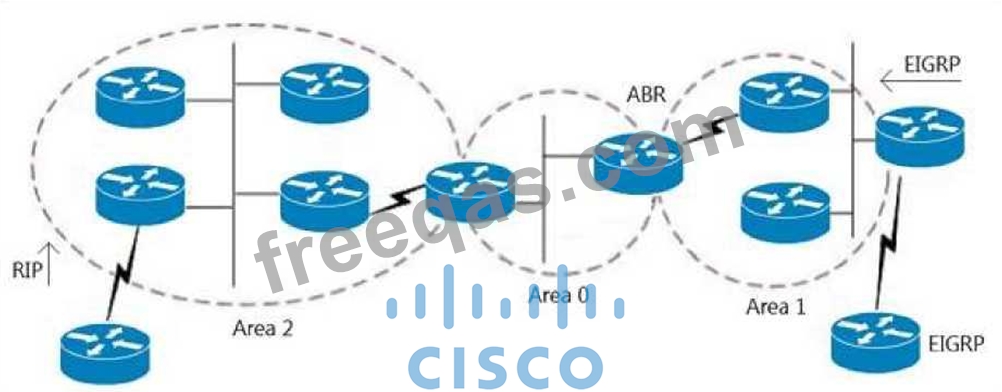
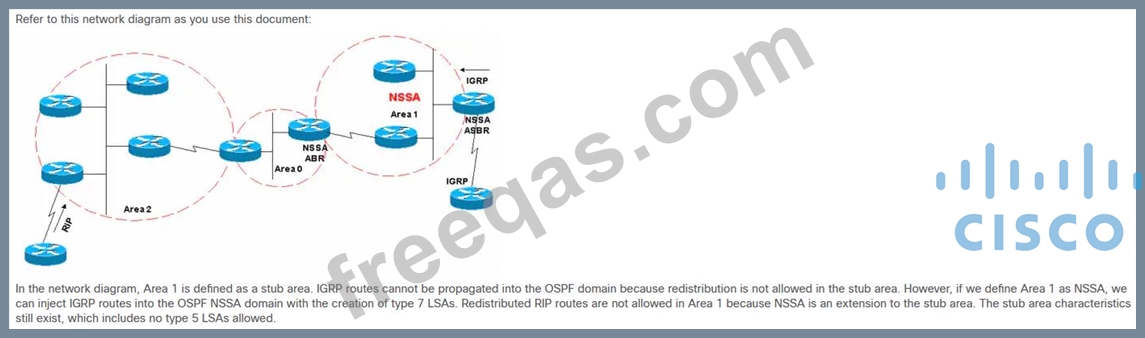
Refer to the exhibit.

Refer to the exhibit. An engineer is designing an OSPF network for a client. Requirements dictate that the routers in Area 1 should receive all routes belonging to the network, including EIGRP, except the ones originated in the RIP domain. Which action should the engineer take?
Correct Answer: A
insert code

Question 384

When expanding an existing Cisco SD-Access network, in addition to the control plane, which two device roles are needed to create an additional fabric site? (Choose two.)

Correct Answer: D,E
An additional Cisco SD-Access fabric site requires edge and border roles in addition to the control-plane function. Edge nodes connect wired endpoints, access-layer devices, and sometimes access points into the fabric. They perform endpoint detection, anycast gateway functions, and fabric encapsulation for user traffic.
Border nodes provide connectivity between the fabric site and external networks such as the WAN, data center, internet edge, or shared services. Without edge nodes, the site has no practical access-layer fabric attachment for endpoints. Without border nodes, the site cannot properly exchange traffic with resources outside the local fabric. A wireless LAN controller may be needed when fabric wireless is part of the design, but it is not one of the mandatory fabric roles for every additional site. Leaf and cEdge are not Cisco SD- Access fabric roles in this context. Reference topics: Cisco SD-Access fabric roles, edge node, border node, control-plane node, fabric site expansion.
insert code

Question 385

What is the purpose of Cisco Catalyst SD-WAN Cloud OnRamp?

Correct Answer: C
Cisco Catalyst SD-WAN Cloud OnRamp is designed to automate and streamline the connection between on-premises sites and cloud environments, making it simple to extend the SD-WAN fabric to public clouds and SaaS providers.
insert code
  • ««
  • «
  • …
  • 73
  • 74
  • 75
  • 76
  • 77
  • 78
  • 79
  • 80
  • 81
  • 82
  • …
  • »
  • »»
[×]

Download PDF File

Enter your email address to download Cisco.300-420.v2026-06-15.q443 Dumps

Email:

FreeQAs

Our website provides the Largest and the most Latest vendors Certification Exam materials around the world.

Using dumps we provide to Pass the Exam, we has the Valid Dumps with passing guranteed just which you need.

  • DMCA
  • About
  • Contact Us
  • Privacy Policy
  • Terms & Conditions
©2026 FreeQAs

www.freeqas.com materials do not contain actual questions and answers from Cisco's certification exams.