FreeQAs
 Request Exam  Contact
  • Home
  • View All Exams
  • New QA's
  • Upload
PRACTICE EXAMS:
  • Oracle
  • Fortinet
  • Juniper
  • Microsoft
  • Cisco
  • Citrix
  • CompTIA
  • VMware
  • ISC
  • SAP
  • EMC
  • PMI
  • HP
  • Salesforce
  • Other
  • Oracle
    Oracle
  • Fortinet
    Fortinet
  • Juniper
    Juniper
  • Microsoft
    Microsoft
  • Cisco
    Cisco
  • Citrix
    Citrix
  • CompTIA
    CompTIA
  • VMware
    VMware
  • ISC
    ISC
  • SAP
    SAP
  • EMC
    EMC
  • PMI
    PMI
  • HP
    HP
  • Salesforce
    Salesforce
  1. Home
  2. Cisco Certification
  3. 300-420 Exam
  4. Cisco.300-420.v2026-06-15.q443 Dumps
  • ««
  • «
  • …
  • 70
  • 71
  • 72
  • 73
  • 74
  • 75
  • 76
  • 77
  • 78
  • 79
  • …
  • »
  • »»
Download Now

Question 366


Refer to the exhibit. EIGRP has been configured on all links. The spoke nodes have been configured as EIGRP stubs, and the WAN links to R3 have higher bandwidth and lower delay than the links to R4. When a link failure occurs at the R1-R2 link, what happens to traffic on R1 that is destined for a subnet attached to R2?

Correct Answer: C
insert code

Question 367

Drag and drop the components in a Cisco SD-Access architecture from the left onto their descriptions on the right.

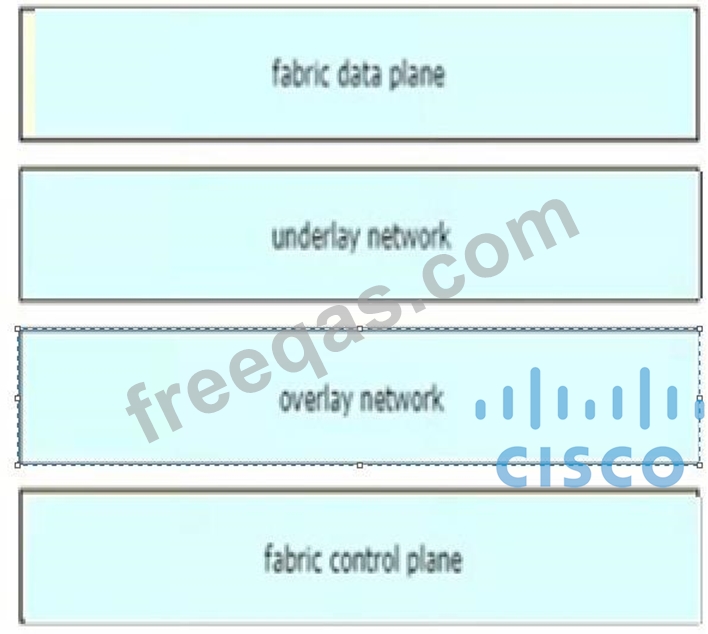
Correct Answer:

insert code

Question 368

What is the purpose of a Cisco SD-Access underlay network?

Correct Answer: C
The Cisco SD-Access underlay provides the physical and IP transport foundation that allows fabric nodes to reach each other. In plain terms, it is the routed connectivity built from the switches, routers, links, and loopback reachability that the overlay depends on. Cisco SD-Access then uses the overlay to provide virtualization, segmentation, policy, and endpoint mobility on top of that transport. This is why the underlay is best described as establishing the connectivity between the switches and routers that form the fabric. Option A describes the abstraction performed by the overlay, not the underlay. Option B is closer to a Layer 2 tunneling description and is not the main purpose of the SD-Access underlay. Option D describes encapsulated overlay behavior, especially VXLAN-based data-plane transport, not the physical/routed foundation itself. A good SD- Access design validates underlay reachability, routing adjacencies, MTU, loopback advertisement, and redundancy before onboarding the overlay services. Without a stable underlay, LISP control-plane mappings and VXLAN data-plane forwarding cannot operate predictably. Reference topics: SD-Access underlay, routed campus foundation, fabric node reachability, overlay dependency.
insert code

Question 369

Refer to the exhibit. An architect designed a BGP routing solution to reduce the number of IBGP peerings to conserve resources. The original design had a total of 36 IBGP peerings. The new design reduces the number of peerings by how many?

Correct Answer: A
The design uses three BGP route reflector clusters. Each three-router cluster requires three internal peerings, for a total of nine, and the three route reflectors require three peerings among themselves. The new design therefore uses 12 IBGP peerings, reducing the original 36 peerings by 24.
insert code

Question 370

How is sub-second failure of a transport link detected in a Cisco SD-WAN network?

Correct Answer: B
Cisco SD-WAN detects subsecond transport failure by running BFD across the IPsec tunnels between WAN Edge routers. The WAN Edge devices form encrypted data-plane tunnels over each transport, and BFD probes those tunnels to measure liveliness, loss, latency, jitter, and path availability. When BFD detects a failed or degraded tunnel, the SD-WAN fabric can withdraw or avoid that path quickly, enabling application- aware routing and fast failover. Hellos between WAN Edge routers and vSmart controllers are control-plane mechanisms and do not directly detect data-plane transport failure between edge routers. BGP is not the SD- WAN overlay control protocol for this function; OMP is used with vSmart for overlay route and policy exchange. Link-state messages between vSmart controllers do not measure transport-path liveliness.
Therefore, BFD on IPsec tunnels is the correct failure-detection mechanism. The design should ensure that BFD timers, tunnel scale, controller policy, and SLA classes are chosen to balance fast failover with platform resources and transport stability. Reference topics: Cisco SD-WAN BFD, IPsec tunnels, transport failure detection, application-aware routing, data-plane liveliness.
insert code
  • ««
  • «
  • …
  • 70
  • 71
  • 72
  • 73
  • 74
  • 75
  • 76
  • 77
  • 78
  • 79
  • …
  • »
  • »»
[×]

Download PDF File

Enter your email address to download Cisco.300-420.v2026-06-15.q443 Dumps

Email:

FreeQAs

Our website provides the Largest and the most Latest vendors Certification Exam materials around the world.

Using dumps we provide to Pass the Exam, we has the Valid Dumps with passing guranteed just which you need.

  • DMCA
  • About
  • Contact Us
  • Privacy Policy
  • Terms & Conditions
©2026 FreeQAs

www.freeqas.com materials do not contain actual questions and answers from Cisco's certification exams.
