FreeQAs
 Request Exam  Contact
  • Home
  • View All Exams
  • New QA's
  • Upload
PRACTICE EXAMS:
  • Oracle
  • Fortinet
  • Juniper
  • Microsoft
  • Cisco
  • Citrix
  • CompTIA
  • VMware
  • ISC
  • SAP
  • EMC
  • PMI
  • HP
  • Salesforce
  • Other
  • Oracle
    Oracle
  • Fortinet
    Fortinet
  • Juniper
    Juniper
  • Microsoft
    Microsoft
  • Cisco
    Cisco
  • Citrix
    Citrix
  • CompTIA
    CompTIA
  • VMware
    VMware
  • ISC
    ISC
  • SAP
    SAP
  • EMC
    EMC
  • PMI
    PMI
  • HP
    HP
  • Salesforce
    Salesforce
  1. Home
  2. Cisco Certification
  3. 300-540 Exam
  4. Cisco.300-540.v2026-04-02.q62 Dumps
  • «
  • 1
  • 2
  • 3
  • 4
  • 5
  • 6
  • 7
  • 8
  • 9
  • 10
  • …
  • »
  • »»
Download Now

Question 1

The main purpose of using IPsec VPN for WAN connectivity is to:

Correct Answer: C
insert code

Question 2

VNF workload optimization often involves:

Correct Answer: C
insert code

Question 3


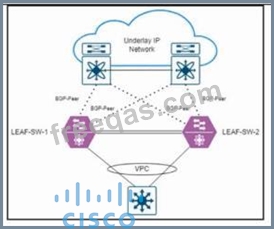
Refer to the exhibit. An engineer is troubleshooting an issue where switch LEAF-SW-1 and switch LEAF- SW-2 receive corrupted forwarding and learning information about each other. LEAF-SW-1 and LEAF-SW-2 are configured with BGP EVPN VTEP. Which action resolves the issue?

Correct Answer: C
In a VXLAN BGP EVPN fabric, each VTEP (NVE interface) must useBGP EVPN as the host-reachability protocolso that MAC/IP information and VTEP reachability are exchanged through the control plane.
From the exhibit:
* LEAF-SW-1 - interface nve1
* source-interface loopback0
* No host-reachability protocol bgp
* Host Learning Mode: Data-Plane in show nve interface
* LEAF-SW-2 - interface nve1
* source-interface loopback0
* host-reachability protocol bgp configured
This mismatch causes one VTEP to rely ondata-plane flood-and-learn, while the other usesEVPN BGP control-plane learning, leading to inconsistent and "corrupted" MAC/IP and ARP/ND information between the leaf switches.
The fix is to configure LEAF-SW-1 to also use BGP for host reachability:
interface nve1
host-reachability protocol bgp
Options B and D are incorrect because anycast VTEP designs intentionally share the sameprimaryloopback IP while usingdifferent secondary IPsandunique BGP router IDs. Option A (removing suppress-arp) does not correct the control-plane mismatch.
Therefore, enabling host-reachability protocol bgp on LEAF-SW-1 (OptionC) resolves the issue.
insert code

Question 4

An engineer must configure NTP servers in Cisco Enterprise NFVIS. The primary NTP server has an IP address of 192.168.1.1 and the backup NTP server has an IP address of 192.168.2.1. Which two commands must be run to complete the configuration? (Choose two.)

Correct Answer: A,E
InCisco Enterprise NFVIS, time synchronization is configured using thesystem time ntpcommand structure.
NFVIS requires a primary and optionally a backup NTP server to maintain accurate system time for the hypervisor and guest VMs.
Correct NFVIS command syntax for NTP configuration:
* system time ntp preferred_server <IP>This command configures thepreferred (primary)NTP server used for system clock synchronization.
* system time ntp backup_server <IP>This command configures thebackupNTP server, which the system uses if the primary becomes unreachable.
These two commands match Cisco NFVIS time-configuration behavior described in NFV infrastructure design and implementation guidelines.
Why the Correct Answers Are A and E
Option A: system time ntp preferred_server 192.168.1.1
This properly configures the primary NTP server in NFVIS. The preferred server is always the first choice for time synchronization.
Option E: system time ntp backup_server 192.168.2.1
This correctly configures the backup NTP server. If the preferred server fails, NFVIS automatically falls back to the backup server.
Both commands directly match NFVIS's NTP command hierarchy and are the only ones that correctly apply to NFVIS.
Why the Other Options Are Not Correct
Option Buses utils ntp, which is not an NFVIS command.
Option Csets manual time and does not configure NTP servers.
Option Dalso uses the utils ntp syntax, which applies to other Cisco platforms but not NFVIS.
insert code

Question 5

An engineer must design a cloud platform forevent-driven applications. The solution must allowmicro-sized atomic componentsto be built, deployed, and run code on demand. Which solution must be used?


Correct Answer: B
Comprehensive and Detailed Explanation From Cisco Cloud Architecture Knowledge Event-driven applications require:
* Stateless, micro-sized execution units
* Automatic scaling
* Code that runsonlywhen triggered
* No server or VM lifecycle management
This model is known asFunction-as-a-Service (FaaS).
Cisco FaaSprovides:
* Serverless execution
* Event-driven triggers
* Deployment of atomic micro-functions
* Automatic scaling and resource abstraction
* Ideal environment for microservices and cloud-native workloads
Why the others are incorrect:
* A. Cisco+ Hybrid Cloud for VDI# delivers desktops, not serverless compute
* C. Cisco+ Hybrid Cloud Virtualization# VM-based infrastructure, not event-driven micro-functions
* D. Cisco Intersight# operational management tool, not a serverless execution platform
insert code
  • «
  • 1
  • 2
  • 3
  • 4
  • 5
  • 6
  • 7
  • 8
  • 9
  • 10
  • …
  • »
  • »»
[×]

Download PDF File

Enter your email address to download Cisco.300-540.v2026-04-02.q62 Dumps

Email:

FreeQAs

Our website provides the Largest and the most Latest vendors Certification Exam materials around the world.

Using dumps we provide to Pass the Exam, we has the Valid Dumps with passing guranteed just which you need.

  • DMCA
  • About
  • Contact Us
  • Privacy Policy
  • Terms & Conditions
©2026 FreeQAs

www.freeqas.com materials do not contain actual questions and answers from Cisco's certification exams.