An engineer must implement a SaaS solution that will use a Cisco ASAv to enhance security for enterprise customers by using Cisco Crosswork NSO. Which command must be run in NSO?
Correct Answer: C
Comprehensive and Detailed Explanation From Cisco NSO Orchestration Knowledge In Cisco NSO deployments: * ncs-setupis only used once, during initial NSO instance creation. * ls -l nso-instance/packages/simply lists packages - not used to start NSO. * ncs -statuschecks status but doesnotrun NSO. To actuallystart the NSO serviceso that device packages (including ASAv service packages) can be loaded and orchestration can begin, the correct command is: ncs This launches the NSO runtime and loads all configured packages, enabling the SaaS ASAv service.
Question 7
OpenStack is:
Correct Answer: B
Question 8
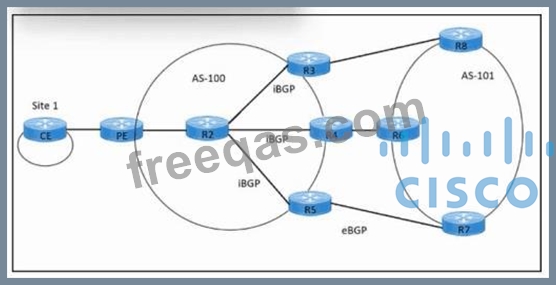
Refer to the exhibit. An engineer working for a private service provider with an employee ID 5207:22:409 must configure iBGP multipath load sharing across the three paths. Which two commands must be run on the PE router? (Choose two.)
Correct Answer: A,E
In the diagram, thePE and R2, R3, R4, R5belong toAS 100. The PE router runs BGP processAS 100, so its BGP configuration must start with: router bgp 100 To performiBGP multipath load sharingacross three equal-cost internal BGP paths, BGP must be instructed to keep and use multiple iBGP paths in the routing table. This is done with: router bgp 100 maximum-paths ibgp 3 * maximum-paths ibgp 3 tells BGP to install up tothreeiBGP paths to the same prefix, enabling CEF to load-share across those paths. * router bgp 100 is required because the PE is inAS 100, not 101. Other options: * ip load-sharing per-destination affects CEF behavior but does not enable BGP iBGP multipath by itself and is not specific to three iBGP paths. * ip load-sharing ibgp 3 is not a valid IOS BGP command. * router bgp 101 would configure the wrong AS and break the iBGP relationships shown in AS-100. Thus, the correct commands on the PE to achieve iBGP multipath load sharing over the three internal paths are maximum-paths ibgp 3androuter bgp 100, corresponding toA and E.
Question 9
What does enabling gRPC allow in Cisco NFVI Assurance and Monitoring?
Correct Answer: A
Comprehensive and Detailed Explanation In Cisco NFV Infrastructure (NFVI) Assurance and Monitoring, enabling gRPC activates the device's ability to support model-driven telemetry streaming. Key points from Cisco SP Cloud/NFVI design principles: gRPC is used as the transport protocol for model-driven telemetry. Telemetry replaces traditional polling methods (SNMP, CLI scraping) with continuous, push-based updates. It allows NFVI components to stream real-time operational data (CPU, memory, interfaces, VM metrics, fabric state) to collectors such as Cisco Crosswork, InfluxDB, Prometheus, or other analytic systems. gRPC does not provide NetFlow/IPFIX export or syslog itself; those are separate subsystems. Evaluation of options: A). telemetry streaming - Correct. gRPC enables model-driven streaming telemetry. B). IPFIX monitoring - Incorrect; IPFIX uses UDP exports, not gRPC. C). Cisco IOS NetFlow monitoring - Incorrect; uses NetFlow export protocols. D). system logging - Incorrect; syslog uses UDP/TCP, not gRPC.