A security administrator is given the security and availability profiles for servers that are being deployed.
* Match each RAID type with the correct configuration and MINIMUM number of drives.
* Review the server profiles and match them with the appropriate RAID type based on integrity, availability, I/O, storage requirements. Instructions:
* All drive definitions can be dragged as many times as necessary
* Not all placeholders may be filled in the RAID configuration boxes
* If parity is required, please select the appropriate number of parity checkboxes
* Server profiles may be dragged only once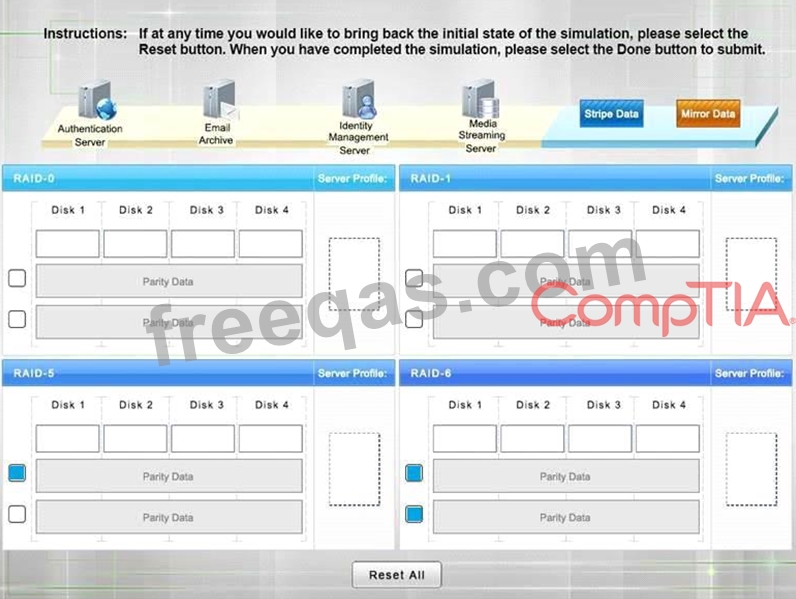
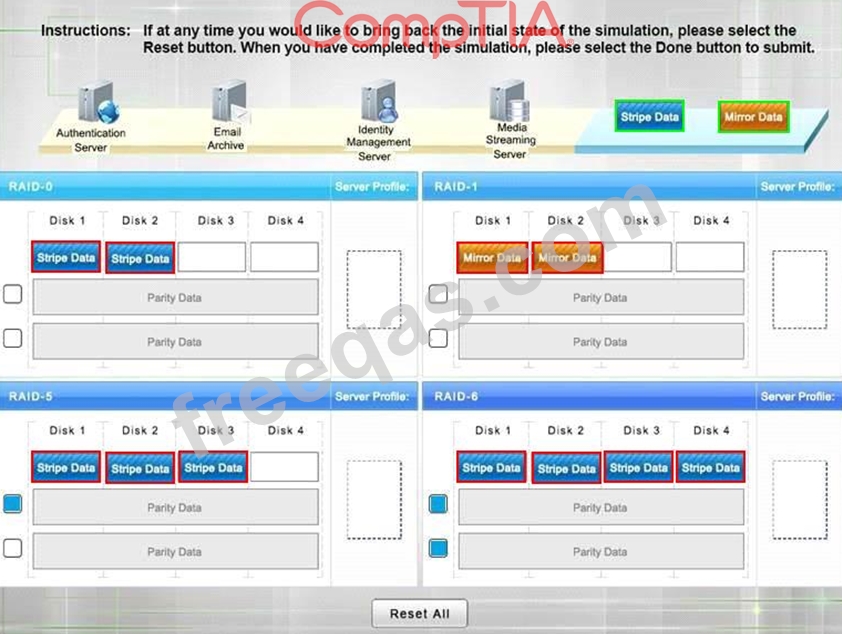
RAID-0 is known as striping. It is not a fault tolerant solution but does improve disk performance for read/write operations. Striping requires a minimum of two disks and does not use parity.
RAID-0 can be used where performance is required over fault tolerance, such as a media streaming server.
RAID-1 is known as mirroring because the same data is written to two disks so that the two disks have identical data. This is a fault tolerant solution that halves the storage space. A minimum of two disks are used in mirroring and does not use parity. RAID-1 can be used where fault tolerance is required over performance, such as on an authentication server. RAID-5 is a fault tolerant solution that uses parity and striping. A minimum of three disks are required for RAID-5 with one disk's worth of space being used for parity information. However, the parity information is distributed across all the disks. RAID-5 can recover from a sing disk failure.
RAID-6 is a fault tolerant solution that uses dual parity and striping. A minimum of four disks are required for RAID-6. Dual parity allows RAID-6 to recover from the simultaneous failure of up to two disks. Critical data should be stored on a RAID-6 system.
http://www.adaptec.com/en-us/solutions/raid_levels.html
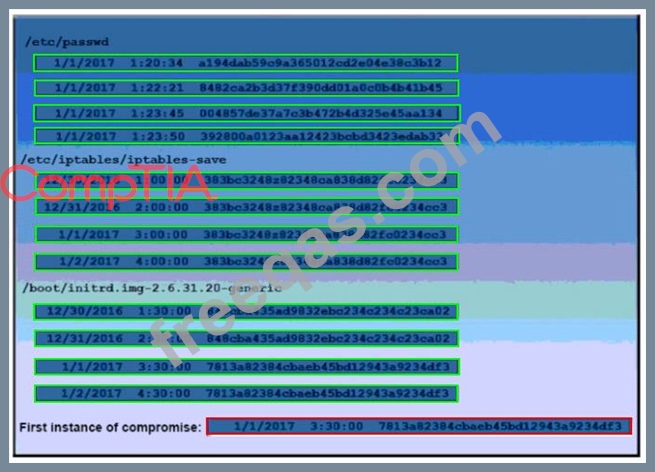
A security auditor is reviewing the following output from file integrity monitoring software installed on a very busy server at a large service provider. The server has not been updates since it was installed. Drag and drop the log entry that identifies the first instance of server compromise.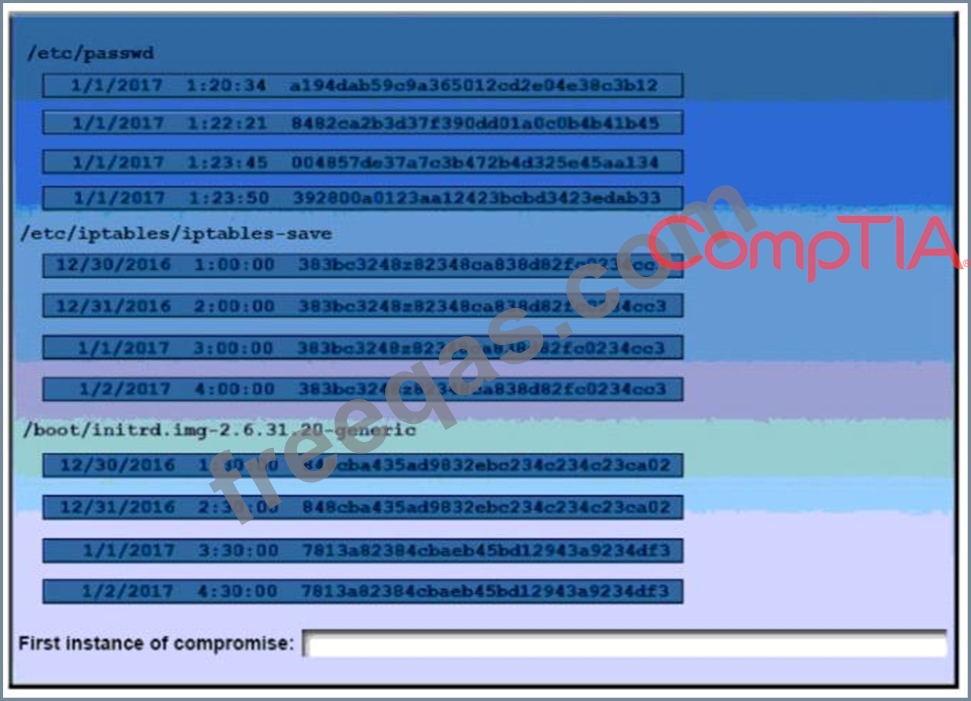
Which of the following types of attacks precedes the installation of a rootkit on a server?
A forensics analyst is investigating a hard drive for evidence of suspected illegal activity. Which of the following should the analyst do FIRST?
Which of the following help find current and future gaps in an existing COOP?

