FreeQAs
 Request Exam  Contact
  • Home
  • View All Exams
  • New QA's
  • Upload
PRACTICE EXAMS:
  • Oracle
  • Fortinet
  • IBM
  • Juniper
  • Microsoft
  • Cisco
  • Citrix
  • CompTIA
  • VMware
  • ISC
  • SAP
  • EMC
  • PMI
  • HP
  • Salesforce
  • Other
  • Oracle
    Oracle
  • Fortinet
    Fortinet
  • IBM
    IBM
  • Juniper
    Juniper
  • Microsoft
    Microsoft
  • Cisco
    Cisco
  • Citrix
    Citrix
  • CompTIA
    CompTIA
  • VMware
    VMware
  • ISC
    ISC
  • SAP
    SAP
  • EMC
    EMC
  • PMI
    PMI
  • HP
    HP
  • Salesforce
    Salesforce
  1. Home
  2. Databricks Certification
  3. Databricks-Certified-Professional-Data-Engineer Exam
  4. Databricks.Databricks-Certified-Professional-Data-Engineer.v2024-05-28.q108 Dumps
  • ««
  • «
  • …
  • 6
  • 7
  • 8
  • 9
  • 10
  • 11
  • 12
  • 13
  • 14
  • 15
  • …
  • »
  • »»
Download Now

Question 46

A Spark job is taking longer than expected. Using the Spark UI, a data engineer notes that the Min, Median, and Max Durations for tasks in a particular stage show the minimum and median time to complete a task as roughly the same, but the max duration for a task to be roughly 100 times as long as the minimum.
Which situation is causing increased duration of the overall job?

Correct Answer: D
This is the correct answer because skew is a common situation that causes increased duration of the overall job. Skew occurs when some partitions have more data than others, resulting in uneven distribution of work among tasks and executors. Skew can be caused by various factors, such as skewed data distribution, improper partitioning strategy, or join operations with skewed keys. Skew can lead to performance issues such as long-running tasks, wasted resources, or even task failures due to memory or disk spills. Verified References:
[Databricks Certified Data Engineer Professional], under "Performance Tuning" section; Databricks Documentation, under "Skew" section.
insert code

Question 47

A table in the Lakehouse namedcustomer_churn_paramsis used in churn prediction by the machine learning team. The table contains information about customers derived from a number of upstream sources. Currently, the data engineering team populates this table nightly by overwriting the table with the current valid values derived from upstream data sources.
The churn prediction model used by the ML team is fairly stable in production. The team is only interested in making predictions on records that have changed in the past 24 hours.
Which approach would simplify the identification of these changed records?

Correct Answer: E
Explanation
The approach that would simplify the identification of the changed records is to replace the current overwrite logic with a merge statement to modify only those records that have changed, and write logic to make predictions on the changed records identified by the change data feed. This approach leverages the Delta Lake features of merge and change data feed, which are designed to handle upserts and track row-level changes in a Delta table12. By using merge, the data engineering team can avoid overwriting the entire table every night, and only update or insert the records that have changed in the source data. By using change data feed, the ML team can easily access the change events that have occurred in the customer_churn_params table, and filter them by operation type (update or insert) and timestamp. This way, they can only make predictions on the records that have changed in the past 24 hours, and avoid re-processing the unchanged records.
The other options are not as simple or efficient as the proposed approach, because:
Option A would require applying the churn model to all rows in the customer_churn_params table, which would be wasteful and redundant. It would also require implementing logic to perform an upsert into the predictions table, which would be more complex than using the merge statement.
Option B would require converting the batch job to a Structured Streaming job, which would involve changing the data ingestion and processing logic. It would also require using the complete output mode, which would output the entire result table every time there is a change in the source data, which would be inefficient and costly.
Option C would require calculating the difference between the previous model predictions and the current customer_churn_params on a key identifying unique customers, which would be computationally expensive and prone to errors. It would also require storing and accessing the previous predictions, which would add extra storage and I/O costs.
Option D would require modifying the overwrite logic to include a field populated by calling spark.sql.functions.current_timestamp() as data are being written, which would add extra complexity and overhead to the data engineering job. It would also require using this field to identify records written on a particular date, which would be less accurate and reliable than using the change data feed.
References: Merge, Change data feed
insert code

Question 48

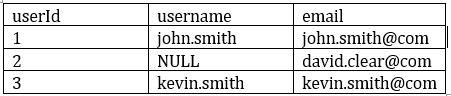
What could be the expected output of query SELECT COUNT (DISTINCT *) FROM user on this table
Correct Answer: B
Explanation
The answer is 2,
Count(DISTINCT *) removes rows with any column with a NULL value
insert code

Question 49

Which of the following scenarios is the best fit for the AUTO LOADER solution?
Correct Answer: A
Explanation
The answer is, Efficiently process new data incrementally from cloud object storage.
Please note: AUTO LOADER only works on data/files located in cloud object storage like S3 or Azure Blob Storage it does not have the ability to read other data sources, although AU-TO LOADER is built on top of structured streaming it only supports files in the cloud object stor-age. If you want to use Apache Kafka then you can just use structured streaming.
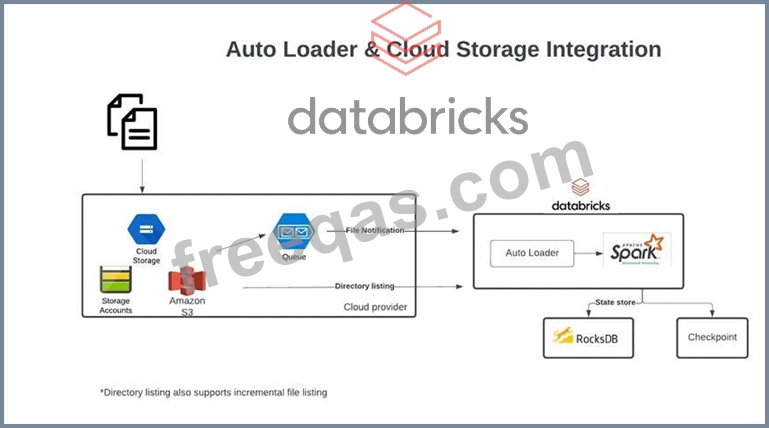
Diagram Description automatically generated

Auto Loader and Cloud Storage Integration
Auto Loader supports a couple of ways to ingest data incrementally
1.Directory listing - List Directory and maintain the state in RocksDB, supports incremental file listing
2.File notification - Uses a trigger+queue to store the file notification which can be later used to retrieve the file, unlike Directory listing File notification can scale up to millions of files per day.
[OPTIONAL]
Auto Loader vs COPY INTO?
Auto Loader
Auto Loader incrementally and efficiently processes new data files as they arrive in cloud storage without any additional setup. Auto Loader provides a new Structured Streaming source called cloudFiles. Given an input directory path on the cloud file storage, the cloudFiles source automatically processes new files as they arrive, with the option of also processing existing files in that directory.
When to use Auto Loader instead of the COPY INTO?
*You want to load data from a file location that contains files in the order of millions or higher. Auto Loader can discover files more efficiently than the COPY INTO SQL command and can split file processing into multiple batches.
*You do not plan to load subsets of previously uploaded files. With Auto Loader, it can be more difficult to reprocess subsets of files. However, you can use the COPY INTO SQL command to reload subsets of files while an Auto Loader stream is simultaneously running.
Refer to more documentation here,
https://docs.microsoft.com/en-us/azure/databricks/ingestion/auto-loader
insert code

Question 50

The data architect has mandated that all tables in the Lakehouse should be configured as external (also known as "unmanaged") Delta Lake tables.
Which approach will ensure that this requirement is met?

Correct Answer: D
To create an external or unmanaged Delta Lake table, you need to use the EXTERNAL keyword in the CREATE TABLE statement. This indicates that the table is not managed by the catalog and the data files are not deleted when the table is dropped. You also need to provide a LOCATION clause to specify the path where the data files are stored. For example:
CREATE EXTERNAL TABLE events ( date DATE, eventId STRING, eventType STRING, data STRING) USING DELTA LOCATION '/mnt/delta/events'; This creates an external Delta Lake table named events that references the data files in the '/mnt/delta/events' path. If you drop this table, the data files will remain intact and you can recreate the table with the same statement.
References:
* https://docs.databricks.com/delta/delta-batch.html#create-a-table
* https://docs.databricks.com/delta/delta-batch.html#drop-a-table
insert code
  • ««
  • «
  • …
  • 6
  • 7
  • 8
  • 9
  • 10
  • 11
  • 12
  • 13
  • 14
  • 15
  • …
  • »
  • »»
[×]

Download PDF File

Enter your email address to download Databricks.Databricks-Certified-Professional-Data-Engineer.v2024-05-28.q108 Dumps


Email:

FreeQAs

Our website provides the Largest and the most Latest vendors Certification Exam materials around the world.

Using dumps we provide to Pass the Exam, we has the Valid Dumps with passing guranteed just which you need.

  • DMCA
  • About
  • Contact Us
  • Privacy Policy
  • Terms & Conditions
©2026 FreeQAs

www.freeqas.com materials do not contain actual questions and answers from Cisco's certification exams.