FreeQAs
 Request Exam  Contact
  • Home
  • View All Exams
  • New QA's
  • Upload
PRACTICE EXAMS:
  • Oracle
  • Fortinet
  • IBM
  • Juniper
  • Microsoft
  • Cisco
  • Citrix
  • CompTIA
  • VMware
  • ISC
  • SAP
  • EMC
  • PMI
  • HP
  • Salesforce
  • Other
  • Oracle
    Oracle
  • Fortinet
    Fortinet
  • IBM
    IBM
  • Juniper
    Juniper
  • Microsoft
    Microsoft
  • Cisco
    Cisco
  • Citrix
    Citrix
  • CompTIA
    CompTIA
  • VMware
    VMware
  • ISC
    ISC
  • SAP
    SAP
  • EMC
    EMC
  • PMI
    PMI
  • HP
    HP
  • Salesforce
    Salesforce
  1. Home
  2. Databricks Certification
  3. Databricks-Certified-Professional-Data-Engineer Exam
  4. Databricks.Databricks-Certified-Professional-Data-Engineer.v2024-05-28.q108 Dumps
  • ««
  • «
  • …
  • 8
  • 9
  • 10
  • 11
  • 12
  • 13
  • 14
  • 15
  • 16
  • 17
  • …
  • »
  • »»
Download Now

Question 56

A distributed team of data analysts share computing resources on an interactive cluster with autoscaling configured. In order to better manage costs and query throughput, the workspace administrator is hoping to evaluate whether cluster upscaling is caused by many concurrent users or resource-intensive queries.
In which location can one review the timeline for cluster resizing events?

Correct Answer: C
insert code

Question 57

At the end of the inventory process a file gets uploaded to the cloud object storage, you are asked to build a process to ingest data which of the following method can be used to ingest the data incrementally, the schema of the file is expected to change overtime ingestion process should be able to handle these changes automatically. Below is the auto loader command to load the data, fill in the blanks for successful execution of the below code.
1.spark.readStream
2..format("cloudfiles")
3..option("cloudfiles.format","csv)
4..option("_______", 'dbfs:/location/checkpoint/')
5..load(data_source)
6..writeStream
7..option("_______",' dbfs:/location/checkpoint/')
8..option("mergeSchema", "true")
9..table(table_name))

Correct Answer: D
Explanation
The answer is cloudfiles.schemalocation, checkpointlocation
When reading the data cloudfiles.schemalocation is used to store the inferred schema of the incoming data.
When writing a stream to recover from failures checkpointlocation is used to store the offset of the byte that was most recently processed.
insert code

Question 58

A data architect has heard about lake's built-in versioning and time travel capabilities. For auditing purposes they have a requirement to maintain a full of all valid street addresses as they appear in the customers table.
The architect is interested in implementing a Type 1 table, overwriting existing records with new values and relying on Delta Lake time travel to support long-term auditing. A data engineer on the project feels that a Type 2 table will provide better performance and scalability.
Which piece of information is critical to this decision?

Correct Answer: A
Delta Lake's time travel feature allows users to access previous versions of a table, providing a powerful tool for auditing and versioning. However, using time travel as a long-term versioning solution for auditing purposes can be less optimal in terms of cost and performance, especially as the volume of data and the number of versions grow. For maintaining a full history of valid street addresses as they appear in a customers table, using a Type 2 table (where each update creates a new record with versioning) might provide better scalability and performance by avoiding the overhead associated with accessing older versions of a large table.
While Type 1 tables, where existing records are overwritten with new values, seem simpler and can leverage time travel for auditing, the critical piece of information is that time travel might not scale well in cost or latency for long-term versioning needs, making a Type 2 approach more viable for performance and scalability.References:
* Databricks Documentation on Delta Lake's Time Travel: Delta Lake Time Travel
* Databricks Blog on Managing Slowly Changing Dimensions in Delta Lake: Managing SCDs in Delta Lake
insert code

Question 59

A data architect has designed a system in which two Structured Streaming jobs will concurrently write to a single bronze Delta table. Each job is subscribing to a different topic from an Apache Kafka source, but they will write data with the same schema. To keep the directory structure simple, a data engineer has decided to nest a checkpoint directory to be shared by both streams.
The proposed directory structure is displayed below:
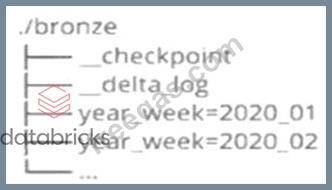
Which statement describes whether this checkpoint directory structure is valid for the given scenario and why?

Correct Answer: E
This is the correct answer because checkpointing is a critical feature of Structured Streaming that provides fault tolerance and recovery in case of failures. Checkpointing stores the current state and progress of a streaming query in a reliable storage system, such as DBFS or S3. Each streaming query must have its own checkpoint directory that is unique and exclusive to that query. If two streaming queries share the same checkpoint directory, they will interfere with each other and cause unexpected errors or data loss. Verified References: [Databricks Certified Data Engineer Professional], under "Structured Streaming" section; Databricks Documentation, under "Checkpointing" section.
insert code

Question 60

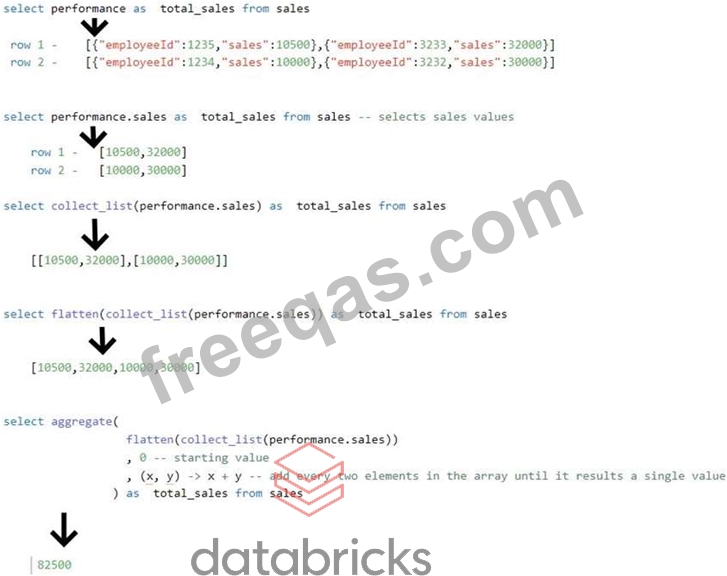
You are trying to calculate total sales made by all the employees by parsing a complex struct data type that stores employee and sales data, how would you approach this in SQL Table definition, batchId INT, performance ARRAY<STRUCT<employeeId: BIGINT, sales: INT>>, in-sertDate TIMESTAMP Sample data of performance column
1.[
2.{ "employeeId":1234
3."sales" : 10000},
4.
5.{ "employeeId":3232
6."sales" : 30000}
7.]
Calculate total sales made by all the employees?
Sample data with create table syntax for the data:
1.create or replace table sales as
2.select 1 as batchId ,
3.from_json('[{ "employeeId":1234,"sales" : 10000 },{ "employeeId":3232,"sales" : 30000 }]',
4. 'ARRAY<STRUCT<employeeId: BIGINT, sales: INT>>') as performance,
5. current_timestamp() as insertDate
6.union all
7.select 2 as batchId ,
8. from_json('[{ "employeeId":1235,"sales" : 10500 },{ "employeeId":3233,"sales" : 32000 }]',
9. 'ARRAY<STRUCT<employeeId: BIGINT, sales: INT>>') as performance,
10. current_timestamp() as insertDate
Correct Answer: C
Explanation
The answer is
1.select aggregate(flatten(collect_list(performance.sales)), 0, (x, y) -> x + y)
2.as total_sales from sales
Nested Struct can be queried using the . notation performance.sales will give you access to all the sales values in the performance column.
Note: option D is wrong because it uses performance:sales not performance.sales. ":" this is only used when referring to JSON data but here we are dealing with a struct data type. for the exam please make sure to understand if you are dealing with JSON data or Struct data.

Other solutions:
we can also use reduce instead of aggregate
select reduce(flatten(collect_list(performance.sales)), 0, (x, y) -> x + y) as total_sales from sales we can also use explode and sum instead of using any higher-order funtions.
1.with cte as (
2. select
3. explode(flatten(collect_list(performance.sales))) sales from sales
4.)
5.select
6. sum(sales) from cte
Sample data with create table syntax for the data:
1.create or replace table sales as
2.select 1 as batchId ,
3.from_json('[{ "employeeId":1234,"sales" : 10000 },{ "employeeId":3232,"sales" : 30000 }]',
4. 'ARRAY<STRUCT<employeeId: BIGINT, sales: INT>>') as performance,
5. current_timestamp() as insertDate
6.union all
7.select 2 as batchId ,
8. from_json('[{ "employeeId":1235,"sales" : 10500 },{ "employeeId":3233,"sales" : 32000 }]',
9. 'ARRAY<STRUCT<employeeId: BIGINT, sales: INT>>') as performance,
10. current_timestamp() as insertDate
insert code
  • ««
  • «
  • …
  • 8
  • 9
  • 10
  • 11
  • 12
  • 13
  • 14
  • 15
  • 16
  • 17
  • …
  • »
  • »»
[×]

Download PDF File

Enter your email address to download Databricks.Databricks-Certified-Professional-Data-Engineer.v2024-05-28.q108 Dumps


Email:

FreeQAs

Our website provides the Largest and the most Latest vendors Certification Exam materials around the world.

Using dumps we provide to Pass the Exam, we has the Valid Dumps with passing guranteed just which you need.

  • DMCA
  • About
  • Contact Us
  • Privacy Policy
  • Terms & Conditions
©2026 FreeQAs

www.freeqas.com materials do not contain actual questions and answers from Cisco's certification exams.