FreeQAs
 Request Exam  Contact
  • Home
  • View All Exams
  • New QA's
  • Upload
PRACTICE EXAMS:
  • Oracle
  • Fortinet
  • Juniper
  • Microsoft
  • Cisco
  • Citrix
  • CompTIA
  • VMware
  • ISC
  • SAP
  • EMC
  • PMI
  • HP
  • Salesforce
  • Other
  • Oracle
    Oracle
  • Fortinet
    Fortinet
  • Juniper
    Juniper
  • Microsoft
    Microsoft
  • Cisco
    Cisco
  • Citrix
    Citrix
  • CompTIA
    CompTIA
  • VMware
    VMware
  • ISC
    ISC
  • SAP
    SAP
  • EMC
    EMC
  • PMI
    PMI
  • HP
    HP
  • Salesforce
    Salesforce
  1. Home
  2. Databricks Certification
  3. Databricks-Certified-Professional-Data-Engineer Exam
  4. Databricks.Databricks-Certified-Professional-Data-Engineer.v2025-10-27.q109 Dumps
  • ««
  • «
  • …
  • 11
  • 12
  • 13
  • 14
  • 15
  • 16
  • 17
  • 18
  • 19
  • 20
  • …
  • »
  • »»
Download Now

Question 71

What is the main difference between the bronze layer and silver layer in a medallion architecture?

Correct Answer: C
Explanation
Medallion Architecture - Databricks
Exam focus: Please review the below image and understand the role of each layer(bronze, silver, gold) in medallion architecture, you will see varying questions targeting each layer and its purpose.
Sorry I had to add the watermark some people in Udemy are copying my content.
A diagram of a house Description automatically generated with low confidence
insert code

Question 72

The data engineer team is configuring environment for development testing, and production before beginning migration on a new data pipeline. The team requires extensive testing on both the code and data resulting from code execution, and the team want to develop and test against similar production data as possible.
A junior data engineer suggests that production data can be mounted to the development testing environments, allowing pre production code to execute against production data. Because all users have Admin privileges in the development environment, the junior data engineer has offered to configure permissions and mount this data for the team.
Which statement captures best practices for this situation?

Correct Answer: C
The best practice in such scenarios is to ensure that production data is handled securely and with proper access controls. By granting only read access to production data in development and testing environments, it mitigates the risk of unintended data modification. Additionally, maintaining isolated databases for different environments helps to avoid accidental impacts on production data and systems.
References:
* Databricks best practices for securing data: https://docs.databricks.com/security/index.html
insert code

Question 73

A table in the Lakehouse namedcustomer_churn_paramsis used in churn prediction by the machine learning team. The table contains information about customers derived from a number of upstream sources. Currently, the data engineering team populates this table nightly by overwriting the table with the current valid values derived from upstream data sources.
The churn prediction model used by the ML team is fairly stable in production. The team is only interested in making predictions on records that have changed in the past 24 hours.
Which approach would simplify the identification of these changed records?

Correct Answer: B
Explanation
This is the correct answer because the JSON posted to the Databricks REST API endpoint 2.0/jobs/create defines a new job with an existing cluster id and a notebook task, but also specifies a new cluster spec with some configurations. According to the documentation, if both an existing cluster id and a new cluster spec are provided, then a new cluster will be created for each run of the job with those configurations, and then terminated after completion. Therefore, the logic defined in the referenced notebook will be executed three times on new clusters with those configurations. Verified References: [Databricks Certified Data Engineer Professional], under "Monitoring & Logging" section; Databricks Documentation, under
"JobsClusterSpecNewCluster" section.
insert code

Question 74

A data pipeline uses Structured Streaming to ingest data from kafka to Delta Lake. Data is being stored in a bronze table, and includes the Kafka_generated timesamp, key, and value. Three months after the pipeline is deployed the data engineering team has noticed some latency issued during certain times of the day.
A senior data engineer updates the Delta Table's schema and ingestion logic to include the current timestamp (as recoded by Apache Spark) as well the Kafka topic and partition. The team plans to use the additional metadata fields to diagnose the transient processing delays:
Which limitation will the team face while diagnosing this problem?

Correct Answer: A
When adding new fields to a Delta table's schema, these fields will not be retrospectively applied to historical records that were ingested before the schema change. Consequently, while the team can use the new metadata fields to investigate transient processing delays moving forward, they will be unable to apply this diagnostic approach to past data that lacks these fields.
References:
* Databricks documentation on Delta Lake schema management: https://docs.databricks.com/delta/delta- batch.html#schema-management
insert code

Question 75

In order to facilitate near real-time workloads, a data engineer is creating a helper function to leverage the schema detection and evolution functionality of Databricks Auto Loader. The desired function will automatically detect the schema of the source directly, incrementally process JSON files as they arrive in a source directory, and automatically evolve the schema of the table when new fields are detected.
The function is displayed below with a blank:
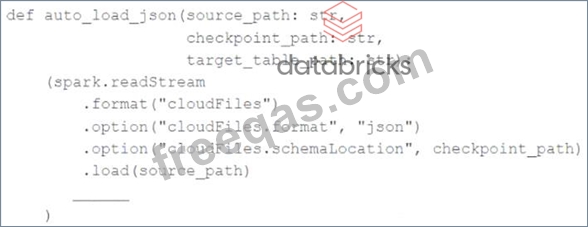
Which response correctly fills in the blank to meet the specified requirements?
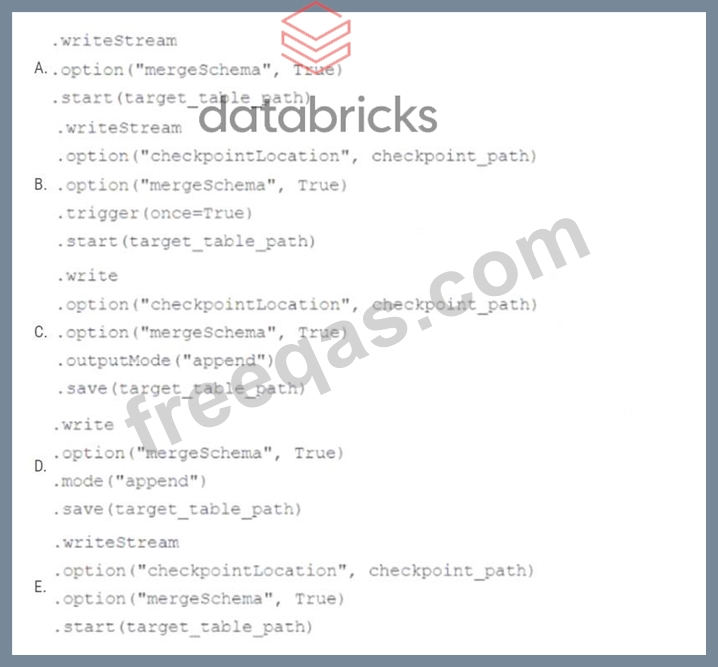
Correct Answer: B
Option B correctly fills in the blank to meet the specified requirements. Option B uses the "cloudFiles.
schemaLocation" option, which is required for the schema detection andevolution functionality of Databricks Auto Loader. Additionally, option B uses the "mergeSchema" option, which is required for the schema evolution functionality of Databricks Auto Loader. Finally, option B uses the "writeStream" method, which is required for the incremental processing of JSON files as they arrive in a source directory. The other options are incorrect because they either omit the required options, use the wrong method, or use the wrong format. References:
* Configure schema inference and evolution in Auto Loader: https://docs.databricks.com/en/ingestion
/auto-loader/schema.html
* Write streaming data: https://docs.databricks.com/spark/latest/structured-streaming/writing-streaming- data.html
insert code
  • ««
  • «
  • …
  • 11
  • 12
  • 13
  • 14
  • 15
  • 16
  • 17
  • 18
  • 19
  • 20
  • …
  • »
  • »»
[×]

Download PDF File

Enter your email address to download Databricks.Databricks-Certified-Professional-Data-Engineer.v2025-10-27.q109 Dumps


Email:

FreeQAs

Our website provides the Largest and the most Latest vendors Certification Exam materials around the world.

Using dumps we provide to Pass the Exam, we has the Valid Dumps with passing guranteed just which you need.

  • DMCA
  • About
  • Contact Us
  • Privacy Policy
  • Terms & Conditions
©2026 FreeQAs

www.freeqas.com materials do not contain actual questions and answers from Cisco's certification exams.