FreeQAs
 Request Exam  Contact
  • Home
  • View All Exams
  • New QA's
  • Upload
PRACTICE EXAMS:
  • Oracle
  • Fortinet
  • Juniper
  • Microsoft
  • Cisco
  • Citrix
  • CompTIA
  • VMware
  • ISC
  • SAP
  • EMC
  • PMI
  • HP
  • Salesforce
  • Other
  • Oracle
    Oracle
  • Fortinet
    Fortinet
  • Juniper
    Juniper
  • Microsoft
    Microsoft
  • Cisco
    Cisco
  • Citrix
    Citrix
  • CompTIA
    CompTIA
  • VMware
    VMware
  • ISC
    ISC
  • SAP
    SAP
  • EMC
    EMC
  • PMI
    PMI
  • HP
    HP
  • Salesforce
    Salesforce
  1. Home
  2. Databricks Certification
  3. Databricks-Certified-Professional-Data-Engineer Exam
  4. Databricks.Databricks-Certified-Professional-Data-Engineer.v2025-10-27.q109 Dumps
  • ««
  • «
  • …
  • 12
  • 13
  • 14
  • 15
  • 16
  • 17
  • 18
  • 19
  • 20
  • 21
  • …
  • »
  • »»
Download Now

Question 76

The data science team has created and logged a production using MLFlow. The model accepts a list of column names and returns a new column of type DOUBLE.
The following code correctly imports the production model, load the customer table containing the customer_id key column into a Dataframe, and defines the feature columns needed for the model.

Which code block will output DataFrame with the schema'' customer_id LONG, predictions DOUBLE''?

Correct Answer: A
Given the information that the model is registered with MLflow and assuming predict is the method used to apply the model to a set of columns, we use the model.predict() function to apply the model to the DataFrame df using the specified columns. The model.predict() function is designed to take in a DataFrame and a list of column names as arguments, applying the trained model to these features to produce a predictions column.
When working with PySpark, this predictions column needs to be selected alongside the customer_id to create a new DataFrame with the schema customer_id LONG, predictions DOUBLE.
References:
* MLflow documentation on using Python function models:
https://www.mlflow.org/docs/latest/models.html#python-function-python
* PySpark MLlib documentation on model prediction:
https://spark.apache.org/docs/latest/ml-pipeline.html#pipeline
insert code

Question 77

Which of the following table constraints that can be enforced on Delta lake tables are supported?
Correct Answer: D
Explanation
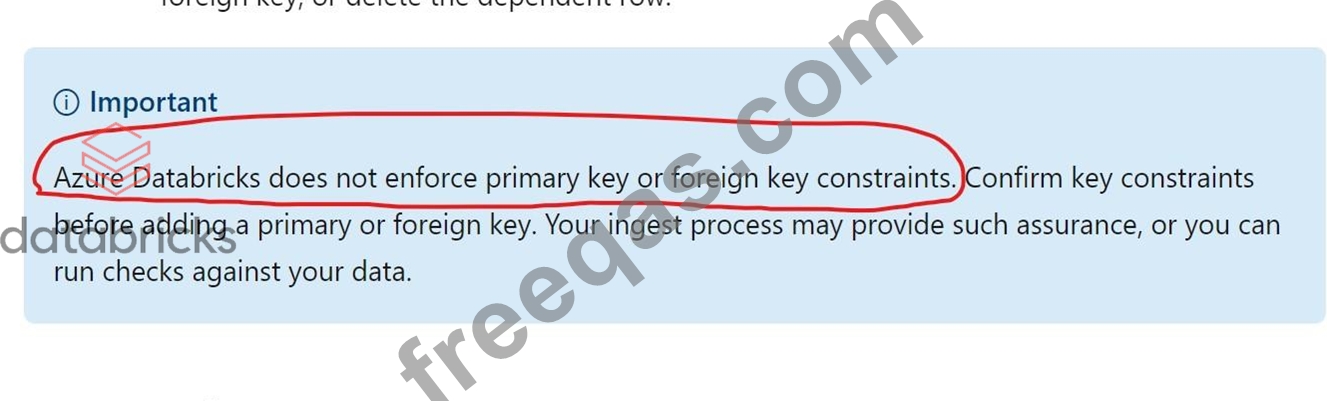
The answer is Not Null, Check Constraints
https://docs.microsoft.com/en-us/azure/databricks/delta/delta-constraints
* CREATE TABLE events( id LONG,
* date STRING,
* location STRING,
* description STRING
* ) USING DELTA;
ALTER TABLE events CHANGE COLUMN id SET NOT NULL;
ALTER TABLE events ADD CONSTRAINT dateWithinRange CHECK (date > '1900-01-01'); Note: Databricks as of DBR 11.1 added support for Primary Key and Foreign Key when Unity Catalog is enabled but this is for information purposes only these are not actually enforced. You may ask then why are we defining these if they are not enforced, so especially these information constraints are very helpful if you have a BI tool that can benefit from knowing the relationship between the tables, so it will be easy when creating reports/dashboards or understanding the data model when using any Data modeling tool.
Primary and Foreign Key
Graphical user interface, text, application, email Description automatically generated
insert code

Question 78

A junior data engineer is working to implement logic for a Lakehouse table named silver_device_recordings. The source data contains 100 unique fields in a highly nested JSON structure.
The silver_device_recordings table will be used downstream for highly selective joins on a number of fields, and will also be leveraged by the machine learning team to filter on a handful of relevant fields, in total, 15 fields have been identified that will often be used for filter and join logic.
The data engineer is trying to determine the best approach for dealing with these nested fields before declaring the table schema.
Which of the following accurately presents information about Delta Lake and Databricks that may Impact their decision-making process?

Correct Answer: D
Delta Lake, built on top of Parquet, enhances query performance through data skipping, which is based on the statistics collected for each file in a table. For tables with a large number of columns, Delta Lake by default collects and stores statistics only for the first 32 columns. These statistics include min/max values and null counts, which are used to optimize query execution by skipping irrelevant data files. When dealing with highly nested JSON structures, understanding this behavior is crucial for schema design, especially when determining which fields should be flattened or prioritized in the table structure to leverage data skipping efficiently for performance optimization.
Reference: Databricks documentation on Delta Lake optimization techniques, including data skipping and statistics collection (https://docs.databricks.com/delta/optimizations/index.html).
insert code

Question 79

The data engineering team maintains the following code:

Assuming that this code produces logically correct results and the data in the source tables has been de-duplicated and validated, which statement describes what will occur when this code is executed?

Correct Answer: B
This is the correct answer because it describes what will occur when this code is executed. The code uses three Delta Lake tables as input sources: accounts, orders, and order_items. These tables are joined together using SQL queries to create a view called new_enriched_itemized_orders_by_account, which contains information about each order item and its associated account details. Then, the code uses write.format("delta").mode("overwrite") to overwrite a target table called enriched_itemized_orders_by_account using the data from the view. This means that every time this code is executed, it will replace all existing data in the target table with new data based on the current valid version of data in each of the three input tables. Verified References: [Databricks Certified Data Engineer Professional], under "Delta Lake" section; Databricks Documentation, under "Write to Delta tables" section.
insert code

Question 80

An external object storage container has been mounted to the location/mnt/finance_eda_bucket.
The following logic was executed to create a database for the finance team:

After the database was successfully created and permissions configured, a member of the finance team runs the following code:

If all users on the finance team are members of thefinancegroup, which statement describes how thetx_sales table will be created?

Correct Answer: D
Explanation
https://docs.databricks.com/en/lakehouse/data-objects.html
insert code
  • ««
  • «
  • …
  • 12
  • 13
  • 14
  • 15
  • 16
  • 17
  • 18
  • 19
  • 20
  • 21
  • …
  • »
  • »»
[×]

Download PDF File

Enter your email address to download Databricks.Databricks-Certified-Professional-Data-Engineer.v2025-10-27.q109 Dumps


Email:

FreeQAs

Our website provides the Largest and the most Latest vendors Certification Exam materials around the world.

Using dumps we provide to Pass the Exam, we has the Valid Dumps with passing guranteed just which you need.

  • DMCA
  • About
  • Contact Us
  • Privacy Policy
  • Terms & Conditions
©2026 FreeQAs

www.freeqas.com materials do not contain actual questions and answers from Cisco's certification exams.